Categories
Belief Finding Gnostics God Mental Health Seeking, Finding

Six Impossible Things Before Breakfast

John David:

I’m going to start with the easy stuff before it all falls apart.

These are 10 important books to me:

Wolf Hall by Hilary Mantel. I think her exploration of power, and its intersection with personal animus, is thrilling. Will she ever finish the trilogy? She is my generation’s George R.R. Martin. (I also appreciate her portrait of Henry, who too often is a caricature of a horny monster. Antonia Fraiser, who has written a lot about Henry and his wives, made the great point that while we know Henry is going to marry six women — and kill two of them — Henry doesn’t know this about himself. Each marriage was the answer in his head.)

Independent People by Haldor Laxness. It’s grim, and Icelandic, and is so achingly human about despair and disappointment. Zach recommended it to me when I was looking for non-English novels to assign to my group.

The Makioka Sisters by Jun’ichiro Tanizaki. Painfully, achingly human and blackly funny. It’s a grim Jane Austen novel with more diarrhea. It’s set in Japan right before World War II, and explores modernity in a country on the brink of being decimated by atomic bombs.

Religion and the Decline of Magic by Keith Thomas. He’s looking at 15h and 16th systems of magic, and then how that is incorporated into traditional religious belief. Thomas doesn’t question people’s vocation. If someone identified as a necromancer, he calls them a necromancer and then doesn’t feel the need to whisper to us in the next sentence, “Of course necromancers do not exist.” He trusts his readers enough. I read a book about Madame Blavatsky and the guy writing it was so mean about her weight, and personal appearance, and sneered at everything Blavatsky did. I am not attempting, in a list of beloved books, to rehabilitate the life and career of Blavatsky. But I don’t need that guy in my ear being a jerk.

The Complete Flannery O’Connor by Flannery O’Connor. Her religious world view is singular and fierce and very Old Testament. (A mentally handicapped boy is drowned in a pond as a kind of baptism and that’s considered a happy ending for that kid.) My personal bible is engraved with this quote from O’Connor: “Grace changes us and the change is painful.”

The Complete Gerard Manley Hopkins by Gerard Manley Hopkins. His descriptions of nature — “skies of couple-colour as a brinded cow”, “my heart in hiding stirred for a bird”, “Goldengrove unleaving” — feel essential to me. My friend Steve gets so mad about Hopkins seemingly giving up his poetry for his life as a Jesuit, so anytime we talk about Hopkins, we talk about that. But I’d rather discuss the poems.

Dickens: A Biography by Peter Ackroyd. It is as long as two Dickens novel, and there are several sections where Ackroyd imagines conversations with Dickens and his comrades that can get a little smurfy. But for someone like me, with a fascination with the 19th century (my lectures tend to focus on Victorian society, culture, literature, morality), it’s such a densely rich package of information. And you can’t understand England in the 19th century without understanding Dickens.

The Woman in White by Wilkie Collins. About 20 years ago, I picked up a copy of The Woman in White at a used bookstore and was hooked from the opening line. (“This is the story of what a Woman’s patience can endure, and what a Man’s resolution can achieve.”) After finishing it (oh! One of my favorite reading moments in my life is being on the Metro to work and reading a scene in the novel where you find out that someone wicked has read someone else’s diary and how that is revealed was so shocking to me that I honestly gasped and put the book down and the woman sitting next to me asked if I was okay. “No, I am not,” I said. “Something scandalous happened in my book”) I wanted to learn more about Wilkie Collins, a man I’d never heard of until that moment. So I got a bio of him and that’s when I started to unravel a lot of bad, received wisdom about the 19th century. The Victorians are used as a strawman for prudery and repression, but reading the lived lives of those 19th century denizens really solidified my belief in Performed Morality (what we profess publicly so others will think we’re good) and Actual Morality (what we do in the shadows), and that we in the 21st century are not much different from our Victorian cousins except we dress for comfort and don’t die from cholera as often.

Alice in Wonderland by Lewis Carroll. The first chapter book I remember falling in love with. I’ve read it countless times. I think it’s what defines me as a reader. When I taught it several years ago (I keep using the word “teach” and it occurs to me that I need to clear some stuff up and I’ll do that after this list), and really thought about the book and my relationship to it, I was surprised to realize that when I read it as a boy in, what? The 1980s? I had no idea it was an Old Book. Alice dressed differently than I did in the illustrations, but there was no sense that we were separated by 100 or so years.

Life of the Beloved by Henri Nouwen. It’s a spiritual book that didn’t make me feel cringey while reading it.

Now. More About Mike.

I am a college drop-out. I never finished. I tried, but I was both Too Poor and Too Mentally Ill in my late teens and early 20s. What I know, I know from self-teaching and listening to people smarter than I am. My day job is in financial regulatory compliance (I explain laws and regulations to people in the debt industry to make sure they’re on the right side of consumer law in their acts and practices), and I’ve cobbled together a side-gig as a teacher for adult continuing education. I didn’t want to leave you with the impression that I am something — a college graduate or some other sort of papered smart person — that I am not.

Now, to our Darker Purpose. I want to start by saying that I am about five steps behind you in all of this. I think you are incredibly well-educated in the language of rhetoric and philosophy, and I’m just very handsome and Trying My Best. This isn’t me asserting false modesty, or looking for some affirmations in return. I just want to be honest about where I am able to meet you w/r/t this conversation.

1) “we’re probably approaching the question of religion with two completely different paradigmatic approaches – mine seems to be more coldly philosophical, and yours seems more intent on finding meaning and happiness.”

I think, embarrassingly, this could also be described as, “You, John David, have given this all much more thought than I have; I’m just making my way through by feeling.” Because I don’t feel the pressing need to proselytize or convert, I also don’t feel the need to defend my faith from anything other than gross simplifications and lazy talking points. (This is ironic, of course, because I just got finished suggesting that I am a lazy, unthinking believer. We’ll just have to embrace this mystery!)

I approach religion as something I want to live with (and you will say, “No, I get it, but why?”), and you approach it as something you want to make sense of. You bring up Kierkegaard at some point and I raised both hands above my head in the universal sign for “this child needs help” and Zach kind of explained it to me, but I guess what I’m saying is, “Meet your new best friend Mike Bevel who takes Leaps of Faith all the time!”

2) “if you’ll grant me the liberty, I wanted to ask some deep and probing questions about what you said in your last e-mail. As I hope you know, absolutely nothing has the purpose of offending you. I’ve been really delighted to share in this correspondence with someone so kind and thoughtful, so I’m genuinely interesting in learning something about how you might approach these questions other than what you might consider to be my cool, objective, distant approach.”

I have only been delighted with every interaction we’ve had, and at no point do I feel you’ve been offensive. You can ask, and argue, and push back, and even express frustration. You are at 100% trust right now.

3) “I’m assuming that you’ve heard the saying that ‘anecdotes do not constitute data.'”

I didn’t list this with the other books (I don’t think the whole book is as strong as its thesis), but have you read Wendy Kaminer’s Sleeping with Extraterrestrials? She argues that, somewhere along the way, this deformed sense of propriety infected discourse and we have stopped asking follow-up questions to extraordinary claims. If someone says “I was taken aboard an alien spacecraft” or “Jesus appeared in my room last night” we (the universal “we”) worry that we’re rude if we say, “I don’t know if I believe that.” Kaminer wants us to ask more questions.

4) “What about your mystical experiences, if anything, led to you in the direction of a different conclusion – keeping in mind of course, that when someone tells you they were abducted by aliens, you would be likely to question their sanity, not engage them in rational discussion…”

Because I wanted it to be God. I think that’s probably a frustrating answer. I’m not using rationalism — and I think you are much more developed along that line. Because it felt like what I had always imagined God would feel like. (Have you seen Russian Doll on Netflix? One character attempts to bring up morality as a cause for the time loop they’re in, and another says, “The universe is moral and just happens to have your ideas about morality?”) But there isn’t anything rational about the experience.

Language fails me a little when we get here. I don’t believe that God is a person. I don’t believe that there is a place we go after this life that matches the artistic ideals of Heaven. I think God wants us to live this life here, and live it as well as we can, doing as little harm to those around us and trying as much as we can to love everyone, or at least to respect the belovedness in them. I don’t believe in miracles. I don’t believe intercessory prayer works. I think there’s a force in the universe that is good, and I want to align myself with that goodness in the universe.

(But man would I love an afterlife. It’s my narcissism. I think that I am so important that of course I should continue to live, just as I am, for all of eternity. I know it’s not true, but I want it to be true.)

5) “You said in your last email that the connection ‘with what I’ve decided to experience as God … has encouraged me to continue as a believer. Specifically, I’d like to ask this. What about that experience led you to believe that it was God?”

This is question 4 again, and I remain just as unable to describe it to you. I always get anxious in these situations because I don’t want to give the impression that my not being able to answer it means that it’s unanswerable. (It might very well be unanswerable.) It just means I am not yet smart enough to explain it. (And I may reach a point where I am smart enough and then the answer will be, “Oh, you did all this for nothing.”) And maybe that’s why faith is: the belief that you’ll eventually be able to explain the unexplainable.

“But why do you love carrot cake so much?” you could also ask, and I could only answer, “Because it tastes incredibly delicious and I am not a monster.” Why do I think it was God? Because it checked all my boxes for what God would feel like. The experience felt large and ineffable, but also suffused with love. I’d never experienced it before.

I’ll show a chink in my Armor of Faith: There are times where, especially when I dip into a depressive state, and I don’t feel that experience of God, where I begin to doubt, well, a lot of things. I doubt God. I doubt myself as a believer. I doubt the experience itself. I don’t know if I’ll ever live a comprehensive life of untroubled belief. That doesn’t worry me.

6) “If it was really a God, why doesn’t It/He/She want everyone to know that It exists, and why does It so readily reveal itself to some people and hide itself from others?”

I have two answers for this.

Mike Bevel: Christian — God reveals himself* to everyone, all the time, and is always talking to us and making himself known. We just don’t listen. God is love, and that gets in the way of our selfishness. There was a parody ad Y E A R S ago, with a woman on screen, showing a face of distress, with an anvil on her head. She says to the camera, “The pressure is unbearable. I feel it here, and here, and here. I struggle with how to deal with this pain.” And an off-camera voice says, “Have you ever thought about taking the anvil off your head?” And she says, “No, I hadn’t. But I’m willing to try anything.” There’s a screen-wipe to show the passing of time, and the woman is back on screen, this time looking calm and happy, and with no anvil on her head. She says, “It’s gone. The pressure’s gone. The agonizing pain. All of it. Gone.” And the off-camera voice says, “Would you try taking the anvil off your head again?” And she says, hopefully, “Yes! Yes I would take the anvil off my head.” It’s a parable, John David.

[* I am not great at un-gendering my language around God. I don’t believe that God has a gender of any kind; but I think of him in male terms because that’s what I grew up believing and hearing. It’s not great.]

Mike Bevel: Doubting Thomas — Yeah. I don’t know. That’s a good question. God is a Chatty Cathy throughout so much of the Old Testament*, and now we seem to have more silence than anything. It can feel devastating.

[* I am a Baptist. But I have a LOT of affinity for the Gnostics. And I’m more Marcion in my reading of the Bible than not.]

7) “You’ve said something that I’m afraid not many Christians are willing to admit: ‘I believe God exists not for any tangible reason.’ Is there any other arena of decision-making or thought aside from the spiritual/theological where this assertion would not be scoffed at?”

I guess I’d ask back how do you handle personal preferences in your worldview? Because that seems to be an irrational exception rationalists make. Here, for instance, is a list of foods I hate:

  • Cantaloupe
  • Eggplant
  • Celery
  • Cooked Celery
  • Cooked Carrots
  • Hominy
  • Green Peppers
  • Any Cooked Peppers
  • Chocolate
  • Unidentifiable Chunks of Things That Cause the Texture of a Dish to be Upsetting

8) “Your assertion that ‘I believe evolution is wrong not for any tangible reason’ is going to be met with utter bewilderment by scientists.”

I was VERY worried that at some point I expressed some creationist sympathies. I think you’re making a hypothetical point here. And I just want to go on the record to you, friend to friend: I 100% believe in evolution.

But.

I don’t understand at all how it works. I accept it on faith. I accept that smarter people than I am have a handle on it. I think we’re refining our ideas about it all the time because our science gets better and better. (We can’t really say that about religion, though, can we? Religion more often than not wants to firmly entrench itself in dogmatism and doesn’t take kindly to, “Well, here’s some new information you may want to incorporate.”)

I sometimes find myself deeply depressed and embarrassed that so much of how the world works is as much an article of faith for me as my belief in religion. I am not saying that religion and science themselves are two sides of the same coin; I’m just saying that in my thieves’ pouch, they are. (I will watch the fuck out of a science documentary, btw.)

9) “I think you have said perhaps one thing that is incorrect, and I want to see what you have to say in response. You said, ‘I’m making choices toward belief because my years of disbelief left me sad and depressed and empty.’ I’m certainly glad that you’re no longer experiencing those emotions anymore. However, in the very sentence before that, you said ‘God may or may not exist.’ Do you think that your psychological state was so vastly improved by the existence of something you haven’t even convinced yourself of? If you’d had said ‘God exists, I know him, and I can feel him,’ then I would be much more convinced of that feeling being responsible for your (what I hope is now non-existent) sadness and depression. However, how can that sadness and depression be conclusively gone if you haven’t even fully convinced yourself that the cause of your happiness even exists?”

This is a complicated question. They’re all complicated, actually, as far as I am concerned. But this one. Whoo-boy.

I am mentally ill. I am mentally ill and treated, right now, and it’s going great, thank you for asking. I am prone to:

  • Depression
  • Anxiety
  • Intrusive violent thoughts
  • Obsessive-compulsive ideation

Some of that might be genetic. Some of it might be nurture. (My childhood Wasn’t Great.) And it’s so easy (whether it’s correct or not) to write off my experiences as “Ohhhhhh. [makes spiral gesture around ear] Got it.” God didn’t take any of that away — that was all Western medicine and talk therapy. (Psychiatry, by the way. I mean, talk about taking things on faith. “Let’s just see what happens when this medication originally developed for avian diabetes gets into your brain” is as nutty as any religious belief.)

When I say that God may or may not exist, I think what I’m trying to do is provide a space for the other person to feel safe in their disbelief. I don’t want to convert someone through conversation. So, I believe God exists, but I am not troubled at all being fully in communion (heh) with someone who doesn’t believe in God at all. Like, for instance, Zach. He’s an atheistic Buddhist. He does not share any of my religious beliefs. I love that guy so fucking much.

My sadness and depression may never truly be gone, because I may just not have a brain that makes the typical amount of whatever, we’ve established I’m no scientist. But what I’m getting better at, both with my belief in God, and just through trusting myself, is not blaming myself for my feelings. That’s a fun game I run: Oh, I am sad, must be because I did something super shitty and this is the way the world works. Why I’m not a Calvinist I don’t know. If I ever start talking like a Calvinist, that should be your cue that I’m on the road to Self Harm.

John David: I love these emails with you so much. Thank you for your kindness, patience, curiosity, and deep intelligence. This continues to be such a pleasure. I’m so glad we met.

Categories
Interludes Mental Health Seeking

Interlude: Who’s Afraid of Virginia Woolf

A dear friend wrote to me. Is there anything better than a perfect email, with questions tailored specifically tailored to you, so that you can be your Fullest Self? There is not.

She writes, 

Can we talk about Albee’s “Who’s Afraid…”? I just became aware that people think it’s a play of … extremity? Like a once in a lifetime kind of conversation, so brutal and strange. To be watched as a kind of awareness of how bad marriage can get. Uhhh what. A stunning depiction of emotional abuse. Whaaattttt. 

I watched the Elizabeth Burton film on Thanksgiving (naturally) and I don’t know if I am just less concerned with being happy (by which I mean aspiring to be happier than I could possibly be) or “unhealthier” but I realized Albee’s is a profoundly humane vision. To have people who play our games – who learn the rules as quickly as we need to change them – is sort of the ideal, there’s an essential queerness to both relationships, I feel like, that I can’t name. And the frisson and sadism doesn’t feel unkind. I feel really unsatisfied with contemporary interpretations of the play as “emotional abuse” and depicting “unhappiness” rooted in childlessness and untruth — I think it depicts a tolerance for emotive play and… camp? maybe? 

That how I talk. I’d **hate** to have more decorum. I mean, when we watched the film, everyone was laughing and saying, “they’re just like us!” without anxiety. &  I’d hate for people to have more decorum around me. I have running not-exactly-jokes just like they do, mythologies and agreed upon backstories and trauma sinks. It never occurred to me that it was a sort of after school special; seems preposterous. Certainly wasn’t Albee’s intent, but has it really occupied that cultural space? Am I weird? Am I unwittingly abused and too intense, abusing those around me? Do you never want to have “Who’s Afraid of Virginia Woolf?” conversations?

The mild moral panic of the whole thing makes me anxious.


Every word of this email was as manna to mine soul. I’ve been Sick Unto Death, and so close to the very veil of mortality that I have become, in essence, a sibyl, and I now know terrible things, like this show I watched called Apparitions, made by maybe the BBC or some other English-y network, but not Masterpiece Theatre.

Kenny Rogers is Martin Shaw as Father Jacob in the BBC’s Apparitions.

Apparitions stars a guy who looks like a healthier Kenny Rogers as a Catholic priest who plays by his own rules and is an exorcist. He has a gun more often than you’d think he would, because (a) he’s a priest, and (b) this is England. The Wikipedia page for the show says that it’s “more religiously accurate and fact-based” but what isn’t mentioned is that it’s a little anti-Semitic (exorcised demons compare themselves to victims of the Holocaust, and a Jewish man, to get revenge on God, hides his Jewishness and becomes a Catholic priest for reasons that could never be convincingly conveyed) and then there’s an episode where Bosnian Muslims participate in some sort of backwards mass to free a demon from hell by, among many things, throwing a pig off a roof and you should not watch this show. There’s also a complicated episode about abortion that sets every movement — pro life/pro choice — back about 1000 years. There’s only one season, baruch hashem.

But back to the email. I’ll paste my reply to my friend below and then offer this whole post as an opportunity for you, dear reader, to talk to me, dear writer, about this play, by Edward Albee, which I hold dear. My reply follows:

H______! But how wonderful of you to write to me! And about one of my favorite plays of all time.

from l to r: Holly Twyford, Danny Gavigan, Maggie Wilder, and Gregory Linington
Btw, I fled from a party, or, rather, an Evening with Friends, in part because this horrible man talked smack about this particular production and I’m feeling brave enough to name the guy who caused me this psychic distress, but I can’t remem– RICK. His name is Rick and he requires a lot of attention in any social setting.

It hadn’t always been. I had only ever seen the Burton/Taylor picture, with Sandy Dennis, whom I love so much. “I dance like the wind,” said petulantly, is my Love Language.

I saw Woolf as a stage play last year (I think? Or 2016?) at Ford’s Theater, where Lincoln was shot, but of course not at the performance I saw, but an earlier one. And for me, having only seen the movie, the play was a shock and a revelation. The movie is excellent, I think, but it’s not Albee’s play. Burton and Taylor are working out their own issues with each other and with everyone else, and they’re using the script as architecture, and it’s fascinating, and those two do a great job. But, seeing it performed as a play, rather than as a movie — which allows it to be claustrophobic because you’re stuck in that house with those people, rather than the neat reprieve at the roadhouse where Sandy Dennis dances like the wind — changes the very nature of what we’re seeing.

Sandy Dennis

(I’m going to go through and find all your questions — both actual and rhetorical — after I get my own thoughts out in one blow.)

The play is laugh-out-loud funny. (I also saw it with amazing actors. I may have seen it five times.) It’s also, when cast a certain way — less Taylor/Burton, for example — a play that’s about the Nuclear Option. Or tennis. Or nuclear tennis. Up until George and Martha (also the name of this country’s First Parents) walk through the door, George has only returned Martha’s serves. He’s never tried to serve himself. But something is different this night (Walpurgisnacht, Albee calls it), and George comes to the realization that if he continues only returning Martha’s serves, the game will go on forever. And George is tired of the game, and tired of Martha winning. So he does the only thing that’s left for him to do: he destroys the game entirely.

What I love so much about the ending is its lack of resolution. George has killed their son. George has upended their fantasy. And George wants to stay with Martha. But there’s no sense that things will get better — Albee isn’t interested in better. He’s interested in transactions. We don’t know if it changes everything. Heck, there may even be another kid, later — perhaps adopted (from some orphanage of the mind). I think of George and Martha as an updating of The Macbeths, of the Scotland Macbeths. There’s love, desire, and utter unpredictability. (“I have given suck, and know how tender ’tis to love the babe that milks me. I would, while it was smiling in my face, have plucked my nipple from it’s boneless gum and dashed its brains out had I so swore to that.”)

Now. On to your email to me.

1) people think it’s a play of … extremity?

So this question of yours — with its implied contradiction — is fascinating to me. I’m very interested in now thinking about this play not as One Extraordinary Night Where George Has Enough. I’m interested in considering it as “Here’s this relationship. Here’s how it’s navigated.”

I do think it’s a play of extremity. As I described above, when I saw it as a play I felt like I was watching George doing the only thing left for him. He can’t win otherwise; Martha is too smart and too skilled, but only when others follow the rules. (Martha, by the way, is the first to break the rules by mentioning the Unmentionable Son.)

Richard Burton and a Friend

When George is cast with Richard Burton, that dude is imposing. He’s Richard Burton. He’s Camelot. He’s Becket. (He’s also The Exorcist II: The Heretic, and Linda Blair has a tap-dancing scene and I love you so much.) His George is a match for Elizabeth Taylor’s Martha. But the play — the text of the play — doesn’t really show them as equals. Martha has had the upper hand for quite some time. George is nebbishy. That George is willing to kill their son should be both darkly comic (the child doesn’t exist in the first place) and utterly disruptive, and an act of desperation. Richard Burton qua Richard Burton is not desperate or a nebbish.

2) To be watched as a kind of awareness of how bad marriage can get.

Albee doesn’t like heterosexual marriage. (He doesn’t like gay marriage, either. He just hates marriage.) While alive, he’d get super cranky when people tried to say that George and Martha are actually two men. The cattiness and bitchiness play into gay stereotypes that we’re still living with today.

My friend Steve has argued — and I’m pretty convinced — that if Albee wanted to write a play with two gay men, he would have written a play with two gay men. And that is both Incredibly True as well as Needing a Closer Look. And I say that because Albee isn’t always trustworthy, the way none of us are entirely trustworthy, about his motivations. He’s a gay man who loved the provocation of homosexuality, but who also deeply hated homosexuality, too. Albee liked disrupting the norm. But I think he was uncomfortable being thought of only in terms of his sexuality, which is the bastion of the homophobic masc4masc gay guy. (He was in a relationship with the playwright Terrence McNally, and McNally said Albee was impossible to be with, ultimately.)

Terrence McNally (left) and Edward Albee (right)

3) I realized Albee’s is a profoundly humane vision. To have people who play our games – who learn the rules as quickly as we need to change them – is sort of the ideal, there’s an essential queerness to both relationships, I feel like, that I can’t name.

This is a very unexpected reading of the script. And I think you hit on something vital to the play. George and Martha do, deeply, love each other. But by the time we get to the Fatal Night, George has maybe had enough and needs a change and the only way he can affect that change is to burn it all to the ground.

We don’t know if Martha will adapt (the play is very interested in evolution and Survival of the Fittest — more than the movie is, I think?) to these new rules: their son is now dead. But, from what we’ve seen of Martha, who has survived her father and who has survived this marriage, I think she’ll catch on quickly. And, knowing what we know of Martha, she’ll begin to gain the upper hand again. This play is not about tidy endings.

4) I feel really unsatisfied with contemporary interpretations of the play as “emotional abuse” and depicting “unhappiness” rooted in childlessness and untruth — I think it depicts a tolerance for emotive play and… camp? maybe? 

Camp! Yes! And that may be where Albee gets frustrated with gay readings of the play. It’s not gay, it’s camp. And camp has certainly been nurtured and exploited by queer people for about forever. Calling the play a play about gayness misses the entire camp aspect, and I think Albee worked hard at that.

I think there is some emotional abuse going on; but it’s part of the game up to this point. And like you, the play isn’t a meditation on childlessness. I don’t think either George or Martha is all that interested in being parents to a living child. The play is very interested in control, and separating the wheat (George and Martha) from the chaff (Honey and Nick).

Something that occurs to me while thinking about this play now, and writing to you, is that, in a sense, George and Martha are — either wittingly or unwittingly — grooming Nick and Honey to be successors to George and Martha. With G&M, we see a mythology that has been well-established. With N&H, we’re seeing a mythology as it’s forming. If Nick and Honey continue repeating those origin myths, they’ll soon become defining characteristics of that relationship.

5) I have running not-exactly-jokes just like they do, mythologies and agreed upon backstories and trauma sinks. It never occurred to me that it was a sort of after school special; seems preposterous. Certainly wasn’t Albee’s intent, but has it really occupied that cultural space?

Lady Elaine Fairchild from Mister Roger’s Neighborhood

I recently graduated from therapy. My therapist, a man named Tift who has a nose like Lady Elaine Fairchild, was pretty good! He wanted me to go shopping too much. (I once said, “Shopping makes me anxious,” and he took that as a described stressor that Needed Fixing, whereas I just saw it as This is How I Am. We argued about that for quite some time until I sent him an email that said, “I am not interested in fixing that aspect of myself. Can we please focus on xy, and z?” Where xy, and are not terribly interesting except to me, but they’re connected to my Complicated Relationship with My Mother and my Weird Relationship to Responsibility. Fuck. It would have taken me fewer words to just write, “I was in therapy because I was deeply depressed and manic.” But I had already committed so much to the fullness of this parenthetical that we find ourselves here and I won’t delete.) But I bring up Tift, and therapy, because early on he had asked me to describe my childhood and I said, “I was a terrible student.” And he said, “Is that something you know, or is that something that was told to you?” And he explained that things can be said that aren’t true, and if they’re said to you at an early enough age, and with the weight of authority behind it, you, yourself, will stop questioning it and weave it in to your own mythology about yourself. (As it turns out, I was a terrible student. After my mom died, I was cleaning out her bedroom and found several progress reports from high school, all urgent, and all saying a variation of “Michael is not going to graduate at this rate.” But! I’m not a terrible student for anything I was actively doing. I am a terrible student because our school system has two speeds: everyone, and the morbidly slow learners. Those of us in the middle — and there are a LOT of us in the middle — make do for as long as we can, feeling terrible about ourselves and assured by the Weight of Authority that we’re doomed. And I was doomed for longer than I needed to be because I bought into the myth of failure.)

The myth that George and Martha are participating in is one they’ve built together. Again: the marriage, in its own weird and wobbly way, works. It’s not the marriage that’s in question — it really is the rules of the game. Like you, I don’t think Albee is interested in describing working marriages, giving us an odd map that, rather than pointing us in the right direction, instead points to all the hazards to avoid.

People are inherently lazy, though, and sometimes art can ask so much of us that we beg off the opportunity. We say, “This is a play about a marriage falling apart.” We say, “This is what is Wrong with Middle Class America.” But neither is true and both are overly simple. 

The play in eight words? “George and Martha are going to be fine.”

(I OF COURSE WANT ALWAYS TO TALK ABOUT THIS PLAY THANK YOU SO MUCH FOR THIS OPPORTUNITY DO YOU VALIDATE PARKING AND I GUESS I’LL HEAR FROM YOU IF I’M THE RIGHT CANDIDATE FOR THIS JOB.)

Categories
Mental Health New Testament Old Testament Tanakh The Bible, KJV The Bible, NIV

The Book I’m Not Reading

I own a not insignificant number of copies of Wolf Hall by Hilary Mantel, the best novel ever written in the English language. As a Christian who is saved in Christ (I think?), this fact, and God’s eternal love, are the two things I can depend on.

Wolves Hall, Personal Collection

It’s also an example of how I act out some of my mania / treat my depression. If I’m feeling overwhelmed, or just, you know awake at any given moment, and I’m in a bookstore and there’s a copy of Wolf Hall to be had for the having, I’ll have it. (I’m also aided and abetted by my dear friend and platonic plural husband, Jeffrey, who buys used copies everywhere he sees them and then sends them to me. Compare this to another friend who sent me a pack of allegedly “funny” coasters with ’50s housewives saying dirty things and then imagine a yawn that becomes eternity and that’s about how tired that gift made me.) It’s not that I need it. It’s not like I clearly don’t already have [counts under his breath] 1-2-3-4-…-14-15 copies. But there’s something comforting about each book, and I can no more make sense of it than I can the argument that Jesus was both wholly human and wholly divine. (Which I believe, but based only on faith, not on empirical knowledge.)

I also now own three Bibles:

  1. An NIV translation
  2. A KJV translation
  3. A third one that I’m getting more details on, but it’s gorgeously bound and has snaps, I mean, CAN YOU EVEN BELIEVE THAT? SNAPS?! (Shout-out to Kindra, who should reach out to me because I found the UNFINDABLE and she may be interested.)

il_570xN.1632956735_p2va

The NIV doesn’t get a lot of respect. Purists* feel it is too dumbed down, and that it isn’t translated as carefully as it could be. (This is an argument leveled against Constance Garnett, a Tolstoy translator from the 19th century: we’re told that she was too Victorian, bowdlerized the dirty parts, and haphazardly translated the Russian to make it readable for her English-speaking audience. And to that I say feh. You lay Connie’s translation of War & Peace next to that husband and wife team who are better at Dostoevsky than they are Tolstoy and you’ll see that Garnett got more than enough right.) Uber-purists will want to direct new Bible readers to the KJV, and they’ll go on and on about the majesty of the language and wax rhapsodic over each verilythee, and thou**.

[* Purists can be frustrating, with their belief that there is anything approaching the platonic ideal of perfection. Some of your more dogmatic Christians will try to tell you that the closer in time we get to Christ, the purer the Christianity, but there were schisms and battles that started almost immediately after his crucifixion so ::shrug-emoji::.]

[** Some modern Quakers still practice both plain speech and plain dress and here’s what I want to say about that: it’s entirely none of my business and I love them for their pursuit of/relationship with God. HOWEVER. In the Year of Our Lord 2000 and 18, thees and thines and thous sound anything but plain. They sound affected and draw attention rather than allow the parishioner to not get in the way of the experience. Same for plain dress, which, as it’s practiced today, sometimes veers very closely to Ren Faire attire. I asked one Quaker woman — and you’ll have to trust that I asked this politely — “Why are you dressed like an observant orthodox Jewish woman?” She said, “I get that all the time.” And if you’re being questioned about your dress all the time then IT’S NOT VERY WELL PLAIN IS IT.]

For daily reading — both just to be literate in the Bible and for devotional experiences — I use the New International Version. I agree that the language in the King James Version is beautiful — “Therefore I have uttered what I did not understand” is a gorgeous piece of apology — but I’m not able to focus on the thinking behind the verse. Instead, I’m untangling syntax that isn’t as common today, and muddling through words that don’t tripe easily off the page into my brain.

I read the NIV because I want to understand what the Bible is saying. And, once I feel comfortable with what it’s saying, then I can move on to how to say it in beautifully antiquated English.

If you’re up for some sharing, I’d love to hear how you rank Bibles. What’s your preference for devotional reading? What’s your preference for study? What’s your preference for quoting?


Title Source: “The Book I’m Not Reading” by Patty Larkin

Categories
God Mental Health Seeking

Suffering, Part 2: Good Suffering

This is what happens when someone tries to lead me through a guided meditation. They’ll want to start in a field — not physically, though; I’m not an Outdoorsy Kinda Guy — and they’ll say something like, “Breathe in the clean air of this meadow,” and I’ll breathe in but I’m not sure what “clean air of this meadow” means, or how to pretend it so it makes sense to my body, and while I’m struggling with what that might feel like, how the air would smell, what I might be hearing around me– unless it’s a terrifyingly silent meadow, and what might cause all the birds to be silent? Is something stalking them? Has there been some sort of environmental disaster? What would I do if there were an environmental disaster? I’d immediately get Zach, of course, and the cats, but we only have one cat carrier and three cats. Is this meadow I’m in near a store, maybe? God, if my therapist heard me musing about stores he’d be very frustrated because I just sent him an email a couple of days ago that said, “I’d rather not talk any more about shopping — what I can buy, where I can buy it, why it’s good to know where buyable things are. It takes me out of the appointment. And you may see this as an Issue to Be Solved — but I’m asking permission to maybe leave that problem, if it even really is a problem, until a much later time. There is so much else I’d like help with, so many other wonderful things wrong with me; and I’m sure there are complementary things within my set of traumas that could be used to get at the kernel of the problem without also making me frustrated.” And I wrote an email that said that because at our first session I said, “Sometimes being in a store can trigger an anxiety attack for me.” And then — this is an actual sentence he said aloud to me — he said, “You might be in a store, like Costco, and you’ll see a lot of people with appliances, but you won’t be in the market for an appliance, so you’ll file that away, and then later, maybe you need an appliance, and because you were at Costco, you’ll think, ‘I saw a lot of people at that Costco with appliances. I bet they sell appliances. I bet they have good deals on appliances because so many people had appliances in their carts.'” And by that time, dear reader, I was ready to Girl,Interrupt myself and I am now as far away from the idea of meditation, literally, as I am, metaphorically, and this is what it’s like when I try to meditate, and it’s suffering.

beautiful meadow during sunset

There are two kinds of suffering: useful and unuseful; momentary, and ongoing. There is some suffering we can learn from. And there is some suffering that is merely performative, done in some misguided sense of purpose. The suffering Margaret puts herself through is what I would call Stupid Suffering.

Communion_BreadWineI love Margaret with my entire heart and soul. I love her love of God. I would lay down my life for her. I think she is wrong about what Christ wants from us. He tells his disciples to do two things in memory of him: eat, and drink. He doesn’t say, “Oh, and also, I need you to suffer.”


Suffering is something we do to ourselves, but it’s not something we should do for God — except I’m about to go back to that “two kinds of suffering” argument and play it out for you.

Sitting mindfully, in quiet, so that you close out the noise and thrum of not just the physical world, but of your own self, is useful. It’s restorative. It allows you to be in touch not only with your Very Self, but with the Still Small Voice of God, too, if that is what you are listening for. (You don’t have to listen for it. “You do not have to be good. You do not have to walk on your knees for a hundred miles through the desert repenting.” — Mary Oliver.) But there is some suffering, initially. Sitting quietly is alien to us. Actively trying to silence everything inside and outside of us goes against everything this chattering world has been built on. But the suffering one goes through to reach peace is a Good Suffering. It is building callouses. It is working metaphysical muscles. It is suffering in the pursuit of eventual peace and comfort. Even if it only lasts 15 minutes. Even if it only lasts 15 seconds. Especially if it’s just for one brief, glowing moment.

Margaret’s suffering — her discomfort in the heat, the pain she feels in her body — these she wants to offer up to Christ as if that will somehow lessen his own suffering. She may think her suffering is in pursuit of peace, and it would be hurtful and wrong for me to take that from her; it’s not my place. But that thinking is so deeply misguided to me as to be alien. It’s the Parable of the Hole done wrong. Once there was a man, and he fell into a deep well. His calls for help were answered by a woman, passing, who lept immediately into the hole with him. “I am here with you, and now we are both in this hole.” And nothing changed except for the math.

Categories
Belief Finding God Mental Health New Testament Old Testament Seeking Seeking, Finding

“I battled the Holy Ghost once on the laundry porch”

Truth is a Gentlemen’s Agreement between two people, neither of whom are gentlemen, neither interested in honesty. Instead, these people are simply polite fictions dressed up in spats and a pince-nez, only half-listening because the other half of their attention is focused on how much damage can be caused by what is being shared.

My mom is 73 this year, pocked with Alzheimer’s, haunted by ghosts and it can be tough to suss out from her various descriptions how many are phantoms of the mind, how many are figments of her imagination, and how many, if any, are visitors from some past Other Side. If they have a message for her, it must be frustrating. She won’t remember it. “Well, your brother Michael’s dead,” she explained to me. This was after she and I had talked on the phone earlier that day.

I’m going to tell a story about her, and it’s a Gentlemen’s Agreement story where we’re going to agree, thee and me, that I am telling you the truth.

Deal?

* * * * *

My mom was born in 1945 in Leola, Arkansas, and you’re right, you probably have never heard of it. As of 2010 it had a population of 501. It’s known, if it’s known, and it’s not known, so I’m only using an idiom, for Cox Creek Lake, created in 1964 by damming a tributary of the Saline River. According to my mom, an uncle molested her in that river, holding her afloat with one hand and threatening to drown her.

Haskell

That sounds terrible, I remember telling her, and she said, “Eventually. I didn’t know how to understand it.” She was six.

* * * * *

My maternal grandparents were (are?) (no, were, they’re both dead) a man named Edward Clinton Kelly and a woman named Flossie Laverne Badgett. He was Irish, with seven sisters who lived in a rundown house on the outskirts of Leola, which is already on the outskirts of Malvern, itself an outskirt of Little Rock. It’s like sinking into the Saline River. The sisters refused both indoor plumbing (“not safe”) and electricity, even when the electric company came through to wire every house with incandescence. They lived simply, by candlelight and oil, firelight and the sun. Come evening, the house would curl itself catlike into the darker undergrowth that surrounded it.

I asked my mom once why the sisters didn’t have electricity. “It’s so the Devil wouldn’t be able to see them at night,” she explained. “But what if he brought his own light?” I asked. “He doesn’t have his own light. He lost that when he fell to earth.” Now he preys on us here, in this world, she continued, always looking into windows to see who had a light, like we did. “That’s how he finds you. The sooner you turn the light off at night, the sooner you won’t be visited by the Devil in your bedroom.” I was six.

article-2416873-1BBDBB94000005DC-907_634x361

* * * * *

My mom grew up Southern Baptist because it was Arkansas and everyone in Arkansas was either Southern Baptist or dead. Her grandmother was a Pentecostal named Chloe Badgett. Her church didn’t meet always in a building. It met by the Saline River often throughout the summer, baptising members and non-members, each dunk as sweet as the one that came right before. It was as if they were aspersoria, hoping to fill themselves to the cap with duckweed and Christ’s power.

(My Uncle Thurston told me, when I was 11, about a dam built on the Saline River, in 1964, the one that ultimately created Cox Creek Lake. I was too young to notice any wink in an adult’s eye; never knew lies could be funny. “There are catfish at the bottom of that dam big enough to swaller a man,” he said, gravely, and I have been terrified of water ever since and yet one must be baptized, I guess, if one is to be truly saved. Washed clean of sin, held down by enormous catfish until I drown.)

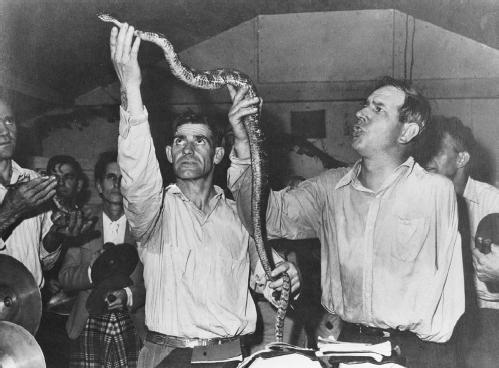
These Pentecostals also handled serpents and drank — or, rather, sipped — poison, based on the Good News revealed in Mark 16:17-18,

And these signs will accompany those who believe: in my name they will cast out demons; they will speak in new tongues; they will pick up serpents with their hands; and if they drink any deadly poison, it will not hurt them; they will lay their hands on the sick, and they will recover.

geuu_01_img0158

I asked my mom if she ever saw Great Grandma Badgett cast out a demon. I was fascinated with the idea. Would you see it ricochet out of the soul of the possessed? Would some furry, cloven-hoofed monster crawl out of the throat and scuttle crablike across the floor? “No,” mama said, “she never cast out demons.” Grandma Laverne, who was still alive then, nodded. “She could have, but she ain’t.” I think Grandma Laverne was in her own kitchen at the time, grinding up ice for iced tea. “I did battle the Holy Ghost on the laundry porch once,” she said. Mama looked at me and then past.

* * * * *

When my mom was born, my grandma was 29 and my grandfather was 70. This’ll be more important in a second only just now I’m going to correct the record.

For years, when I’ve told this story, about my mom, and religion, and why my brother and I didn’t have much of it growing up, in my version of this Gentlemen’s Agreement my grandpa was in his mid-80s when my mom was born, and my grandma was in her mid-20s. While doing only the barest of research for this piece, I learned a bunch of other dates, like that Grandma Laverne was born in 1916, that her husband, Edward, with the weird sisters, was born in 1875. I had thought he came here from Ireland, but according to Ancestry.com he was from Arkansas. His father, however, was Irish, and those Kellys became farmers here, or sharecroppers, rather, and carpenter assistants. I also learned that my grandfather was married before, to a woman named Lizzie, who died the year after Laverne and Edward had their first child, a son named Hubert.

Rehabilitation-client-picking-English-peas-on-farm-near-Batesville-Arkansas-e1409454179239

Family stories aren’t ever for true. They’re for instruction, or comfort, or explanation. What does it mean to know anything anyway? There’s what’s true, and what works, and we aim for the middle, or we don’t aim at all.

* * * * *

Because my grandfather was 70 when my mom was born, and because Great Grandma Badgett had been ordered by God to handle serpents, drink poison, cast out demons (even though she ain’t’ed yet), and heal the sick, she decided that my mom must be a product of the Devil, that it wasn’t the Holy Ghost her daughter battled on the laundry porch. In her heart, 70 was too old for a natural child to be born. There was something unnatural about my mom.

Laying-on-of-Hands

“Did you ever feel unnatural?” I remember asking her. Most stories about her past were slurred to me late on school nights, when she’d have too many cans of Coors and no one else to talk to. That’s how I learned about the river molestation. Or the first of her three marriages. I learned that I wasn’t a wanted child, and that she had tried a bunch of ways to abort me without, you know, aborting me. She would tell me, “Michael, when you boys are out of the house I will kill myself. I won’t be needed any more.” And I believed her, because we’re supposed to believe our parents. And now, mid-70s, she doesn’t remember this plan at all because she doesn’t remember anything. A little girl cries sometimes in the bushes, she says, outside her bedroom.

“Did you ever feel unnatural?” I ask, and she says, “No. I knew I was, but I never felt I was.” How did you know? I asked her. “Because Grandma Badgett told me,” mama said. “She talks directly to God.” Isn’t she dead now, though, I ask? “It would take more than death to keep her quiet,” mama said, and she shuddered.

* * * * *

My Great Grandma Badgett tried to kill my mom the summer my mom was three. There was a large cauldron for boiling blood when the hogs were slaughtered, I’m told for puddings and sausage and if it turns out that none of the Ireland stuff is true then I will have dodged a bullet because Irish food sounds terrible. Great Grandma Badgett filled it with water, built up a fire, and read from the Book of Acts and the Book of Revelations. (This part is the Gentlemen’s Agreement; I don’t know what she read from the Bible or if she read from the Bible. The rest is true, if also gentlemanly agreeable.)

Great Grandma Badgett’s plan was to boil the Devil out of mama. He could not be cast out or frightened by snakes. Poison and the laying on of hands was no good, either. The smell of meat, mama would say, is pleasing to the Lord. “That must be where she got it.” Sometimes when she talks about it, she is talking about it to explain forgiveness: What if the Devil had been responsible for her birth? What if Great Grandma Badgett was all that stood between the righteous and unrighteous. The Bible itself is filled with iron-willed women; couldn’t there be room for one named Chloe?

l_pl1_37653_fnt_tr_t87-12

Other times, though — and, actually, most times — what I’m hearing is a survivor who didn’t make it. Jean-Paul Sartre wrote a short story, “The Wall,” in 1939. Several men are condemned to death, to be killed by firing squad. What Sartre wants to explore is when do we die? There is an easy answer: when something kills us. And then there’s the uncomfortable answer, which is: any time at all.

I believe mama died in that pot. I believed any sense of care and safety and protection and love were plunged out of her. I think she was three, and afraid, and in thrall to a woman who was also far too young for the task she assigned herself, and also, too, afraid.

* * * * *

What happens next changes. She’s never told me the same story twice. So I’ll tell my Gentleman’s version, and that will have to do.

* * * * *

The mailman, on his daily route, passed by and saw a woman in her early 50s struggling with a child not yet not a toddler. He saw the older woman pick the child up, and saw that woman carry that child, kicking and crying, to a pot, suspended over a fire, by chains. He saw all this and he…did nothing. He tipped his cap towards Great Grandma Badgett, and my mom watched him leave.

Where Grandma Laverne was in all of this is never clear. Sometimes mama says she had gone to town for supplies. Sometimes, she’s just sort of not there, until she is, until she comes home and sees her own mother trying to boil her own granddaughter to death.

I want to the story to end heroically — Grandma Laverne tells Great Grandma Badgett, in no uncertain terms, that she’s to take her hands off of her daughter, and to leave that house, and to never return. I want this to resurrect my mom from the death I imagined for her at age three. I want my mom to only feel love and know safety after this.

* * * * *

I want.