Categories
Bible Study Christ Jesus John Luke Mark Matthew New Testament Old Testament Tanakh

Are Jesus and Christ the Same Person?

Maybe! But also maybe not! Let’s dig into the differences. (They definitely are two distinct things.)

We’ll get the easier one out of the way first: Jesus was a first century Jewish apocalyptic preacher/prophet. Some will also include “religious leader,” but Christianity as a religious movement doesn’t really happen until after the crucifixion.

And now all of a sudden I realize that it’s going to be as difficult to explain Jesus as it is going to be to explain Christ.

If we take religion/theology entirely out of the picture (by which I mean, let’s set aside all the supernatural claims of/about Jesus), Jesus is a man born in Bethlehem, a city in the Kingdom of Judah. He is Jewish, both culturally and religiously. We believe he was born roughly around 4 BCE and not much is known of his life in the Canonical Gospels* (the ones that made it into the Bible) until he is baptized by John the Baptist, an Essene.

[* We have something called The Infancy Gospel of Thomas, a Gnostic text from the 2nd century CE. We also have something called the Syriac Infancy Gospel, which borrows a lot of its elements from Thomas’s Infancy Gospel. Stories you’ll read in the Infancy Gospel that don’t show up at all in the New Testament: Jesus bringing a flock of clay birds to life; Jesus raising a boy from the dead who had fallen from a roof to be a witness on Infant Jesus’s behalf, since suspicion had fallen on Jesus as the shover; Infant Jesus killing a man who scolds Jesus and his friends while fishing, only to have to bring the man back to life when the kids tattle to Jesus’s parents.]

Ugh. Wait. We now need to talk about the Essenes. I promise this all fits together, but I thought it was going to turn out differently than this.

The Essenes were a Jewish sect from around the 2nd century BCE up through the 1st century CE. They lived in communes dedicated to poverty, daily immersion, and asceticism. The Dead Sea Scrolls that you’ve maybe heard something about are attributed to the Essenes. Unless they weren’t. There are some scholars — Dr Rachel Elior, Dr Lawrence Schiffman, Moshe Goshen-Gottstein, Chaim Menachem Rabin, to name those I’m familiar with — who don’t believe the Essenes really existed; that they were instead cast-offs from the Zadokites; and that these Zadokites are the ones who wrote the documents collected in the Dead Sea Scrolls. Whether or not John the Baptist was an Essene is a little beside the point; it’s accepted that he existed, and that he did baptise Jesus, and that John, too, was an apocalyptic figure. John preached an end-times theology that included the practice of baptising for the cleansing away of sin.

So, again, we’re going to set the religious stuff aside — or, rather, whether or not the religious stuff is “true” — and just hope to agree to agree that (a) Jesus as a man (not a supernatural figure) existed, (b) he was baptised by John the Baptist, and (c) both were apocalyptic proclaimers who believed that they were living in the final moments before God’s judgment.

Our best sources for biographical information on Jesus as a person come to us from the gospels, though other ancient historians of the time mention him, too. As far as the writer of Mark is concerned, Jesus had no especially supernatural birth, and Mark doesn’t include a genealogy. For Mark, the story of Jesus begins with his baptism in the River Jordan. Mark can also be read as a gospel of adoptionism: Jesus did not become the son of God until he was adopted by God after the baptism* (Mk 1:9-11). Matthew and Luke both give us genealogies, and both have elements of what we call the Christmas Story: the Annunciation, the manger, the Virgin Birth, the star, the shepherds, the wise men. John…is doing his own thing and we’ll talk about him another time.

[* The Gospel of Matthew also has an element of adoptionism to it, where Matthew suggests that Jesus doesn’t become the Son of God until the resurrection*.]

[* The gospels don’t agree on many details. And for a lot of theologians, this is actually of some comfort. If all four gospels aligned cleanly, then we might think that there is some coaching going on. But the fact that there are discrepancies within the gospel narratives actually suggests realistic “testimony.” It’s often discussed in terms of “No one describes an auto* accident the same way.”]

[* There are bumper stickers that say, “My Boss is a Jewish Carpenter,” and I challenge anyone who believes that, or has that sticker, to show me in the Bible anywhere where Jesus does any carpentry. And no, being nailed to a cross does not count as “doing carpentry” so much as it counts as “having carpentry done to you.]

What is true among all the gospels is that Jesus is referred to as The Christ. Or Jesus Christ, which makes it sound like Christ is a surname. But Jesus is a person, and Christ is a title that has been attributed to Jesus. (Is he the Christ? No! say the Jews. Yes! say the Christians. It probably doesn’t matter! says Mike Bevel.)

So, what is Christ?

Christ is the anglicized version of the Greek khristos (χριστός). And khristos is the Hellenized version of the Hebrew word māšîaḥ. Messianism as a concept originated in Judaism, and it essentially means either anointed or covered with oil. In Jewish eschatology, the final messiah — the Very Important One, who will bring about the Messianic Age — would be an anointed king from the line of David. (The term “messiah” has been used for others, by the way, even in the Bible. King David was considered a messiah. So was Cyrus the Great and Alexander the Great. These minor messiahs — men anointed with oil in a ritual ceremony — were never considered to be the Avenging Messiah. This messiah, whom the Jews were waiting for around the time of Jesus and John the Baptist, would come both to rebuild the Jerusalem Temple and to lay low all of the Israelites’ enemies.)

Claims of Jesus’s messiahship start with John the Baptist. It’s likely Jesus had been either a follower, or at least a close adherent, of John. In Mark, our oldest gospel, we hear John say, “The one who is more powerful than I is coming after me; I am not worthy to stoop down and untie the thong of his sandals. I have baptized you with water; but he will baptize you with the Holy Spirit.” (Mk 1:7-8) Matthew adds to Mark’s story: “Then Jesus came from Galilee to John at the Jordan, to be baptized by him. John would have prevented him, saying, ‘I need to be baptized by you, and do you come to me?’ But Jesus answered him, ‘Let it be so now; for it is proper for us in this way to fulfill all righteousness.’ Then he consented.” (Matt 3:13-15)

And it’s at this point that the schism within Judaism starts. There are Jews who do not believe any claims of Jesus’s Christ status, and there are those who do believe Jesus is the prophesied Christ. On either side of that dividing line, however, both sets of Jews believe in The Messiah; one side just picked Jesus as that avatar, and the other said, “We’ll see what comes around on the next dim sum cart.”

Jews had a lot of reasons to deny Jesus the title of Christ. While the gospels, and The Book of Acts, and even the letters of Paul, try to paint a picture of Jesus as Messiah (mostly by just calling him Jesus Christ or Son of God), the Hebrew Bible describes the final messiah as a king sent to do battle and liberate the Jews. In fact, the Jewish messiah has no salvific mission at all. Which is what made Jesus such an alien figure to his own people: there was a claim of messiahship, but it was from a lowly carpenter and itinerant street-preacher who had no power to overturn Rome, rebuild the Temple, or deliver the Jews to the Messianic Age. The messiah that these separatist Jews (and Gentiles) were championing came almost as the Still Small Voice mentioned in 1 Kings. He heals the unclean. He eats with sinners. He performs work on the Sabbath. There is nothing about Jesus as a warrior or an organizer or even a political figure (though he is a political victim) in the New Testament gospels. And there wasn’t at the time, and there isn’t now, a lot of agreement as to how many Hebrew Bible prophecies the birth, life, death, and resurrection of Jesus fulfilled. I mean, for one thing, immediately: THE MESSIAH WAS NOT SUPPOSED TO DIE*. This one did. He got better, of course, but he only hangs around for a little while longer before disappearing pretty much ever since. He appears on the odd piece of toast, or in a mildew stain on a ceiling, but Jesus incarnate isn’t walking amongst us. (Unless, like me, you subscribe to large segments of Gnosticism where the Christ part of Jesus exists in all of us; we’re all Jesus, or at least have the ability to be.)

[* He is also supposed to be named Immanuel, as the Book of Isaiah tells us: “Therefore the Lord himself shall give you a sign; Behold, a virgin shall conceive, and bear a son, and shall call his name Immanuel.” (Is 7:14). The Gospel of Matthew is the only other place that mentions Immanuel, but instead uses Emanuel*, in Matt 1:22-23: “Now all this was done, that it might be fulfilled which was spoken of the Lord by the prophet, saying, Behold, a virgin shall be with child, and shall bring forth a son, and they shall call his name Emmanuel, which being interpreted is, God with us.”]

[* There’s a 1992 book called Out of the Blue by Patrick McManus and I don’t remember almost anything at all except there’s this delightful exchange among children in a preschool. One child asks for an “unraser.” A girl corrects him: “Eraser. E. My name is not Unlizabeth you know.”]

So: Christians believe that Jesus either became or was born the Christ. Jews believe the Christ hasn’t arrived yet. So, in a sense, Jesus and The Christ are not necessarily the same person, but also aren’t necessarily not, but it’s the way Christians worship, recognize, and understand the man from Nazareth.

Categories
Belief Bible Study Genesis Old Testament Tanakh

On the Origin of Navels and Other Things

Did Adam and Eve have navels is a silly question. They didn’t, for several reasons:

1) Adam was fashioned out of earth, not in a womb, with an umbilical cord. And Eve was fashioned out of Adam’s rib.

2) We think they had navels because in all the paintings of Eden and the first family, Adam and Eve are shown with navels, probably because the models being used for those paintings had navels.

3) Adam and Eve never existed. It’s a folk-tale.

But this navel question has troubled theologians forever, because each question comes value-packed with a bunch of other questions, too.

Question: When Adam was formed from the dust of the ground — how old was he? I mean, yes, sure, technically he was 1 day old. But did God create an infant? Did God create a young man?

Question: If God created Adam as an adult, what memories would he have? Does he have memories? Did Adam and Eve dream at all? That first night’s first sleep — what was that like?

(There’s a midrash about Cain’s offering of the first of the field to God — that Cain, hearing of his parent’s banishment from the Garden, to which they could never return, and which they ached for daily, planted a new Garden, one that he knew would not be perfect, but would maybe be perfect enough. And its the fruits of this harvest that Cain brings to God, and which God rejects, for reasons that are only knowable to God.)

An Even Better Question: Why a penis? Why a vagina? Were the first humans supposed to be procreative? Or did God just have this Peaceable Kingdom in mind with only these exhibits? Adam and Eve never get a chance to have sex, let alone get Eve pregnant, before the Fall. And after the Fall, God’s punishment for Eve is pain in childbirth. How was childbirth expected to happen in the Garden of Eden? Does God decide that making humans is something he’s not good at, so he leaves it to us? Are we any better at making humans?

There are two creation stories in Genesis. Biblical literalists will say that there is only one, told from two points of view, and it would do none of us any good to try to convince them otherwise. But there are two creation stories that don’t entirely line up.

Genesis 1 was written at some point after Genesis 2. Genesis 1 is more liturgical in its tone, with its measured refrain. Genesis 2 is a folktale that was likely already fairly old when it was written down. The Bible — both the Hebrew and Christian texts — didn’t come to us from God in the order that we have it. (And it didn’t come to us from God anyway, but you get what I’m saying.) The Bible that we have now is a political document edited together to make a certain point. (Or, actually, points.)

Interestingly, Genesis 1 and Genesis 2 may not even necessarily be about the same God. When God is written about in Genesis 1, the word used for God is “ʼĕlôhîym” or, less complicatedly, elohim (אֱלֹהִים). Elohim usually refers to the Jewish god, but at other times in the Bible it refers to plural deities. This in itself is interesting because it points us in the direction of a sophisticated way of conceptualizing the divine: it suggests polytheism, because ʼĕlôhîym is plural, in a monotheistic culture/deity: Our God is All gods.

The God of Genesis 2 is referred to as YHWH ʼĕlôhîym. YHWH is also known as the Tetragrammaton. It is believed to be the actual name of God, and is never pronounced out loud. Also, we really can’t pronounce it out loud because Hebrew has consonants but no vowels. The best guess is Yahweh. However, you may notice in your Bible, if you’re a Bible reader, that sometimes the word LORD shows up in all-caps. That’s where the Tetragrammaton appears in the original Hebrew. When Jews are reading their Torah portions in synagogue, they won’t say Yahweh, or spell out Y, H, W, H. Instead they may say “Adonai,” or “HaShem,” or “hakadosh baruch hu” which translates to “The Holy One, Blessed Be He.”)

(Names are a powerful component of magic. Knowing something’s name gives you certain powers over it. If anyone knew and could utter the actual living name of God, it’s not clear entirely what would happen, but it would probably not be good.)

So, we have this majestic opening account, where creation is ordered and systematic. First this, and it was good, then this, and it was good. Actually, in Genesis 1, there are three places where the Bible doesn’t close with “and it was good”:

1) On the first day (Gen 1:3-5), when God separates the light from the darkness, that doesn’t get a corresponding “and it was good.” “it was good” for separating. (Separating isn’t creative, it’s ordering. As Sister Aloysius says in ::Doubt::, “When you take a step to address wrongdoing, you are taking a step away from God, but in His service.”)

2) On the second day, God separates waters from waters, and this is also not labeled as “good.” Here, we get a perfunctory “it was so.”

3) On the sixth day God creates humans, separated into male and female. The humans are blessed (Gen 1:28) — but that’s not the same as being called “good,” is it? Because God sees that “the wildlife of the earth after their kind, and the herd-animals after their kind, and all crawling things of the soil after their kind” were good (Gen 1:25); but humans, though, are not singled out for goodness, only a blessing. Their lives are about to become impossibly hard, with a final separation of human from garden.

In Genesis 2, though, we get the Creation Story as if it were a folktale. And we get some initial challenges to God’s omniscience — a concept that has been read ::into:: the Bible, but is not necessarily verified by the text of the Bible.

After God creates Adam — without a belly-button because Adam has no need of a belly-button — he notices that Adam seems lonely. So God says, “I’ll make a helpmate for Adam.” And he creates animals. And in the story, God proudly presents Adam with a new creature and sort of nods expectantly, like, “Huh? Right? Isn’t this what you’ve been missing?” And Adam, who is very polite, greets each creature with platonic love, names it, and then sort of shrugs sadly at God because while this rhinoceros is very cool, as was the peacock before it and the nudibranch that needed to ::immediately:: be put into water, none of these are helpmates. Put more coarsely: he can’t fuck these animals. He can’t talk to them, tell them about his day (which started literally 15 minutes earlier), sleep cradled together like commas. And then, finally, God says, “Well, let’s try this.” And from Adam’s rib, he makes an Eve.

(Or he makes Lilith, but not out of a rib, and this is from a later tradition than the Garden story. Once upon a time, God created Adam and Lilith, both out of the dust of the ground. Lilith refused to be subservient to Adam, which, good for her; but, however, she’s banished and becomes a demon and/or fucks the archangel Samael, who will later wrestle with Jacob, only I don’t think that happened, I think Jacob actually wrestles with Esau, and we’ll talk about that another time when I feel like it.)

God breaths the Breath of Life — or a soul — into Adam. We don’t know if God breathed a soul into Eve or not. The Bible doesn’t say. She has an innate curiosity and confidence that Adam doesn’t appear to have. The Gnostics revered her as the champion of Wisdom and Knowledge. Christians have used her to blame women for everything forever.

(A final bit of trivia, on the subject of navels: When God is haranguing Job for daring to ask “why?”, God says, “Behold now behemoth, which I made with thee; he eateth grass as an ox. Lo now, his strength is in his loins, and his force is in the navel of his belly.”)

Categories
Bible Study Genesis Old Testament Tanakh

Abraham & Isaac

Once upon a time, in the Bible, God and Abraham were having a conversation. God was explaining how he needed to destroy Sodom and Gomorrah, and Abraham was explaining how he shouldn’t do it.

It’s the afternoon, we’ll say, and there is a beautiful sunset, and God and Abraham are standing on a small rise that looks out over a wide plain, and down towards Sodom. This image would hold some significance for Abraham. He has been promised, on multiple occasions, that God will make of him a Great Nation. He has asked Abraham to count the stars in the sky. He has asked him to number the grains of sand. He has shown him wide vistas and said, “This is all for you and your descendants.” All of these are approximations of the legacy Abraham will leave behind. God has asked Abraham to count the stars and number the grains of sand, but at the point of this conversation, this bargaining with God, Abraham has only one child, a boy, Ishmael, whom he fathered with his wife’s handmaid, Hagar. Also, during this conversation, Abraham is 100 years old and his wife, Sarah, is 90.

Earlier in the day, when God appeared to Abraham as three visitors, God tells Abraham that within the year, Sarah will have given birth to a son. Sarah, overhearing this, laughs a little, laughs the quiet part out loud, because, as she says, “I am past childbearing age, and my husband is very old. Am I to have this great pleasure?” But God insists, and tells Abraham that there is a child on the way, and he will be named Isaac.

God then, in need of a listening ear, maybe, or just in the way sometimes God gets lonely (he calls out plaintively for Adam and Eve when they have hidden themselves, and their nakedness, from him) and needs companionship, reveals the plan to destroy Sodom and Gomorrah. The sins in these cities are too great, God says. Something has to be done, God says. Raze it all and salt the earth. Abraham argues, though, that if there are 50 righteous people in Sodom, that it should be spared. That if there are 45 righteous people, that it should be spared. And we go to 40, and then 30, and then 20, and then 10. And God says, “For the sake of 10 righteous people, I will not destroy it.”

Abraham, who has lied twice about his wife being his sister (which is not technically a lie since she is his half-sister) so as to avoid any kind of punishment or murdering because of how beautiful his wife is, has the audacity to question God, and even chide God a little: “Far be it from you to do such a thing—to kill the righteous with the wicked, treating the righteous and the wicked alike. Far be it from you! Will not the Judge of all the earth do right?” This has to sting a little, because, actually, yes, God did, at one point in his history, kill the righteous with the wicked when he flooded the whole earth to punish mankind. God is at his most human in the Hebrew Bible.

Sarah does have a baby, a boy, and she does name him Isaac, which means “laughter” or “he laughs.” It’s a bit of a joke, reminding Sarah that she laughed at the idea of ever having a child of her own. But Sarah also describes Isaac this way: “God has brought me laughter, and everyone who hears about this will laugh with me.”

(How important are Bible citations to you? I’m running through this essay without them because I think they can be interruptive. But if you need ’em, let me know.)

Like most family stories, this one is messy. We’re not even really going to touch on the whole Ishmael of it all, but there’s Ishmael, Abraham’s son, whom Sarah wants banished after the birth of Isaac. All of Sarah’s attention, and all of Abraham’s attention, is on Isaac. (This is a little exaggerated. When Abraham is told by God that Sarah is going to bear a son, Abraham says, “If only Ishmael would live before You!” — in a sense, saying, “I am perfectly happy having Ishmael as my heir. I don’t need another. But God insists, the way God do.)

The most important thing to know about Isaac is that he will soon become entirely a product of trauma. We can read these stories and look for nuggets of hidden truths and Biblical understanding; but we can also just read these stories as stories. Here is a family, here is a terrible request, and on the other side there isn’t a family any longer.

God calls to Abraham, and Abraham says, “Here I am.” God tells Abraham, “Take your son, your only son Isaac, whom you love, and go to the land of Moriah, and offer him there as a burnt offering on one of the mountains that I shall show you.”

And, again, the messiness of the family dynamics ring so true, even to modern ears. God himself ignores Ishmael, and calls Isaac Abraham’s only son. Sons do not fair well in the Hebrew Bible, especially first-born sons. Cain and Abel couldn’t work it out. Ishmael is not considered Abraham’s heir, but Isaac is. Isaac’s sons, Jacob and Esau, are also at odds with each other. Then we get to Joseph and no one likes him. This denial of Ishmael will have consequences later.

God calls to Abraham, tells him to offer his son as a burnt sacrifice, and Abraham sets off the next morning. There is no bargaining this time with God. Why? There is no countering or arguing; no demand for an explanation as to how, exactly, Abraham is going to establish a strong line when one son is banished and the other is dead.

Religious scholars and a certain type of church-y person will say that the story of the Binding of Isaac is about Abraham’s absolute trust in God, and Abraham’s willingness to do anything asked of him. And it might be about that — but this is not a God one should worship. This is cruelty. Sarah says, “God has brought me laughter, and everyone who hears about this will laugh with me.” God says, “Ritually murder your son on a mountain for me.”

A common refrain I have is that the Bible is not the Word of God. The Bible is a composition of a variety of writings, each with a political agenda. I have to remind myself of that when I read about Isaac, or poor Job, or Jephthah and Jephthah’s daughter (more on them in a bit). They describe a certain kind of relationship God has, but it may not be described accurately. In the Hebrew Bible, God says that to show your willingness to follow him, you must sacrifice your son. In the New Testament, Jesus will say to the Rich Young Man, “Sell all your things to follow me.” Of those two sacrifices, one is more moral than the other, at least in my mind.

The sacrificial party is Abraham, Isaac, and two of Abraham’s men. They walk for three days, and we have no idea what they talked about. How much does anyone know on this walk? What is on Abraham’s heart each step that takes him closer to Moriah?

On the third day, Abraham stops and tells his two men to wait for him: “Stay here with the donkey; the boy and I will go over there; we will worship, and then we will come back to you.”

Let’s talk about the word the word “we” is doing here. For those who want to argue that Abraham knew all along that God wasn’t really going to make him sacrifice Isaac, they’ll point to how Abraham says “we will worship” and “we will come back to you.” Why say we, they ask, if Abraham knew he was going to kill his son and return alone.

(An ogre and a child are walking into the woods. The child looks to the ogre and says “Gee, it sure is awfully dark out here and i’m getting scared.” And the ogre says back to the child, “You think you’re scared? I have to walk out of here alone!”)

But it could also be a small lie, this “we” there and “we” back — and Abraham has told small lies before for self-protection. If he said, “We’re going to worship, and then I’ll come back,” he would have to answer some uncomfortable questions and risk being stopped in his divine mission. “We” is a polite fiction to grease the wheels of worship.

This next part in the story is also worth a little digging:

“Abraham took the wood of the burnt offering and laid it on his son Isaac, and he himself carried the fire and the knife. So the two of them walked on together.”

Sacrifices must be pure. They must be unmarked and unblemished. Abraham lets Isaac carry the wood, but not the knife, and not the fire, because if Isaac were to nick himself, or singe his skin, he would no longer be a Good Offering to God.

Sacrifices are also usually from the first-born of the flock. And Isaac is the second-born son. Why doesn’t God ask for Ishmael? And here we enter into a debate between Islam and Judaism and I, a white Baptist, am just the person to tell you about it.

Some Muslims believe that it actually was Ishmael whom Abraham was supposed to sacrifice. There’s a lot of quibbling about the phrase “take thy only son.” Some Muslim scholars say that Ishmael is the only one that could ever have been an “only son” because he was an only son for 14 years, until the birth of Isaac. And Isaac would never have the experience of being an only son, since he is the second born.

The midrash on this story captures some of this uncertainty. Here is a record of the “full” conversation:

God: Take your son
Ibrahaim: I’ve got two sons
God: Your only son.
Ibrahaim: Each son is an only son to his mother.
God: The one whom you love.
Ibrahim: But I love both of them.
God: Ishaq.

(This actually sounds more like the Abraham we know from the Sodom and Gomorrah story.)

In the Bible, Isaac only speaks to his father once. “Father! The fire and the wood are here, but where is the lamb for a burnt offering?” And Abraham answers, “God himself will provide the lamb for a burnt offering, my son.”

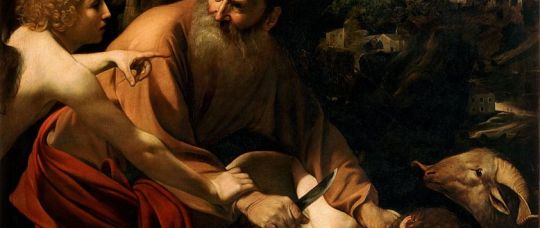
Things move quickly from this point. Abraham builds an altar, lays the wood, binds his son Isaac, and lays him on the sacrificial table.

A father is about to murder his only son. Because a deity said to.

The fact that Abraham doesn’t, in fact, sacrifice his son — an angel stops Abraham and sends a ram, caught in a thicket by its horns. Just as Abraham said God would. “God himself will provide the lamb, my son.”

(There is a LOT of Christian symbolism that can be read into this story — a father sacrificing his only begotten son; a son carrying the wood that he’s to be sacrificed on — but it’s not actually present in the story. This is a Jewish story about a Jewish event. Those Jews who split from Judaism to become Christians would know these Torah stories by memory, and these would, of course, influence the writings of the gospel. But again: the Hebrew Bible isn’t Christian, it’s co-opted.)

Abraham is blessed for his faithfulness — which, again, is often preached as the main message of this story: God may ask you to do the impossible, but he will be with you the whole time. I still don’t care so much for that as a spiritual take-away. There must be other ways for us to demonstrate love and devotion to God (or the Universe or the Sacred Mystery or whatever you are or are not calling the ineffable).

Abraham and Isaac never speak to each other again in the Hebrew Bible. In fact, there’s this curious passage towards the end of this story: “So Abraham returned to his young men, and they arose and went together to Beer-sheba; and Abraham lived at Beer-sheba.”

This event is utterly destabilizing for Isaac. There’s this detail, about how Isaac marries Rebekah in his mother’s tent, and that Rebekah “became his wife, and he loved her; and Isaac was comforted after his mother’s death.” (Gen 24:67) When we see him next, he is an old man, blind, and maybe or maybe not aware that his younger son, Jacob, is heisting the birthright from Esau. Isaac is passive and sad and seemingly cut off from any action — which is what you’d expect from someone who is nearly murdered by his father.

So much care and attention is given to Abraham’s faith and faithfulness. So little is said about what this must have been like for Isaac. “Somewhere there must be more love.”

Categories
Belief Bible Study God Job Old Testament Ruth Tanakh

“Your God Shall Be My God”: The Book of Ruth

In many ways, The Book of Ruth is a gentle echo of The Book of Job. In Job, we witness a righteous man destroyed for a wager who remains unwavering in his faith right up until he asks, “But why?”

(They patch things up in the end, God and Job, and he gets a new family with new children. What’s interesting — and I wish I had thought to write about this when I wrote about Job earlier — is that we don’t know anything about Job’s wife. She has one line: “Do you still persist in your integrity? Curse God, and die.” And after her big speech, that’s the last we see/hear of her. Is she the mother of the new family? Why was she — or, even better, was she — saved from the wager? Did she die too? Did she leave Job? Ocean so full of questions.)

The Book of Ruth is also about a life interrupted by Divine Intervention. It’s Job with a happier ending, but the same unsettling questions about how we interact with God, and how God can interact with us.

(It’s also often used by feminist, queer, and queer-friendly theologians as an example of a loving same-sex relationship, or, at least, Women Getting Strength from Women. I am not going to focus so much on the lesbianism in this story, if there is any, which I’m not entirely sold on, but boy do I recognize and feel deeply that hunger for representation, especially in a text that is so often used to call me, and people like me, an abomination worthy of destruction. Your reading of Ruth as a queer text is valid. Your reading of Ruth as a feminist text is valid. I see you and love you. Misquoting Jesus: “We were not made for the Bible, but the Bible was made for us.” Do with it whatever brings you comfort, including ignoring it.)

(My theology is best represented by this piece attributed to the Sufi mystic Rumi:
Come, come, whoever you are.
Wanderer,
worshiper,
lover of leaving.
It doesn’t matter.
Ours is not a caravan of despair.
Come, even if you have broken your vows a thousand times.
Come.
Come yet again.
Come.)

Ruth is a Jewish text. Written for Jews, by Jews. At its heart, one of its central questions is: who gets to be a Jew, and how? (Christians are interested in the Book of Ruth because it’s used as proof of Jesus’s lineage through King David. In general, Christians are only interested in the parts of the Hebrew Bible that confirm the Jesus Event. That’s also a gross overstatement on my part and I will no doubt be taken to task for that position but heavy is the head that speaks the truth.)

Ruth 1:1 starts out with, “In the days when the judges ruled, there was a famine in the land, and a certain man of Bethlehem in Judah went to live in the country of Moab, he and his wife and two sons.”

Two questions immediately sprang up for rabbis in the first millennium CE:

1) Why would God strike the Jews with a famine?

2) Why would “a certain man” (who we’ll later learn is named Elimelech) flee to live in Moab?

The Ruth Rabbah (רות רבה) is a midrashic interpretation of the events of the Book of Ruth. And for midrash, we can essentially think of it as a way of filling in the gaps. Rabbis would read the Tanakh, and when they came to a “why” question not answered in the text, they would reason themselves to an answer. (It’s how any of us tell a story, anyway, isn’t it? When we get to a why we can’t answer, we will sometimes just make shit up. We’re a storytelling people, more than a logical people.)

The Ruth Rabbah tells us this quick story to answer Question 1: “At that time God said: ‘My children are stubborn. To destroy them is impossible. To return them to Egypt is impossible. I cannot exchange them for another nation. What, then can I do? I must make them suffer and cleanse them with famine.'”

It’s the astonishingly frank reasoning of a sociopath. “I can’t kill them all. I can’t give them back. I didn’t keep the receipt, and it’s not like I can get a new people. I’ll starve them.”

The Ruth Rabbah also tells us why “a certain man” (Elimelech) would flee: “Elimelech was among the great scholars and patrons of the nation, and when the years of famine came, he said: ‘Now all of Israel will come to my door, each with his box (to collect money).’ He stood up and ran away from them.”

So, Elimelech, his wife, Naomi, and his two sons, go to Moab.

Moab is an interesting place for these Jews to go. From yesterday, when we talked about Lot and his daughters, we learned that the eldest daughter bore her father, Lot, a son named Moab, who founds the city of Moab. The younger daughter bore her father a son named Amon. And if we jump to Deuteronomy 23:4-5 for a sec, we learn this: “They should not come into the congregation of God, neither Moabite nor Amonite, even the tenth generation should not enter into the congregation of God, forever, because they did not greet you with bread and water on the way when you left Egypt.”

Once upon a time, Moses and God freed the Israelites from slavery in Egypt. They wandered in the desert for 40 years. They didn’t make a lot of friends. (They did make a golden calf and boy did that really chap God’s hide but I digress.) And it’s a lovely bit of irony that the Moabites and Amonites would be inhospitable to the Israelites. Sodom and Gomorrah were destroyed, in part, because of the cries to heaven of a young woman burned to death (or stung to death — the stories vary) for feeding a starving man. Moab and Amon are born because Lot and his daughters flee Sodom. Time is a flat circle.

Elimelech, Naomi, and their sons Mahlon and Chilion, are now in Moab, and Elimelech promptly dies, leaving Ruth with the kids. The boys took Moabite wives, Mahlon marrying a woman named Ruth; Chilion marrying a woman, Ruth’s sister, Orpah. (By the way, you guys know that Oprah’s actual given first name is Orpah? But so many people pronounced it wrong that she just decided, “Fuck it, I’m Oprah now.”)

The boys then die, too. So Naomi is left a widow with no children, and her daughters-in-law are left widowed, also with no children.

In Job, Job is punished as part of a wager. He has done nothing wrong. In the Ruth story, Elimelech dies probably as punishment for abandoning his people in their time of need. And the sons, Mahlon and Chilion, died because they took Moabite women as wives. (By the way, Ruth and Orpah aren’t just any Moabite women; they’re the daughters of Eglon, king of Moab.) But death isn’t much of a punishment for the dead person. They’re dead. (Oh boy, is someone going to ask me about death and resurrection?) Naomi seems to be the one suffering the brunt here. She is alone, unprotected in a strange and hostile city, with two daughters, now, to care for.

Naomi learns that the famine in Judah has passed. She wants to go home. She tells her daughters-in-law to return to their own homes, and wishes them new husbands and children, adding, “May the Lord deal kindly with you, as you have dealt with the dead and with me.” Naomi says that “the hand of the Lord has turned against me.”

And still, in one of the most beautiful passages in the Hebrew Bible, Ruth says:

“Do not press me to leave you
or to turn back from following you!
Where you go, I will go;
where you lodge, I will lodge;
your people shall be my people,
and your God my God.
Where you die, I will die—
there will I be buried.
May the Lord do thus and so to me,
and more as well,
if even death parts me from you!”

Ruth converts, in that moment, if not ceremonially, and not ritualistically, (God spends a LOT of time with the Israelites explaining exactly how everything needs to be done, like a fussy gay wedding planner*) at least emotionally, to Judaism, and to Naomi. She will worship Naomi’s God. She will be of Naomi’s people.

(* Like, for serious, God gets in the weeds about incense in the Book of Exodus. “I like this smell, and this smell, and I will smite you dead if you even think about bringing in THIS smell.” And as a lover of candles and incense, I’m #TeamGod on this.)

It’s curious/interesting that Ruth’s husband, Mahlon, didn’t seek to convert his wife. As a Moabite, Ruth would not have worship YHWH, the God of the Israelites; her chief diety would be Chemosh*, possibly a fish god. (There are a LOT of fish gods in the ancient past.) While YHWH claims to be the only god, there were p l e n t y of Mesopotamian deities with cults and followers. And in this moment of love, and maybe desperation, Ruth says, “I choose your life.”

(* One of the things we know about King Solomon, world’s biggest non-genius — splitting a baby in half? That’s your solution? — is he had MANY wives. Many wives from many regions who all brought their own religious traditions with them, and their own gods and rituals and rites. The worship of Chemosh was part of Solomon’s kingdom until Josiah comes along and abolishes this religious plurality.)

And this conversion is, for me, the heart of this story. It’s a suggestion of acceptance at a time when the Jews were still very insular. And, read from a Christian point of view, it also speaks to the universal nature of God — that anyone, even a Moabite, can be welcomed.

But a question for me, also at the heart of this story, is about Naomi, who feels that God has turned against her. Who will later change her name to Mara, which means “bitter” (Naomi, by the way, means “pleasant”). Who will tell others that “the Lord has dealt harshly with me, and the Almighty has brought calamity upon me.” Did God actually turn his hand against her, or does she feel, in the middle of all this tragedy and chaos, as if that is what is happening? Is she blaming herself for something that is not her fault, which is something women have been taught to do since literally the invention of humans.

It’s the same question we leave with after the Book of Job, too: has God forsaken me, or am I only a pawn? (A rabbi I talked to about Naomi said, “G-d does not forsake anyone.” Which is comforting, if untrue, because we see in Deuteronomy 31:17 that God actually does forsake people because he tells us he will forsake them: “My anger will be kindled against them in that day. I will forsake them and hide my face from them; they will become easy prey, and many terrible troubles will come upon them. In that day they will say, ‘Have not these troubles come upon us because our God is not in our midst?'” When people tell you who they are, believe them. FROM OPRAH. Everything is connected.)

What’s powerful in this story is that even though Naomi is forsaken by God, Ruth does not leave her side. “Where you go, I will go.”

Categories
Belief Bible Study Genesis Old Testament Tanakh

Lot & His Daughters, or, Hospitality Gone Terribly Wrong

There are Bible stories that aren’t in the Bible, and it occurs to me right now that I could spend a lot of time not writing at all about Lot and his daughters and just talk about how the Bible came to be, well, The Bible. Another time perhaps. Just know that there are more gospels in existence than you may be aware of, and there are extra-Biblical writings that fill in the gaps to a lot of the stories.

For instance.

The rule in Sodom was, “Whosoever giveth bread to a poor person shall be burnt at the stake.” That’s not in the Bible, but in the writings of the Rabbi Rashi, a Talmudic and Tanakhic commentator, who lived in France in the 11th century. (The Talmud is a collection of Jewish scholarship on the Tanakh. The Tanakh is essentially what Christians call the Old Testament, but which we should probably get in the habit of calling the Hebrew Bible.)

Rashi continues: Plotit*, the daughter of Lot, who was married to a prominent Sodomite**, saw a man so poor and so hungry that he was unable even to stand. Feeling sorry for him, each day she would give him a little food she had saved on her way to the water well.

(* Lot’s daughters, and his wife, are not named in the Bible. In the Book of Jasher, which doesn’t exist, but did, because it’s quoted in the Bible and in other texts at the time, Lot has four daughters and no sons. Two of his daughters were married; two were betrothed. Lot’s wife is named Irit.)

(** Not what you’re thinking, gang. This is a reference to someone living in the town of Sodom. Was he gay as pants? The midrash is silent on this.)

People in Sodom soon found themselves wondering how this man, poor and hungry near to death, was not, in fact, dying. Maybe their hope was: he’ll starve to death and we won’t have to worry about not feeding him. Maybe that’s also our hope when we see panhandlers. History doesn’t repeat itself, but it rhymes.

Then, the discovery: that the man wasn’t starving any longer, that Plotit had been secretly feeding him, and for her generosity, she was burned at the stake. Before she died, she cried to heaven: “Master of the World, carry out justice on my behalf!”*

(* In some stories, it’s fire. In others, she’s tied to a tree, drenched in honey, and left to be stung to death by bees. In some stories, JFK is shot by a lone gunman. In other stories, there’s a cabal. There is always more than one story to any one story.)

In the Bible, we need a bit of a prologue before we launch back into the Lot story. There is a man named Abraham. He is 100 years old. He has a wife, named Sarah. She is 90. One day, God appears to Abraham in the form of three men. (“IT’S THE TRINITY!” fundamentalist Christians will say and (a) of all, no, it isn’t; this is a Jewish text. Also, too, the Holy Spirit isn’t necessarily a man. In fact, in Gnostic tradition, the third part of the trinity, the Holy Spirit, is feminine, and possibly God’s wife.)

God has come to Abraham for two reasons: (1) To remind Abraham that his wife Sarah will bear him a son, to be named Isaac; and (2) To investigate Sodom and Gomorrah. “The outcry against Sodom and Gomorrah is so great and their sin so grievous that I will go down and see if what they have done is as bad as the outcry that has reached me. If not, I will know.” (Gen 18:20)

(There’s a wonderful moment in this story where Sarah overhears the visitors when one says that she will have a baby within the year. She laughs — because, again, she’s 90 and her husband is 100. She says, “After I am worn out and my lord is old, will I now have this pleasure?” And God says to Abraham, “Why did Sarah laugh?” And Sarah, in a very human moment, feels embarrassed at being caught laughing at a visitor and says, “I did not laugh.” And God, ever the one to have the last word, says, “You totally did.” This is in Genesis 18:1-15.)

We’re getting to Lot and his daughters. But there’s a little more scene setting. We have to go back to the midrash, because this outcry against Sodom and Gomorrah confused rabbinical scholars.

Why, they wondered, was the singular feminine “her cry” (הַכְּצַעֲקָתָהּ) used instead of the expected (and masculine) “their cry” (הַכְּצַעֲקָתָם)? (The feminine is entirely erased in English translations, using the neuter “the outcry.”)

And now we can begin to introduce Lot, his daughters, and his wife back into the point of it all.

The early interpreters of the Torah said, “‘Her cry’ is the cry of Plotit, crying to God for justice. He heard it, and he came down to Earth to investigate.” Modern scholars might argue that Sodom and Gomorrah are sister cities, and the “her cry” means the city’s own cries for justice. Modern scholars say a lot of things.

God sends two angels — oh boy. I’ll deal real quick-like with angels, but maybe I’ll write about angels fully another time because they are complicated and weird. Often, where the word “angel” appears in the Bible, it really means “messenger.” These were human(ish?) people, with no wings. But sometimes angels mean supernatural beings in extraordinary shapes and that’s not what these angels are, who appear with God before Abraham. In fact, the text is pretty opaque as to whether or not the three visitors to God are all one person (“TRINITY!” NO NO NO. We’ve been OVER THIS.) or if it’s God, and two friends.

Anyway. God sends two angels to Sodom to check things out, and destroy both Sodom and Gomorrah if necessary. (I’m leaving out the whole marvelous bargaining scene between Abraham and God where Abraham says, “But what if there are 50 righteous people?” And God says, “Then I’ll back off.” And Abraham, maybe aware of the reputation of Sodom and Gomorrah, says, “Well, but maybe 40?” And God says, “For 40? Sure.” And Abraham bargains all the way down to 10 righteous people. Keep that number in mind.)

Someone else may ask me to write about homosexuality and the Bible, and I will, even though it makes me tired. When the angels arrive, they meet Lot, who is “at the gate.” He’s a businessman/ambassador, essentially, but he’s also New In Town. (“Excuse me, I am homeless, I am gay, I have AIDS, I’m new in town.”) The Sodomites, who already aren’t known for their stunning hospitality, are also a little frustrated about this out-of-town upstart who has risen pretty high in the heirarchy of Sodom. When Lot ushers the two visiting angels into his home (btw, Lot has no idea that they are angels), “the men of the city, the men of Sodom, both young and old, all the people to the last man, surrounded the house; and they called to Lot, ‘Where are the men who came to you tonight? Bring them out to us, so that we may know them.'”

To “know” someone in the Bible is essentially to fuck them. Just like “feet” in the Bible are almost always a euphemism for dick. Look, I didn’t write the Bible. We’ll talk more about feet, btw, when we get to the Book of Ruth.

And this is where your fundamentalist/literalist/asshole jerks will start with their anti-gay nonsense. What I want to ask you all to do, just for the moment, is say, “Fine.” Say, “The Bible hates homosexuals and homosexuality.” (It doesn’t.) IT DOESN’T MATTER NOW. The Hebrew Bible was not written for us — and that “us” is doing a lot of heavy lifting because I mean “Christians” and “Modern people” mostly. This is how things were in the Olden Timey Days, but cultures grow. Don’t let a book written by people who WOULDN’T LET WOMEN SIT ON COUCHES IF THEY WERE ON THEIR PERIOD dictate your relationship with whatever god you have. (Please don’t recommend “The Red Tent” to me that book is terrible.)

The Sodomites want to sodomite, and Lot wants to be a good host and not allow his guests to be effed in the bee by “all the people to the last man” (which I find hard to believe because I know a LOT of people who won’t leave their house in the evening because once you’ve taken off your daytime toga and put on your nighttime toga you are IN for the DAY) and so he does what any host would do.

He says: “Look, I have two daughters who have not known a man; let me bring them out to you, and do to them as you please; only do nothing to these men, for they have come under the shelter of my roof.” (Gen 19:8)

What do we, as believers — as Christians and Jews — do with this? The Bible is silent in a lot of places where it sure would be nice to have a few additional lines of dialogue. In the Binding of Isaac, it would be nice to know if Abraham and Isaac talked at all on the way back down the mountain, and what did they talk about, and did ANYONE say, “That was…that was weird, right? What we just did? You, my father, trying to slaughter me, your son?” And here, in the Lot story, we don’t hear from the daughters about this bargain.

Scholars of the Ancient Middle East will make a lot out of this idea of the importance of hospitality. And I’m not saying that that’s not valid; I’m just saying that it still isn’t comforting to me, a person in the 21st century. I cannot imagine at any point offering my beloved Little Baby Fosco, Jasper St Jasper (International Cat of Mystery), or Peter the Wicked to my neighbors to rape instead of my guests. (They’re the closest we have to daughters and ugh, you know what’s exhausting? People who get irritated when childless folk call their pets their children. IT’S NOT FOR YOU, PEOPLE WITH CHILDREN.)

And that’s what you want to know, right? How could God allow this? How is Lot a righteous man in the eyes of God if he’s willing to debase his daughters and actively participate in their sexual assault by, again, “all the people to the last man.”

Beloveds, I can’t answer that.

In many ways, as Believers, specifically Christian believers (because I’m not Jewish and cannot speak for the Jews but I do know some Yiddish and my husband is a Jew so: I mean, I layed it all out for you), we need to separate the Bible from our faith. The Bible captures a system of belief of a very specific time, and a very specific place, and of a very specific people, who are nothing like us. The Bible is filled with stories of extraordinary violence — violence committed by man against man, and violence committed by God against people. But it also has the Gospels (for Christians). And it has messages about radical justice for the poor, and the broken, and the lonely. Ultimately, the Bible is a book, and it can be your book, and you can take from it what is meaningful to you and you can ABSOLUTELY leave the rest out, especially if it’s toxic and hurtful to you.

Lot’s daughter, with her dying breath, called out for justice — at least in the midrash. And it’s our difficult task, when we read these passages, to decide if she got justice or not.

The angels, by the way, rescue Lot, his wife, and his two daughters. (Remember, though, that in some stories Lot has four daughters.) Lot tries to convince the two men who are betrothed to his unmarried daughters to come with them, too, but they decline, because they think Lot is joking. God wasn’t able to find his 10 righteous people. He barely found four.

The angels tell Lot and his family to run as far as they can, lest they be consumed by God’s destruction. They also, like a good fairy tale, tell them not to look back.

Imagine. You are fleeing your home. You are fleeing your life. Something extraordinarily violent and horrible and utterly destructive is happening to your city where maybe you had friends. Maybe you had a favorite place to watch the sunset while eating figs. Maybe one of your daughters, or cats, or whoever, is left behind.

You’d look back, right? You couldn’t help but look back. Looking back is such a normal human impulse. It’s even a loving impulse. And Lot’s wife looks back, because. And is immediately turned into a pillar of salt. And maybe that, too, is like a fairy tale, like when Bluebeard’s wife uses the key she’s not supposed to use to open the closet she’s never supposed to open.

There’s a rock formation near the Sanctuary of Agioss Lot, near the Dead Sea, venerated as Lot’s wife as a pillar of salt.

(The end of Lot and his daughters is bonkers. They flee to a town called Zoar, but, for reasons never explained in the Bible, decide they can’t really stay in Zoar. So they flee to a cave in the mountains and Lot’s daughters get Lot drunk, because they want children, and biological clocks, and dad’s right here, and it’s all deeply upsetting, especially if, like me, you’re a Victorian prude about father/daughter incest, and if you’re not, you might enjoy a book called The Kiss by Kathryn Harrison, but please never talk to me about it, I’m very busy. Each daughter fucks the dad, and they both get pregnant [yay?] and that’s the Biblical explanation for the Moabites, because the eldest living daughter had a child named Moab, and the Ammonites, because the younger living daughter has a son named Ammon. We’ll talk a lot about Moabites when we get to the Book of Ruth.)