Categories
Belief Bible Study Finding God Jesus Paul

This Far, But No Farther: Paul’s Radical Ecumenism in Galatians 3:28

There is neither Jew nor Greek, there is neither slave nor free, there is neither male nor female; for you are all one in Christ Jesus. (Galatians 3:28)

Temple worship in Paul’s time was highly segregated, but in a complicated way. Everyone was encouraged to worship at Temple (and there’s only the one Temple at this time; cities do not have their own synagogues), but not everyone was allowed to participate fully in worship. There is full segregation based on gender — men to one side, women to the other — and then within this main system of segregation you would have your Greek gentiles apart, and your slaves apart, on either side of that male/female literal and spiritual dividing line. (I have ::frequent:: stress nightmares about being the logistics manager at the Temple in Jerusalem. I’m great at my job of course; but at what price?) And then the Jesus movement happens (we can’t really call them Christians yet), everything gets thrown off balance. The Jesus movement — sometimes called The Way or Nazarenes in the 1st century CE — can’t compete with Judaism’s exclusivity, so it becomes almost radically ecumenical. Women are recognized as disciples, and even do some teaching. (This doesn’t last super long; a movement that is too egalitarian becomes challenging to harness.) And these early gentile followers (which just means “non-Jew” in this case) of Jesus would want to worship in the way Jesus did, at the Temple, because there are absolutely no other places for ritual worship. (There are house churches, but that’s an entirely different form of worship.)

Imagine falling in love, and wanting to spend your days in full communion with your love. You want to almost transubstantiate yourself into your love, and your love into you. Now imagine that the place where you can be closest to your love tells you, “This spot, but no further.” Imagine being denied full participation in the worship of your love. That’s the tension we see between Jews and gentiles. Gentiles want this immediate experience of the Divine — because ::it recently happened within memory::. Paul has an experience of the resurrected Jesus and it utterly shatters his life and blinds him. On the day of Pentecost, extraordinary things happened to the apostles. After years of divine silence, ::something:: was happening, something that included any who wanted to become a part of it. And the Temple is saying, “Okay. But: here. And no further.

“Jesus is a figurehead, in the very first days of his ministry, for an eschatological gospel: the good news of the end of the world. Not how we’re ending the world today, by killing and destroying it. This is an end of temporality: the wicked days are coming to an end, and a new era of righteousness is coming. This is what John the Baptist, likely an Essene, preached. Whether or not you believe the messianic claims made on Jesus’s behalf, he does pick up John’s cross and also preaches a gospel of repentance. Cast off what is harming you, care for those who need caring for, because all of this is going away and you won’t need your hurt any more. “Repent” literally means “turn back” or “turn away from.” (That this ended up ::not:: happening becomes a problem for the Jesus movement, but that’s for another parenthesis.) And this message resonated with Jews and gentiles alike. When Paul is writing his letters to various churches (“no, you’re doing it wrong” or “no, YOU’RE doing it wrong” or “NO, your doing it wrong” or “STOP STOP STOP STOP STOP STOP STOP”) he wants to challenge Jewish hegemony and insists on an almost-egalitarian ideology for these followers of Jesus. (Does he hate women? When have we ever ::not:: hated women? Is he homophobic? Aren’t we all, aren’t we all.) Insisting that categories like “slave,” and “women,” and “Greek” are meaningless within the community of believers, he tells the Galatians, as early as the late 40s CE, that anyone is welcome in worship.


Paul as Pride Grand Marshall is a fun joke. Others have spent useful time trying to either redeem Paul’s homophobia (an anachronistic term that may or may not be fair to Paul), or reify his position. In letters to the Romans, to the Church in Corinth, and to his fellow evangelizer, Timothy, Paul seems pretty clear on his stance about queer identity. Except it isn’t very clear at all. There’s an ocean of time and distance and references separating us from the mind of Paul.

In the ’90s, I worked at an HIV Day Center in Portland, Oregon. Our intake form was invasive, because we want to know the everything of the mistakes a person makes before we help them. We would ask men if they were homosexual.

Some men were! Some men outly and proudly identified as gay. Some men were not! Sometimes angrily not. Sometimes confusedly not. But our form required an additional question, which was: “Have you had sex with other men?” And a what-shouldn’t-be-all-that shocking number of men who did not identify as homosexual answered yes to the “have you had sex with other men” question. Capitalism was only just formulating bisexuality as a means of selling hair-care products to men, and no one could understand how (a) someone could not be a homosexual; and (b) have sex with men.

Is Paul homophobic? It actually doesn’t matter. We don’t need to listen to Paul’s Grand Theory of Moral Sexuality in order to listen closely to what he writes to the Galatians about radical openness. Inconsistency doesn’t affect our rightness, just like rightness doesn’t keep us from doing wrong. If Paul is wrong about women; if Paul is wrong about women and gay people and sodomy and what the church is doing in Thessalonica and even about his own transfiguring experience of the risen Jesus on his way to Damascus; even if he is wrong about all of that, we can still trust fully that whatever the ineffably divine experience of the universe is, it is open to all: to Greeks and to slaves, to queer people and sinners, to people in all their messy splendor, to every piece of creation sidelined as Other.

Categories
Belief Bible Study Christ Gospels Mark Matthew New Testament

What Happens When Jesus is Racist?: The Syrophoenician Woman

We are spoiled for choice when it comes to reckoning with Jesus of Nazareth. For atheists, he was just another Jewish apocalyptic preacher. (I think there was a time when “Did Jesus exist?” made the rounds as a question and almost all historians of the Ancient Near East (ANE) agree that a man named Jesus actually existed; the miracle stories they leave to theology.) For believers, that flow chart branches a lot. Was he wholly divine? Was he wholly human? Was he both? Was Jesus also God, or was Jesus next to God? Your New Testament will be no help on this by the way.

For me, at this moment right now, Jesus of Nazareth was a Jewish apocalyptic preacher who worked on behalf of the poor, the cast-aside, the hungry, and the needy. (I will no doubt have completely changed my Christology the next time we meet.) I, personally, don’t need him to be the Son of God, but would not be dismayed if it turns out he is. I don’t need him to be divine. How any of us think about Jesus — if you think about Jesus at all — is what you get to do with your one wild and precious life and no one should stand in your way*.

[Except don’t be a dick? If your belief in Jesus compels you to gatekeep Christianity, silence women, preach a Prosperity Gospel, and harm queer people all across the spectrum, then I feel comfortable saying your belief is bad and it is doing bad things to your soul.]

Both Mark and Matthew understood that there was a divine component to Jesus. Mark locates it at the baptism by John. Matthew (and Luke) locates it at Jesus’s very conception. John is way out on his own with the suggestion that Jesus of Nazareth was ever-present from the beginning. (One of the reasons why I say your New Testament will not help you is that none of our gospel writers really agree on the fundamentals of what Jesus’s purpose was. And that’s even before we get to the letters of Paul — the earliest Christian writings we currently have. What is interesting in Paul, though, are these glimpses of the oral traditions passed around these newly forming Christian communities after the crucifixion. In one of his letters, Paul quotes a creed that we have never seen anywhere else, in the Bible or any other ANE writings, that suggests that the very first Christians located Jesus’s divinity at the resurrection. All of this is called Adoptionism, and the Adoptionism argument is: was Jesus actually God, or did God adopt Jesus because of his righteous ways.)

The above is a long throat-clear/level-setting for what I really want to write about, which is the exorcism of the Syrophoenician (or Canaanite woman’s daughter. Because I think it captures an actual event (minus the exorcism), and shows us Jesus as a human being.

The story shows up in Mark (Mark 7:24-30) and Matthew (15:21-28). They are almost the same story; however, Matthew adds some stuff that Mark doesn’t. (In fact, all the gospel writers after Mark in the New Testament use Mark as their rough draft and add their own bells* and whistles.) The bones: Jesus is among the Gentiles in Tyre and Sidon***. A Gentile woman (Mark calls her Syrophoenician; Matthew calls her a Canaanite) begs Jesus to heal her demon-possessed daughter. Jesus initially refuses, and his reason isn’t super explicit, except he uses a racial slur against the woman (likening her and other Gentiles to dogs). But this woman isn’t easily cowed. She argues back, insists that even a Gentile is worthy of healing, and Jesus changes his mind. In Mark he says, “Go; the demon has left your daughter.”

[* For one thing, because Matthew is pushing an Incarnation Christology — God came to earth in the form of a human baby — he has the Canaanite woman say, “Have mercy on me, Lord, Son of David.” (Matt 15:22)

[** LENNY: I can’t help it! It gets me mad! It gets me upset! Why, Meg’s always run wild–she started smoking and drinking when she was fourteen years old, she never made good grades–never made her own bed! But somehow she always seemed to get what she wanted. She’s the one who got singing and dancing lessons; and a store-bought dress to wear to her senior prom. Why, do you remember how Meg always got to wear twelve jingle bells on her petticoats, while we were only allowed to wear three apiece? Why?! Why should Old Grandmama let her sew twelve golden jingle bells on her petticoats and us only three!!!

BABE: I don’t know!! Maybe she didn’t jingle them as much.]

[*** There is some geographical parallelism in Mark. Jesus will offer a teaching or a feeding to the Jews, and then he’ll be taken by boat to the Gentile communities to work a miracle, teaching, or feeding there, too.]

What do we do with this passage? What do we do when Jesus is racist?

My study Bible used to be a New International Version (NIV), though I prefer a New Revised Standard Version (NRSV) now, and the modern editors of the NIV have added a heading to the Mark account, “Jesus Honors a Syrophoenician Woman’s Faith,” and in Matthew, this story is labeled, “The Faith of a Canaanite Woman.” The NRSV does a little better. (Though it’s important maybe to point out that these section headings do not appear in the original texts. Also not in the original texts: chapters or verse numbers. Those all came later.) For Mark, the NRSV labels it “The Syrophoenician Woman’s Faith” and in Matthew it’s “The Canaanite Woman’s Faith.”

The NIV is an Evangelical Bible, and is translated with a theological purpose. The NIV doesn’t want to focus on Jesus’s racism and his human crankiness. Jesus doesn’t “honor” the Syrophoenician woman’s faith at all. In fact, a better heading for this section might be, “Jesus is a Jerk and Regrets It.”

(I will absolutely be executed as a heretic when our country finally settles on theocracy as its main governing position.)

I think, as believers anywhere along that path, it is our duty to sit with this story. Not smooth it over. Not erase this flash of cruelty. Not make it about the Syrophoenician woman’s faith — which is strong — but about Jesus’s humanness. I am far more comforted by a human Jesus than I am by a divine being who hasn’t fucked up. This passage, in both Mark and Matthew, is often used to describe Jesus’s conversion of the Gentiles to…well, we can’t call it Christianity yet because Jesus is still alive. But essentially, he’s converting/convincing people to his way of thinking about God’s laws and what is required of people here and now on earth. But that’s an Evangelical reading, which never sits well with me. It takes the focus away from what the text literally tells us.

One way New Testament scholars decide if something was actually said/done by Jesus is to see if it’s something that goes against what the gospeler is trying to get across. (I haven’t said this in a while, but: The Bible — the WHOLE Bible — is a political document with differing points of view and a variety of biases.) Mark’s purpose is to write a gospel that can be used in concert with existing Jewish liturgy and to announce that Jesus is the Christ/Messiah. The Syrophoenician woman’s story is a strange interlude, and shows Jesus acting in a way that is unusual and uncomfortable. So — I feel this maybe actually happened, because it’s an uncharacteristic portrait of Jesus. (And by “actually happened” I believe a Gentile woman approached Jesus and begged for a healing. She believed her daughter was demon-possessed, and she was in a time/culture that allowed for demonic possession. Mark is absolutely obsessed with demons. Did her daughter have a demon? I don’t know. I don’t think so? But that’s my own bias. Did Jesus heal this girl in some way? Again, I don’t know. These are issues of theology rather than textual investigation.)

And if Jesus is wholly human AND wholly divine — he is just being his Father’s son here. God throughout the Hebrew scriptures calls for outright genocide, not the “mild” racism on display with Jesus here. God is often cranky. He is jealous and vindictive and absolutely picks favorites. Why wouldn’t Jesus, too, have some of those traits?

Categories
Bible Study Christ Jesus John Luke Mark Matthew New Testament Old Testament Tanakh

Are Jesus and Christ the Same Person?

Maybe! But also maybe not! Let’s dig into the differences. (They definitely are two distinct things.)

We’ll get the easier one out of the way first: Jesus was a first century Jewish apocalyptic preacher/prophet. Some will also include “religious leader,” but Christianity as a religious movement doesn’t really happen until after the crucifixion.

And now all of a sudden I realize that it’s going to be as difficult to explain Jesus as it is going to be to explain Christ.

If we take religion/theology entirely out of the picture (by which I mean, let’s set aside all the supernatural claims of/about Jesus), Jesus is a man born in Bethlehem, a city in the Kingdom of Judah. He is Jewish, both culturally and religiously. We believe he was born roughly around 4 BCE and not much is known of his life in the Canonical Gospels* (the ones that made it into the Bible) until he is baptized by John the Baptist, an Essene.

[* We have something called The Infancy Gospel of Thomas, a Gnostic text from the 2nd century CE. We also have something called the Syriac Infancy Gospel, which borrows a lot of its elements from Thomas’s Infancy Gospel. Stories you’ll read in the Infancy Gospel that don’t show up at all in the New Testament: Jesus bringing a flock of clay birds to life; Jesus raising a boy from the dead who had fallen from a roof to be a witness on Infant Jesus’s behalf, since suspicion had fallen on Jesus as the shover; Infant Jesus killing a man who scolds Jesus and his friends while fishing, only to have to bring the man back to life when the kids tattle to Jesus’s parents.]

Ugh. Wait. We now need to talk about the Essenes. I promise this all fits together, but I thought it was going to turn out differently than this.

The Essenes were a Jewish sect from around the 2nd century BCE up through the 1st century CE. They lived in communes dedicated to poverty, daily immersion, and asceticism. The Dead Sea Scrolls that you’ve maybe heard something about are attributed to the Essenes. Unless they weren’t. There are some scholars — Dr Rachel Elior, Dr Lawrence Schiffman, Moshe Goshen-Gottstein, Chaim Menachem Rabin, to name those I’m familiar with — who don’t believe the Essenes really existed; that they were instead cast-offs from the Zadokites; and that these Zadokites are the ones who wrote the documents collected in the Dead Sea Scrolls. Whether or not John the Baptist was an Essene is a little beside the point; it’s accepted that he existed, and that he did baptise Jesus, and that John, too, was an apocalyptic figure. John preached an end-times theology that included the practice of baptising for the cleansing away of sin.

So, again, we’re going to set the religious stuff aside — or, rather, whether or not the religious stuff is “true” — and just hope to agree to agree that (a) Jesus as a man (not a supernatural figure) existed, (b) he was baptised by John the Baptist, and (c) both were apocalyptic proclaimers who believed that they were living in the final moments before God’s judgment.

Our best sources for biographical information on Jesus as a person come to us from the gospels, though other ancient historians of the time mention him, too. As far as the writer of Mark is concerned, Jesus had no especially supernatural birth, and Mark doesn’t include a genealogy. For Mark, the story of Jesus begins with his baptism in the River Jordan. Mark can also be read as a gospel of adoptionism: Jesus did not become the son of God until he was adopted by God after the baptism* (Mk 1:9-11). Matthew and Luke both give us genealogies, and both have elements of what we call the Christmas Story: the Annunciation, the manger, the Virgin Birth, the star, the shepherds, the wise men. John…is doing his own thing and we’ll talk about him another time.

[* The Gospel of Matthew also has an element of adoptionism to it, where Matthew suggests that Jesus doesn’t become the Son of God until the resurrection*.]

[* The gospels don’t agree on many details. And for a lot of theologians, this is actually of some comfort. If all four gospels aligned cleanly, then we might think that there is some coaching going on. But the fact that there are discrepancies within the gospel narratives actually suggests realistic “testimony.” It’s often discussed in terms of “No one describes an auto* accident the same way.”]

[* There are bumper stickers that say, “My Boss is a Jewish Carpenter,” and I challenge anyone who believes that, or has that sticker, to show me in the Bible anywhere where Jesus does any carpentry. And no, being nailed to a cross does not count as “doing carpentry” so much as it counts as “having carpentry done to you.]

What is true among all the gospels is that Jesus is referred to as The Christ. Or Jesus Christ, which makes it sound like Christ is a surname. But Jesus is a person, and Christ is a title that has been attributed to Jesus. (Is he the Christ? No! say the Jews. Yes! say the Christians. It probably doesn’t matter! says Mike Bevel.)

So, what is Christ?

Christ is the anglicized version of the Greek khristos (χριστός). And khristos is the Hellenized version of the Hebrew word māšîaḥ. Messianism as a concept originated in Judaism, and it essentially means either anointed or covered with oil. In Jewish eschatology, the final messiah — the Very Important One, who will bring about the Messianic Age — would be an anointed king from the line of David. (The term “messiah” has been used for others, by the way, even in the Bible. King David was considered a messiah. So was Cyrus the Great and Alexander the Great. These minor messiahs — men anointed with oil in a ritual ceremony — were never considered to be the Avenging Messiah. This messiah, whom the Jews were waiting for around the time of Jesus and John the Baptist, would come both to rebuild the Jerusalem Temple and to lay low all of the Israelites’ enemies.)

Claims of Jesus’s messiahship start with John the Baptist. It’s likely Jesus had been either a follower, or at least a close adherent, of John. In Mark, our oldest gospel, we hear John say, “The one who is more powerful than I is coming after me; I am not worthy to stoop down and untie the thong of his sandals. I have baptized you with water; but he will baptize you with the Holy Spirit.” (Mk 1:7-8) Matthew adds to Mark’s story: “Then Jesus came from Galilee to John at the Jordan, to be baptized by him. John would have prevented him, saying, ‘I need to be baptized by you, and do you come to me?’ But Jesus answered him, ‘Let it be so now; for it is proper for us in this way to fulfill all righteousness.’ Then he consented.” (Matt 3:13-15)

And it’s at this point that the schism within Judaism starts. There are Jews who do not believe any claims of Jesus’s Christ status, and there are those who do believe Jesus is the prophesied Christ. On either side of that dividing line, however, both sets of Jews believe in The Messiah; one side just picked Jesus as that avatar, and the other said, “We’ll see what comes around on the next dim sum cart.”

Jews had a lot of reasons to deny Jesus the title of Christ. While the gospels, and The Book of Acts, and even the letters of Paul, try to paint a picture of Jesus as Messiah (mostly by just calling him Jesus Christ or Son of God), the Hebrew Bible describes the final messiah as a king sent to do battle and liberate the Jews. In fact, the Jewish messiah has no salvific mission at all. Which is what made Jesus such an alien figure to his own people: there was a claim of messiahship, but it was from a lowly carpenter and itinerant street-preacher who had no power to overturn Rome, rebuild the Temple, or deliver the Jews to the Messianic Age. The messiah that these separatist Jews (and Gentiles) were championing came almost as the Still Small Voice mentioned in 1 Kings. He heals the unclean. He eats with sinners. He performs work on the Sabbath. There is nothing about Jesus as a warrior or an organizer or even a political figure (though he is a political victim) in the New Testament gospels. And there wasn’t at the time, and there isn’t now, a lot of agreement as to how many Hebrew Bible prophecies the birth, life, death, and resurrection of Jesus fulfilled. I mean, for one thing, immediately: THE MESSIAH WAS NOT SUPPOSED TO DIE*. This one did. He got better, of course, but he only hangs around for a little while longer before disappearing pretty much ever since. He appears on the odd piece of toast, or in a mildew stain on a ceiling, but Jesus incarnate isn’t walking amongst us. (Unless, like me, you subscribe to large segments of Gnosticism where the Christ part of Jesus exists in all of us; we’re all Jesus, or at least have the ability to be.)

[* He is also supposed to be named Immanuel, as the Book of Isaiah tells us: “Therefore the Lord himself shall give you a sign; Behold, a virgin shall conceive, and bear a son, and shall call his name Immanuel.” (Is 7:14). The Gospel of Matthew is the only other place that mentions Immanuel, but instead uses Emanuel*, in Matt 1:22-23: “Now all this was done, that it might be fulfilled which was spoken of the Lord by the prophet, saying, Behold, a virgin shall be with child, and shall bring forth a son, and they shall call his name Emmanuel, which being interpreted is, God with us.”]

[* There’s a 1992 book called Out of the Blue by Patrick McManus and I don’t remember almost anything at all except there’s this delightful exchange among children in a preschool. One child asks for an “unraser.” A girl corrects him: “Eraser. E. My name is not Unlizabeth you know.”]

So: Christians believe that Jesus either became or was born the Christ. Jews believe the Christ hasn’t arrived yet. So, in a sense, Jesus and The Christ are not necessarily the same person, but also aren’t necessarily not, but it’s the way Christians worship, recognize, and understand the man from Nazareth.

Categories
Bible Study New Testament

The Skull of Mary Magdalene, Who Wasn’t a Prostitute, Blame Gregory, He Got it Wrong

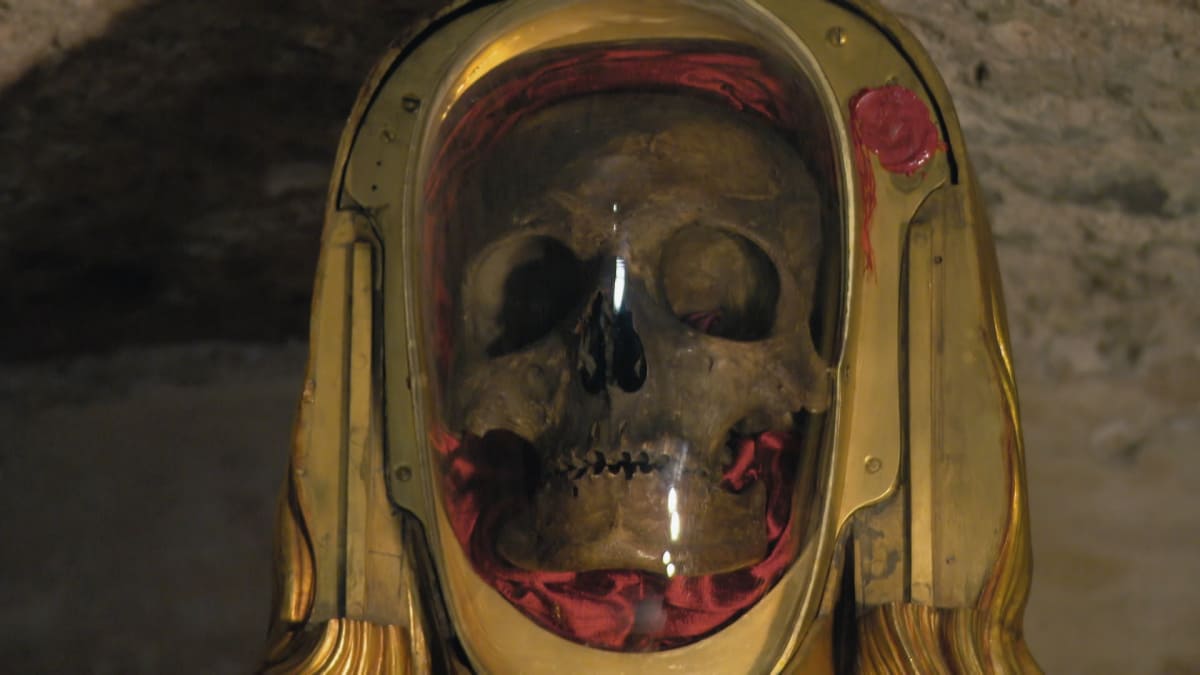
If you’re visiting the South of France, you’ll of course want to stop by Saint-Maximin-la-Sainte-Baume. They have the skull of Mary Magdalene.

There are a lot of Marys in the Bible — specifically, in the New Testament. (There are no Marys in the Hebrew scriptures, but Myriam is the Hebrew version of Mary; and she is Maryam in Aramaic, the language Jesus et al spoke. The Greek translation of the Bible uses Mariam, and in the New Testament, the Greek is Maria.)

Mary Magdalene is not the prostitute. In fact, to make this easy, let’s run through the list of Marys in the New Testament:

1) Mary, the mother of Jesus.

2) Mary Magdalene, or Mary of Magdala. She is not the prostitute. She is a woman whom Jesus heals by casting seven demons out of her. She is described as one of the disciples of Christ, and is a woman of wealth. She financed a lot of Jesus’s ministry work.

3) Mary of Bethany. She is the sister of Martha and Lazarus, who you may remember was raised from the dead by Jesus.

4) Mary of Clopas. Too complicated to get into here. She only appears once, as one of the four women at the cross. James Tabor believes that Mary of Clopas is actually Marym, the mother of Jesus, under her new married name, to a man named Cleopas.

5) Mary, the mother of James and Joseph.

6) Mary, mother of John Mark.

There is also a woman, in the Book of John, who is “caught in the very act of committing adultery” (John 8:4). We don’t know her name. But her story gives us the oft-used quote “Let he who is without sin cast the first stone.” Somehow (and I’ll tell you how in a titch), Mary of Magdala, who just had a case of the demons, got conflated with the woman caught in adultery. And the poor woman caught in adultery somehow (again, in a titch, hold tight) also became a prostitute.

We can blame this on Pope Gregory I.

Gregory was a 6th century Christian, and the 64th pope (not counting the anti-popes). He is known mainly for two things: converting a lot of pagans to Christianity, and, in a series of Easter sermons in 581, rolling Mary Magdalene, Mary of Bethany, and the adulturous woman all into one Mary, who was also a prostitute.

Gregory was wrong to do this.

(Btw, you can visit Gregory’s tomb at St Peter’s Basilica in Rome. He died at the age of 64 without much muss or fuss.)

But back to Mary Magdalene’s skull, kept in the South of France, in the Church of Saint-Maximin-la-Sainte-Baume.

Is it Mary Magdalene’s skull? Maybe! None of our bones, it turns out, have “property of [your name here]” helpfully stamped on them. One thing about religion: it doesn’t have to be true to be believed. And if enough people believe that that skull with the weird golden wig is Mary Magdalene, then, much like the Velveteen Rabbit, it becomes, in a sense, the skull of Mary Magdalene. A sort of transubstatiation, if you will; and if you’re Catholic, you definitely won’t. As it turns out, Truth is less objective than we are probably comfortable admitting. Truth is Time + Consensus.

Humans are a meaning-finding phenomenon in the universe. Something about our brains, maybe, and how we developed consciousness. And meaning shifts, over time, through stresses and accumulation. Certain trees were sacred to certain spirits. Certain wells were tended by gods or faeries or spirits of some kind or other. And there is a transition that starts to happen, historically, in Europe, where Christianity starts to edge out magic as the system of belief. Healing pools that once might belong to a naiad, say, were converted to sites sacred to the Blessed Virgin. Churches were built over spaces that had been previously claimed by other gods. The magic, for what it’s worth, was still in effect; it was just now attributed to Someone Else. Miracle sites were converted from their pagan origins to Christian ones. “You can still worship here, but here is how you will now worship.”

Saint-Maximin-la-Sainte-Baume has Mary Magdalene’s skull. But who knows what god is effecting the miracles attributed to her? The Romans were there before the Christians, and the Romans themselves displaced a Celtic population. The universe is vast and lovely and filled with mystery, and how you pray is how you pray.

Categories
Belief Bible Study Genesis Old Testament Tanakh

On the Origin of Navels and Other Things

Did Adam and Eve have navels is a silly question. They didn’t, for several reasons:

1) Adam was fashioned out of earth, not in a womb, with an umbilical cord. And Eve was fashioned out of Adam’s rib.

2) We think they had navels because in all the paintings of Eden and the first family, Adam and Eve are shown with navels, probably because the models being used for those paintings had navels.

3) Adam and Eve never existed. It’s a folk-tale.

But this navel question has troubled theologians forever, because each question comes value-packed with a bunch of other questions, too.

Question: When Adam was formed from the dust of the ground — how old was he? I mean, yes, sure, technically he was 1 day old. But did God create an infant? Did God create a young man?

Question: If God created Adam as an adult, what memories would he have? Does he have memories? Did Adam and Eve dream at all? That first night’s first sleep — what was that like?

(There’s a midrash about Cain’s offering of the first of the field to God — that Cain, hearing of his parent’s banishment from the Garden, to which they could never return, and which they ached for daily, planted a new Garden, one that he knew would not be perfect, but would maybe be perfect enough. And its the fruits of this harvest that Cain brings to God, and which God rejects, for reasons that are only knowable to God.)

An Even Better Question: Why a penis? Why a vagina? Were the first humans supposed to be procreative? Or did God just have this Peaceable Kingdom in mind with only these exhibits? Adam and Eve never get a chance to have sex, let alone get Eve pregnant, before the Fall. And after the Fall, God’s punishment for Eve is pain in childbirth. How was childbirth expected to happen in the Garden of Eden? Does God decide that making humans is something he’s not good at, so he leaves it to us? Are we any better at making humans?

There are two creation stories in Genesis. Biblical literalists will say that there is only one, told from two points of view, and it would do none of us any good to try to convince them otherwise. But there are two creation stories that don’t entirely line up.

Genesis 1 was written at some point after Genesis 2. Genesis 1 is more liturgical in its tone, with its measured refrain. Genesis 2 is a folktale that was likely already fairly old when it was written down. The Bible — both the Hebrew and Christian texts — didn’t come to us from God in the order that we have it. (And it didn’t come to us from God anyway, but you get what I’m saying.) The Bible that we have now is a political document edited together to make a certain point. (Or, actually, points.)

Interestingly, Genesis 1 and Genesis 2 may not even necessarily be about the same God. When God is written about in Genesis 1, the word used for God is “ʼĕlôhîym” or, less complicatedly, elohim (אֱלֹהִים). Elohim usually refers to the Jewish god, but at other times in the Bible it refers to plural deities. This in itself is interesting because it points us in the direction of a sophisticated way of conceptualizing the divine: it suggests polytheism, because ʼĕlôhîym is plural, in a monotheistic culture/deity: Our God is All gods.

The God of Genesis 2 is referred to as YHWH ʼĕlôhîym. YHWH is also known as the Tetragrammaton. It is believed to be the actual name of God, and is never pronounced out loud. Also, we really can’t pronounce it out loud because Hebrew has consonants but no vowels. The best guess is Yahweh. However, you may notice in your Bible, if you’re a Bible reader, that sometimes the word LORD shows up in all-caps. That’s where the Tetragrammaton appears in the original Hebrew. When Jews are reading their Torah portions in synagogue, they won’t say Yahweh, or spell out Y, H, W, H. Instead they may say “Adonai,” or “HaShem,” or “hakadosh baruch hu” which translates to “The Holy One, Blessed Be He.”)

(Names are a powerful component of magic. Knowing something’s name gives you certain powers over it. If anyone knew and could utter the actual living name of God, it’s not clear entirely what would happen, but it would probably not be good.)

So, we have this majestic opening account, where creation is ordered and systematic. First this, and it was good, then this, and it was good. Actually, in Genesis 1, there are three places where the Bible doesn’t close with “and it was good”:

1) On the first day (Gen 1:3-5), when God separates the light from the darkness, that doesn’t get a corresponding “and it was good.” “it was good” for separating. (Separating isn’t creative, it’s ordering. As Sister Aloysius says in ::Doubt::, “When you take a step to address wrongdoing, you are taking a step away from God, but in His service.”)

2) On the second day, God separates waters from waters, and this is also not labeled as “good.” Here, we get a perfunctory “it was so.”

3) On the sixth day God creates humans, separated into male and female. The humans are blessed (Gen 1:28) — but that’s not the same as being called “good,” is it? Because God sees that “the wildlife of the earth after their kind, and the herd-animals after their kind, and all crawling things of the soil after their kind” were good (Gen 1:25); but humans, though, are not singled out for goodness, only a blessing. Their lives are about to become impossibly hard, with a final separation of human from garden.

In Genesis 2, though, we get the Creation Story as if it were a folktale. And we get some initial challenges to God’s omniscience — a concept that has been read ::into:: the Bible, but is not necessarily verified by the text of the Bible.

After God creates Adam — without a belly-button because Adam has no need of a belly-button — he notices that Adam seems lonely. So God says, “I’ll make a helpmate for Adam.” And he creates animals. And in the story, God proudly presents Adam with a new creature and sort of nods expectantly, like, “Huh? Right? Isn’t this what you’ve been missing?” And Adam, who is very polite, greets each creature with platonic love, names it, and then sort of shrugs sadly at God because while this rhinoceros is very cool, as was the peacock before it and the nudibranch that needed to ::immediately:: be put into water, none of these are helpmates. Put more coarsely: he can’t fuck these animals. He can’t talk to them, tell them about his day (which started literally 15 minutes earlier), sleep cradled together like commas. And then, finally, God says, “Well, let’s try this.” And from Adam’s rib, he makes an Eve.

(Or he makes Lilith, but not out of a rib, and this is from a later tradition than the Garden story. Once upon a time, God created Adam and Lilith, both out of the dust of the ground. Lilith refused to be subservient to Adam, which, good for her; but, however, she’s banished and becomes a demon and/or fucks the archangel Samael, who will later wrestle with Jacob, only I don’t think that happened, I think Jacob actually wrestles with Esau, and we’ll talk about that another time when I feel like it.)

God breaths the Breath of Life — or a soul — into Adam. We don’t know if God breathed a soul into Eve or not. The Bible doesn’t say. She has an innate curiosity and confidence that Adam doesn’t appear to have. The Gnostics revered her as the champion of Wisdom and Knowledge. Christians have used her to blame women for everything forever.

(A final bit of trivia, on the subject of navels: When God is haranguing Job for daring to ask “why?”, God says, “Behold now behemoth, which I made with thee; he eateth grass as an ox. Lo now, his strength is in his loins, and his force is in the navel of his belly.”)