Categories
Belief Bible Study Finding God Jesus Paul

This Far, But No Farther: Paul’s Radical Ecumenism in Galatians 3:28

There is neither Jew nor Greek, there is neither slave nor free, there is neither male nor female; for you are all one in Christ Jesus. (Galatians 3:28)

Temple worship in Paul’s time was highly segregated, but in a complicated way. Everyone was encouraged to worship at Temple (and there’s only the one Temple at this time; cities do not have their own synagogues), but not everyone was allowed to participate fully in worship. There is full segregation based on gender — men to one side, women to the other — and then within this main system of segregation you would have your Greek gentiles apart, and your slaves apart, on either side of that male/female literal and spiritual dividing line. (I have ::frequent:: stress nightmares about being the logistics manager at the Temple in Jerusalem. I’m great at my job of course; but at what price?) And then the Jesus movement happens (we can’t really call them Christians yet), everything gets thrown off balance. The Jesus movement — sometimes called The Way or Nazarenes in the 1st century CE — can’t compete with Judaism’s exclusivity, so it becomes almost radically ecumenical. Women are recognized as disciples, and even do some teaching. (This doesn’t last super long; a movement that is too egalitarian becomes challenging to harness.) And these early gentile followers (which just means “non-Jew” in this case) of Jesus would want to worship in the way Jesus did, at the Temple, because there are absolutely no other places for ritual worship. (There are house churches, but that’s an entirely different form of worship.)

Imagine falling in love, and wanting to spend your days in full communion with your love. You want to almost transubstantiate yourself into your love, and your love into you. Now imagine that the place where you can be closest to your love tells you, “This spot, but no further.” Imagine being denied full participation in the worship of your love. That’s the tension we see between Jews and gentiles. Gentiles want this immediate experience of the Divine — because ::it recently happened within memory::. Paul has an experience of the resurrected Jesus and it utterly shatters his life and blinds him. On the day of Pentecost, extraordinary things happened to the apostles. After years of divine silence, ::something:: was happening, something that included any who wanted to become a part of it. And the Temple is saying, “Okay. But: here. And no further.

“Jesus is a figurehead, in the very first days of his ministry, for an eschatological gospel: the good news of the end of the world. Not how we’re ending the world today, by killing and destroying it. This is an end of temporality: the wicked days are coming to an end, and a new era of righteousness is coming. This is what John the Baptist, likely an Essene, preached. Whether or not you believe the messianic claims made on Jesus’s behalf, he does pick up John’s cross and also preaches a gospel of repentance. Cast off what is harming you, care for those who need caring for, because all of this is going away and you won’t need your hurt any more. “Repent” literally means “turn back” or “turn away from.” (That this ended up ::not:: happening becomes a problem for the Jesus movement, but that’s for another parenthesis.) And this message resonated with Jews and gentiles alike. When Paul is writing his letters to various churches (“no, you’re doing it wrong” or “no, YOU’RE doing it wrong” or “NO, your doing it wrong” or “STOP STOP STOP STOP STOP STOP STOP”) he wants to challenge Jewish hegemony and insists on an almost-egalitarian ideology for these followers of Jesus. (Does he hate women? When have we ever ::not:: hated women? Is he homophobic? Aren’t we all, aren’t we all.) Insisting that categories like “slave,” and “women,” and “Greek” are meaningless within the community of believers, he tells the Galatians, as early as the late 40s CE, that anyone is welcome in worship.


Paul as Pride Grand Marshall is a fun joke. Others have spent useful time trying to either redeem Paul’s homophobia (an anachronistic term that may or may not be fair to Paul), or reify his position. In letters to the Romans, to the Church in Corinth, and to his fellow evangelizer, Timothy, Paul seems pretty clear on his stance about queer identity. Except it isn’t very clear at all. There’s an ocean of time and distance and references separating us from the mind of Paul.

In the ’90s, I worked at an HIV Day Center in Portland, Oregon. Our intake form was invasive, because we want to know the everything of the mistakes a person makes before we help them. We would ask men if they were homosexual.

Some men were! Some men outly and proudly identified as gay. Some men were not! Sometimes angrily not. Sometimes confusedly not. But our form required an additional question, which was: “Have you had sex with other men?” And a what-shouldn’t-be-all-that shocking number of men who did not identify as homosexual answered yes to the “have you had sex with other men” question. Capitalism was only just formulating bisexuality as a means of selling hair-care products to men, and no one could understand how (a) someone could not be a homosexual; and (b) have sex with men.

Is Paul homophobic? It actually doesn’t matter. We don’t need to listen to Paul’s Grand Theory of Moral Sexuality in order to listen closely to what he writes to the Galatians about radical openness. Inconsistency doesn’t affect our rightness, just like rightness doesn’t keep us from doing wrong. If Paul is wrong about women; if Paul is wrong about women and gay people and sodomy and what the church is doing in Thessalonica and even about his own transfiguring experience of the risen Jesus on his way to Damascus; even if he is wrong about all of that, we can still trust fully that whatever the ineffably divine experience of the universe is, it is open to all: to Greeks and to slaves, to queer people and sinners, to people in all their messy splendor, to every piece of creation sidelined as Other.


Categories
Belief Gnostics God Gospels Jesus John Luke Mark Matthew New Testament

The Bad Seed

“verily thou hast done unwisely…vex me not”

The Bible we have is a book in one volume, and so we read it as if it’s a book in one volume. But it’s really a whole bunch of books, and gospels, and pieces of poems, like a Lutheran hot dish, which is why we have Protestantism.

There are more Christian gospels in the world than appear in the New Testament.

Thomas the Israelite1 wrote an infancy gospel, probably in the 2nd century CE. (Or, at least, that’s the guess, and the dating of the earliest primary document.) It’s important to know that something not being written down doesn’t make it illegitimate, any more than something written down is legitimate. No one, from the late 100s to now, has been keen on including Thomas the Israelite’s infancy gospel, or any other infancy gospel, and the excuses are largely about its timing: it wasn’t written down soon enough. It’s almost 200 years after the birth/death of Jesus, and isn’t written by Someone Who Was There. (A gospel being written by Someone Who Was There became a main measuring stick still used today when judging whether something is Bible-worthy or not. Unless it’s by a woman who was there and then we immediately jettison it, so its part of the ecosystem that the species Dans brown live on.) But even today we have books about people written by other people who Were Not There. They’re called history books and biographies.

Infancy gospels would be very important, and a lot of early Christian apologists would have loved to find a legitimate infancy gospel to fill in those missing years where Jesus appears to not do much. (This leads to everything from “Jesus traveled to India and became a Buddhist master” to “he traveled to Arabia in order to become a magus.” As inconsistent as Christian apologists are — and they are very inconsistent — they do grant that they are check-mated here and have no documentation to support their idea that Jesus didn’t do these things. I’ve got more to say about this, but it’s in that footnote you passed.)

Apologists’ inability to believe in infancy gospels doesn’t mean they don’t exist. They do. And the reason apologists might stay away is often insufferably unpleasant.

In the Infancy Gospel of Thomas2, Thomas tells us that Jesus killed the following people:

– The son an Annas, who mucks up a pretty pool Jesus created on the Sabbath, by withering him either like or literally into a fig tree. (You may remember Annas from Jesus Christ Superstar and the song “This Jesus Must Die.” One of the reasons might be because Jesus killed his kid.)

– A kid who bumped into him. (When the kid’s parents complained to Joseph — “What if he blessed people instead of cursing them?” — Joseph had a talk with Jesus, who carefully explained that he was Very Right to kill that kid, and then Jesus blinded his accusers. Joseph tried again to parent Jesus, and Jesus said, “You’re working my last nerve, Joe. Pray you don’t finish.”)

– Probably this other kid named Zeno, who “fell off the roof.” When that kid’s parents told Joseph, Jesus immediately ran to the corpse and brought it to life so it could exonerate him.

In an infancy gospel from the late 600s/early 700s, “Pseudo-Matthew,” Jesus doesn’t kill anyone. Instead, no one can eat unless Jesus is at the table, and when Jesus isn’t at the table no one eats. Also, Jesus is surrounded by “the brightness of God” day and night which would make him impossible to share a room with.

The Syrian Infancy Gospel (c. late 400s) shows that people keep dumping dirty Jesus water on sick kids, with miraculous results. No little amount of time is spent cataloging attempts by people trying to steal the bathwater to throw on lepers. (There’s also a dragon in this gospel which is defeated with some of Jesus’s soiled laundry.)

Later, Jesus becomes angry with some boys who are too good at hide-and-seek so he turns them into goats. Oh, and one time Jesus dressed himself up as a king and made his friends drag people from the road to honor him.

The Divinity of Jesus

There are competing theories in the gospel about the Divinity of Jesus. You may not know that there are competing theories, because the New Testament is presented as unified and inerrant. But you’ve got your Incarnationists over here, and your Adoptionists over there, and here’s how they differ.

Incarnationists believe that God was incarnated on Earth in Jesus, who also existed with God from one moment before the beginning of everything. So actually, there’s a schism right there with the Incarnationsts. Some believe that Jesus only existed from the beginning in the way that your ability to pull off a convincing English accent existed from birth: something you could do, but not something you were always doing. Jesus is a unique experience God has on earth. And then some, like, for instance, the writer of the Gospel of John, believe that Jesus and God are the same, and have always existed, but are separate, but not different, and God has always been God and Jesus, and Jesus has always been Jesus and God. For this narrative, btw, you need to fix a bunch of plot holes; but because the plot holes are terminal plot holes, fixing them only makes everything hole-ier. For instance, if Jesus is divine from the very beginning, he needs a pristine and spotless womb. And a pristine and spotless womb cannot even have caught a flashing glimpse of a penis let it be awashed in schiaparelli sin and that’s absolutely no house for a savior. But we also have Original Sin to contend with. How spotless and pristine can a womb be if its bearer is tainted? So now we have to remember that Mary was conceived without original sin. But she can’t be supernatural — that doesn’t exist. She’s not divine, or demi-divine. Except when she is. She’s a human woman, because Jesus has to be born of a human woman. But she has to be so extraordinary as to almost negate her humanity. And then if this were a sonata, I’d put one of those repeat signs so you would know to go back and repeat this again, every 50 years, until you die.

It’s bonkers.

Adoptionists believe that Jesus was born entirely human. Mary is human, Jesus is human, God is God, and doesn’t notice Jesus until (a) his baptism in the Jordan by John; (b) his crucifixion; or (c) his resurrection. In this case, God notices how great Jesus has been and gives him Employee of the Year. The Gospel of Mark in the New Testament is an Adoptionist gospel. (People will argue with me and I just won’t listen.) Mark knows nothing about Jesus’s birth, the angels, the annunciation, the magi, the stars. Mary, his mother, is mentioned only once and she has no speaking lines. Jesus becomes divine at the moment of baptism, when the “heavens [are] torn apart,” the Spirit descends (who is this “spirit”? Another time, my ducks), and a voice comes from haven, saying, “You are my Son, the Beloved; with you I am well pleased.” (All quotations from Mark 1:9-11 in the NRSV.)

Matthew and Luke are also sometimes viewed as Adoptionist. Jesus does not become divine until Mary conceives. Matthew and Luke do not say anything about Jesus’s eternalness. So we’ll add a (pre-a) to the above list and say “until his conception.”

John is the only wholly Incarnationist gospel we have in the New Testament.

This is a little bit of an issue for the gap we have when we take all gospels together. Combined, here is what we know:

pre-birth to birth: check
1ish to 12: absolutely nothing
12: check (he’s a rabbi now)
12 to 29: absolutely nothing
30 to 33: busy

We have nothing in the New Testament that fills those gaps. If Jesus was an incarnation of God — God made Flesh — you’d think that would be remarked on. Initially some very excited shepherds visit. We get some Persian magician-spies. And that’s it. This extraordinary event — a magical star, angels everywhere, prophecies — is forgotten. Kinda like the One Ring, I guess? But not really. Here’s a kid, born of a young woman, who might or might be a virgin depending on how you translate, and he’s not lying at the bottom of a river covered in silt. He’s around! He’s in his community! And unlike the way we’ve pubertized magic in popular culture, where wizardy kids don’t have control over their sexua– sorry, magic, until pubert– sorry, until they learn to control their orgas. Shit. Unlike that, there’s no sense that Jesus has to “control his powers” because Jesus is God and God is not a horny teen witch. (Unless he is!)

So if we’re to understand Jesus in an Incarnationist context, this knowledge gap is puzzling. However, if we are rational Markan Adoptionists, then that gap is explained by an entire Portnoise of all the very boring same things that all teens do. He’s not the Christ yet. He hasn’t been adopted by God down by the river.

Infancy gospels are an Incarnationist genre. They’re wild, and I love them. They’re also necessary for belief, but not convenient for it. They sit uneasily next to stories of Jesus’s meekness and humility, and run counter to his own ambivalence about his divinity. They’re flawed portraits by flawed people, looking for a savior who might look like them.


Footnotes

1 Some of you may know about the gnostic Secret Gospel of Thomas. Thomas the Israelite, to whom this infancy gospel is attributed, is not that Thomas. Unless he is. But mostly probably not.]

2 None of the gospels we have — both in the New Testament and those left out — came with titles. They didn’t have chapters or verses, either. All of that stuff is added later, and titles like Pseudo-Matthew were/are used primarily to scare people away and reaffirm that they’re Not Really Gospels. But they are.

Categories
Uncategorized

“we medicate the mysterious, and in relieving suffering, take its meaning away”

In a collection of reviews by Hilary Mantel (the best writer in the history of all languages, spoken, unspoken, yet to be spoken, never to be spoken), this passage is really worth our time, especially in relation to the ways in which we do and don’t believe.

[Background: She’s reviewing a biography of Gemma Galgani, a woman made a saint in 1940. (Mantel also considers a bio of Thérèse de Lisieux.) It’s an alchemical process, this refining and transmuting of the soul until all it can be is the golden nature of God at work in the world. And, as happens with alchemy, there’s violence to the material; saints flock to mortification as lambs to slaughter. (“Eustochia of Messina stretched her arms on a DIY rack she had constructed…St Angela of Foligno drank water contaminated by the putrefying flesh of a leper.”)]

At the heart of Bell and Mazzoni’s endeavour is an understanding that a phenomenon may retain spiritual value, even after its biological and psychological roots have been uncovered. To describe the physical basis of an experience is not to negate the experience, as William James pointed out long ago. But now that neuroscience has such excellent tools for envisaging and describing the brain, we are tempted to accept descriptions of physiological processes as a complete account of experience. We then go further, and make value judgments about certain experiences, and deny their value if they don’t fit a consensus; we medicate the mysterious, and in relieving suffering, take its meaning away.

“The Hair Shirt Sisterhood,” London Review of Books (4 March 2004)

The question of meaning in suffering naturally springs to mind; through a glass compassionately, the question may even feel necessary. We don’t want to see someone suffering needlessly, and we especially don’t want to see someone suffering for something we’ve cataloged as nonsense. We don’t see our own values as subjective when we feel we have the additional authority of, say, science, or data, behind it.

I think this sentence in the passage quoted above is especially useful: “[A] phenomenon may retain spiritual value, even after its biological and psychological roots have been uncovered.

For this next trick, I’m going to relate dementia with demonic possession. Now, we’ve never met before, right?

A “controversial” therapy for people with dementia is acceptance. (“Controversial” because there are some professionals who feel it’s unethical to lie, especially to someone whom we’ve categorized as vulnerable, in any situation; that truth somehow has a moral component to it that necessitates its primacy.) Rather than challenging someone about their experience — they tell you that they went to a wedding today; you know that they’ve never left the house — you accept the experience. “I bet it was a beautiful ceremony,” you might say. “What did you eat? What did the groom wear? Were they cheap or did they spring for an open bar?” The truth, in this case, doesn’t matter. It’s the belief that matters. And besides, that wedding is as true for the person with dementia as the fact that they’ve not left the house at all is true for you.

Which is why exorcisms actually (sometimes) work? We won’t get into whether or not a literal demon was expelled from a human body. But if your frame of reference and your system of belief includes the chance for evil spirits to inhabit a person, working with them to not believe that is not your job and robs the person of their experience of the world. It doesn’t have to be your experience for it to be valid. And it doesn’t have to be true to be believed. So exorcisms ::do:: bring relief to some people. (And medical surgeries can backfire and people are allergic to all matter of serums, treatments, unguents, and the like. There’s no treatment with a 100 percent success rate except abstinence.)

Exorcisms also will spectacularly not work*. Those tend to be the cases that make it into various media with their accompanying criminal charges. In Germany, in 1976, Anneliese Michel’s parents and priest were charged with negligent homicide when Michel died under exorcismic care. The state alleged Michel died of malnutrition and dehydration, sanctioned by her parents and priests. Her parents and priest averred that her symptoms were demonically caused, and that because of the lengthy exorcism, she died free of possession. The prosecution relied on Michel’s diagnosis of epilepsy and accompanying mental illness. The defense introduced tapes of the exorcisms where demonic voices can be heard among the rites and screams.

[* In the 21st century, exorcisms in Sri Lanka, America, New Zealand, and Romania, among a host of others, ended with the death of the possessed person. And while that is interesting, if you’re interested, it is also worth paying attention to the fact that women, more than men, die during these rites that span religious practices and beliefs. Men, more than women, use demonic possession as a defense in criminal trials and explanations for their actions.]

In America, the number of preventable deaths of hospitalized patients range from 22 thousand at the low end, to as high as 250 thousand. (A doctor named Benjamin Rodwin challenges the high numbers in a 2020 paper, “Rate of Preventable Mortality in Hospitalized Patients: a Systematic Review and Meta-analysis.“) Numbers for preventable deaths of possessed people are not tracked in any systemic way, though one would imagine those with an interest in medical data would put the number at 100 per cent. Exorcisms, unlike hospital visits, rarely leave a paper trail, however, so a true analysis of these data is unlikely.

But medical care in hospitals remains popular, even with the risk of death and infection. Similarly, exorcism remains popular with believers because, for the most part, exorcisms work. How they work is, of course, where differences will crystalize. And we find ourselves back where we started, with the word “truth” sitting uneasily next to “belief,” which has taken its shoes off and is eating something obnoxious. Truth has no value in these questions, because these aren’t questions of truth, and both sides are very sure that what they’re doing is truthful. What does have value is the belief, and what we’re left with is the question of a person’s dignity, a person’s autonomy, and a person’s right to believe seven impossible things before breakfast.

Each of us lives within a context equal parts our own making, and forced on us. It is impossible even to definitively declare what is self-directed and what is the only avenue left because of social circumstance. Middle and upper class women in the 19th century fainted with an alarming frequency not necessarily because their corsets were too tight, or the air was bad, or their diet too rich (though all those things could absolutely be true). Fainting and illness was a means of controlling their own narrative. Unpleasant conversation, unpleasant news, unpleasant circumstances offered wonderful opportunity for a swoon in a puddle of whalebone and crinoline. (Working class women and dairy maids fainted far less because who would do they work if they did? Illness is a vacation afforded only to the well-to-do.) Men writing in the early to mid 20th century were so worried about the appearance of emasculation — so many men had gone to war and died heroes, or gone to war and returned heroes — that they overperformed masculinity to the point where Norman Mailer confused a knife with his penis and stabbed his wife. Twice. Even if there is something that exists called “better behavior,” it would be a challenge to enforce without significant changes to the underlying social conditions and pressures. As the philosopher Abigail Thorn says, even if one performed better behavior perfectly, one would still be performing it within a context that privileges one type of experience and expression over another. And when an individual exists within contexts that are not of their creation, what authority do we have to tell them that what they are doing is wrong?

Gemma Galgani dissolved into religious ecstasy with a regularity that allowed her sister to bring friends home to watch. She bled from her hands and feet and her aunt complained about the stains. The context that made sense to her was one of religious suffering; this is what she knew her purpose to be. Priests tend the flock, saints protect them, and religious ecstatics “drink pus from cancerous sores” (as Catherine of Siena did), lick the floor in cross-shaped scrapes of the tongue until it bled (Bartolomea Capitanio), or die of starvation to satiate the poor (Margaret of Cortona — and before you judge Meg, consider the effectiveness of any number of programs designed to feed the hungry). Within their own context and within their own words, they were not coerced into these actions, except coerced by a deep love for God. “Many Theresas have been born who found for themselves no epic life wherein there was a constant unfolding of far-resonant action,” George Eliot writes in Middlemarch. If one does find an epic life for oneself, who has the authority to deny that calling?

The religious context rubs a blister against the rational context, and the rational context thinks only of its blister, and how to treat it. It doesn’t matter which is true; it should matter which is believed.

Categories
Blog SotD

The Brown Scapular of Our Lady of Mount Carmel

Our story starts in the 13th century, with a man named Simon Stock. He will eventually become a saint (though he may never have existed, which is a trick some saints do; and then again, he may have absolutely existed, since parts of him are scattered throughout Europe, with some bones in Bordeaux, a tibia in Kensington, and part of his skull that he no longer needed, resting in Aylesford), but he isn’t when we meet him, on 16 July 1251, experiencing a vision of the Holy Mother, a brown scapular in her hand, and a promise that anyone wearing it would be delivered from Purgatory (if to Purgatory they were sent) on the immediately subsequent Saturday, which was the Holy Mother’s day to run errands, selecting the not-yet-holy who sported the divine object.

the Holy Mother presenting Simon Stock with the brown scapular

(You are asking, because you aren’t Catholic, and neither am I, what is a scapular? My first encounter was when Zach’s Aunt Sue gave him one for Christmas and I thought it was a bookmark and it absolutely isn’t. The term derives from the Latin for shoulders, and there are two kinds: devotional and monastic. Scapulars, that is. There are two kinds of scapulars and only one kind of shoulder I am not an anatomist. Aunt Sue, who left convent life after Vatican II when the Church became “too liberal” and she worried she’d be expected to play folk music on a guitar, gave Zach a devotional scapular, which you’ll see pictured, and you, too, will say, in your Best Baptist, “That is absolutely a bookmark.” But you wear it, I promise, with one end over your chest, and one end down your back. Monastic scapulars look like something women of a certain age would buy at Elaine Fisher as they blossom and bloom into the sorceresses all women become eventually. They’re both holy garments, like what Mormons wear, only older, and with not as much secrecy. As of this writing, there is no porn where scapulars play a significant role. There are, however, entire series devoted to getting young Mormon boys out of their spiritual underwear.)

Later, after Simon’s vision of the Holy Mother, even after his death in 1265, if he died, Pope John XXII in 1322 issued a Papal Bull titled Sacratissimo uti culmine. Pope John XXII, whose human name was Jacques d’Euse, and who fretted about witchcraft, having believed himself the target of an assassination attempt by poison and sorcery, also claimed a vision of the Holy Mother, telling him about her deal with Simon (who, if he existed, still isn’t a saint yet at this point), and that he, Pope John XXII, should tell the world to buy brown scapulars, both devotional and monastic, drink Ovaltine, and elevate the Carmelite Order above all others, because of this gift of fabric and promise.

gals, on the town, casting spells and brewing poisons and coming for your man

(Do we have a copy of this Bull? No we do not. But things get lost and the Vatican is large and we’ve lived in our house for over 15 years and there are boxes we haven’t unpacked so one feels generous with one’s patience, and simply lives in hope. Yet also it seems important to also mention that Jacques was, for a time, a fervent non-believer in the Beatific Vision — the ultimate union of the soul to God — and so, if he did write this Bull that no one can find, yet, he must have done it later, when he calmed down about Beatific Visions, and agreed that those who died in grace immediately enjoy a glimpse of God.)

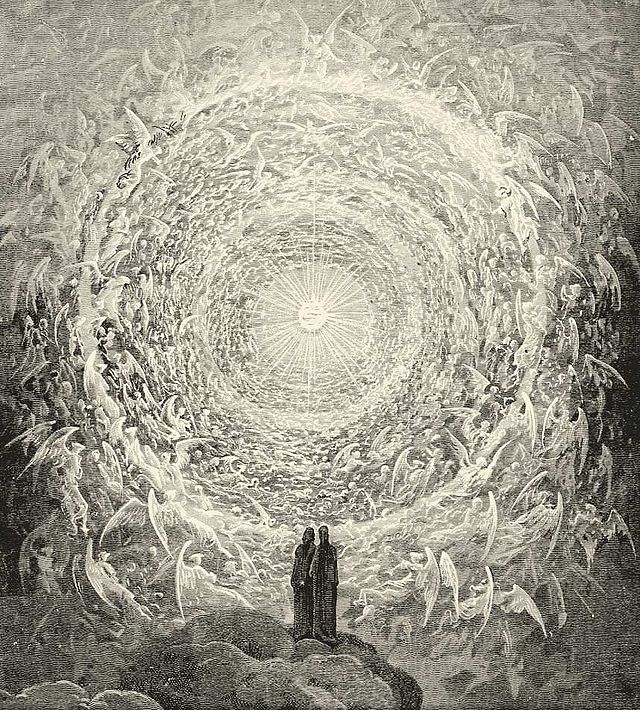
Gustave Dore’s image of the Beatific Vision for Dante’s Paradiso

(This, too, feels parenthetical, but John XXII had a counter, an anti-pope, Nicholas V, set up in papal finery by the King of Bavaria, a land that only exists in our hearts, even though the literal land of Bavaria is still there, or the memory of the land, since you can’t step into the same river twice, and you can’t trust land, either, after seven hundred years, to be where you left it, so that physical space is as liminal as sacred space. Nicholas is eventually excommunicated by XXII, but he pled so eloquently for forgiveness that John showed mercy on him, absolving him of the excommunication, and held him in honorable imprisonment, in Avignon, which is fun to say, Avignon, until Nicholas’s death in 1333.)

the Anti-Pope, Nicholas V

Eventually, no one believed in Saint Simon, even with his jigsaw puzzle of a body, and no one believed in Pope John XXII’s Papal Bull. They — a list to long to list — said, “It’s a nice story.” They said, “It’s a metaphor.” And now official Church teaching is that the Sabbatine Privilege — that is, the privilege to wear brown and get out of Purgatory — is not official Church dogma at all. A man named Patrick, a good Catholic name, said in 2001, “People are free to believe it if they wish, but we cannot say that the Church teaches it.”

Patrick McMahon, O.Carm

There is a Carmelite monastery in Colorado where one can, through the Internet, purchase a brown scapular. It comes with an instruction manual that proudly announces its belief in Saint Simon Stock (who is believed to have slept in the hollowed-out trunk of a tree, by the way, which accounts for his last name). It also says, “Without saying to Mary that we venerate her, love her, and trust in her protection, we tell her these things every moment of the day by simply wearing the scapular.” Because we all of us are busy, but we all need to get dressed.

Categories
Blog

A.N. Wilson is Not Good

A friend is reading A. N. Wilson, The Mystery of Charles Dickens.  He is finding it “delicious,” but knows nothing about the subject.  Have you read it?  Any thoughts?  Wilson is often controversial, is he not?

from an email Steve sent me last night

Oh boy. A.N. Wilson. [takes a long drag off a candy cigarette] That’s a name I thought I’d left far behind me.

Because sometimes the long way is the best way I’ll just ramble before arriving at the point. My first Wilson was The Victorians, which I bought in the early 2000s, because I was beginning my fascination with the era. (And I am not sure if you know this story or not, but all of this [gestures at my shelves of 19th century history and sociology] began with an impulse purchase of Wilkie Collins’s The Woman in White. First off, the author’s name was ridiculous, as if someone were trying to parody a Gilbert & Sullivan operetta or introduce a landlord character into the Hundred Acre Wood. The title was also very intriguing: were there other colors she looked at in the morning? Did she know the night before that, before buying the flowers for herself, she would wear something in a white? Was it actual white, or an off-white? Was it ivory? Shades of vanilla? So much depends, etc. etc. Anyway, the opening line of The Woman in White sold me entirely: This is the story of what a Woman’s patience can endure, and what a Man’s resolution can achieve. And then, when I looked up the author, expecting him to be swallowed in high collars and I don’t know, the son of a vicar or a boatswain — something that sounded really English — instead I saw a small toad of a man, with a bulging forehead, a very necessary beard, and a delightfully perverted story. This revelation ran so counter to my $200-level-question-on-Jeopardy! understanding of the 19th century, which I was assured was filled with moral prigs only doing right and it was exhausting, that I bought a biography of Collins (by Catherine Peters), read about how counter-culture his life was (two separate households with two women whom he didn’t want to marry but whom he deeply loved), and thought, “Wait a minute.” And then I started reading deeper into that hundred-something-year period and reached my absolutely facile theory of Performed vs Lived morality.) It was large, which felt right to me: I wanted something with a lot of pages because, like McTeague, quantity equaled value. (In McTeague, the title character buys a painting with a lot of figures in it because he feels like he’s getting more than his money’s worth.) And I read…a lot of it. I haven’t finished it. It’s 20 years later and my bookmark is still somewhere around the half-way mark. I found other books, better books; and also realized that biography was actually a more informative way to understand particular eras — because what became very clear to me is that we can’t look at the 19th century as a single thing. (Well, now, writing that I want to hedge a little: there is something to a 19th century novel that is sort of  Platonic (I used that right, right?); but — and now I’m back to my original “all 19th century novels are not the same” point: novels coming out of the 1830s are vastly different than those in the 1850s, than those in the 1870s, than those in the fin de siècle. They reflect different pressures, different mores, and different audiences.) My keenest interests in the 19th century are the 1850s-1860s, which sees the rise of the sensation novel; and then post-Dickens literature, both because we start to see explicit criticisms of the century as a whole, and because an incredibly powerful voice for the poor ceased speaking.

So we don’t get some of Victoria’s later cattiness, like when one of her ladies-in-waiting (for what? the vote? a guilt-free cheesecake recipe? men to give up pretending and just admit that they have no idea what they’re doing down there?)

My last serious attempt to read Wilson was his biography of Queen Victoria, which is terrible, stick with Stanley “Bitchy Gossip” Weintraub, the American heterosexual Lytton Strachey. Wilson, a man, views the young Victoria as bratty and whiny, and unfair to her mother and her mother’s (allegedly not but come on) boyfriend John Conroy (who, by the way, was taking one for the team by seducing Victoria’s mother because he saw the hope of a regency that he would be the driver of, and once burrowed in like a tick, it would be tough to extract him, even if you held a match to his butt, like my mom taught us, which is how I got burned once on my inner thigh). Her mother and Conroy had devised a system, the Kensington System, that essentially stripped all agency and power from the child Victoria. She was allowed no playmates (because who was worthy enough to be the friend of a monarch-in-waiting?), no real outings, and slept in her mother’s room, even through most of her puberty. All of this, Wilson wipes away with, “Kids, amirite?” (Also, too, he just isn’t…gay? Enough? I mean, all Englishmen are gay, and everyone in England is an actor who has appeared in EastEnders or played Miss Marple (or both), so these gay Englishmen who perform heteronormativity are just really good at disappearing into the role. Except Wilson. So we don’t get some of Victoria’s later cattiness, like when one of her ladies-in-waiting (for what? the vote? a guilt-free cheesecake recipe? men to give up pretending and just admit that they have no idea what they’re doing down there?) developed stomach cancer, but Vicky and her first prime minister, Lord Melbourne, who kept getting caught in sex scandals, so he’s essentially the Bill Clinton of the 1830s, spread this rumor that Lady Flora Hastings was pregnant, probably with John Conroy’s love-child, and then, when Lady Flora dies, of the aforementioned stomach cancer, Victoria still claims, “But you totally get that she looked pregnant, right?”

I actually didn’t know that Wilson had written a biography of Charles Dickens. In the future, everyone will write a biography of Charles Dickens for 15 minutes. I am burdened with Too Much Knowledge, so a title like The Mystery of Charles Dickens isn’t going to do much for me, unless it is discovered that Dickens was actually Rosina Bulwer Lytton pulling a long prank on her husband by being a better writer than he was. (Rosina was married to Edward Bulwer Lytton of “It was a Dark and Stormy Night” fame, and they were always divorcing, and one of Rosina’s favorite things was to disguise herself as a costermonger and mingle at the back of public readings Edward was giving, and then she’d throw fruit at him. Also, in a neat bit of coincidence for this email, she told people that she was the model for the woman in white in the novel The Woman in White (she didn’t wear a lot of white, p.s.) and that the villain of the novel, Count Fosco, was supposed to be based on Edward, only Wilkie was unable to truly capture how evil Edward was so she considered the novel a failure as a novel, but an excellent entree into any conversation.) But I just looked at the book on Amazon and there is no mention of this so I will assume I know all the mysteries of Charles Dickens. Besides, the book is only 368 pages. Mysteries take time. Our mutual friend Keats wrote, “The point of diving into a lake is not immediately to swim to the shore, but to be in the lake, to luxuriate in the sensation of water. You do not work the lake out, it is an experience beyond thought.” And that’s why the only biography of Dickens you need is Peter Ackroyd’s 1200 page opus where, periodically, he just throws in an imaginary conversation he, Ackroyd, is having with Dickens and other writers of the period. It’s bonkers and makes no sense, but telling someone’s life linearly doesn’t make any more sense so why not? Ackroyd is blind to Dickens’s faults often, but in a way where you, the reader, are not, so you’ll find yourself saying, “Pete, Pete, Pete,” and there you are in your own imagined conversation with Peter Ackroyd and everything is an ouroborus eating itself.

But if your friend is finding Wilson’s slight bio of Dickens “delicious” I could also suggest some books on the Fasting Girls of the 19th century, who also felt self-satisfied, subsisting on so very little.