Categories
Belief Bible Study Genesis Old Testament Tanakh

On the Origin of Navels and Other Things

Did Adam and Eve have navels is a silly question. They didn’t, for several reasons:

1) Adam was fashioned out of earth, not in a womb, with an umbilical cord. And Eve was fashioned out of Adam’s rib.

2) We think they had navels because in all the paintings of Eden and the first family, Adam and Eve are shown with navels, probably because the models being used for those paintings had navels.

3) Adam and Eve never existed. It’s a folk-tale.

But this navel question has troubled theologians forever, because each question comes value-packed with a bunch of other questions, too.

Question: When Adam was formed from the dust of the ground — how old was he? I mean, yes, sure, technically he was 1 day old. But did God create an infant? Did God create a young man?

Question: If God created Adam as an adult, what memories would he have? Does he have memories? Did Adam and Eve dream at all? That first night’s first sleep — what was that like?

(There’s a midrash about Cain’s offering of the first of the field to God — that Cain, hearing of his parent’s banishment from the Garden, to which they could never return, and which they ached for daily, planted a new Garden, one that he knew would not be perfect, but would maybe be perfect enough. And its the fruits of this harvest that Cain brings to God, and which God rejects, for reasons that are only knowable to God.)

An Even Better Question: Why a penis? Why a vagina? Were the first humans supposed to be procreative? Or did God just have this Peaceable Kingdom in mind with only these exhibits? Adam and Eve never get a chance to have sex, let alone get Eve pregnant, before the Fall. And after the Fall, God’s punishment for Eve is pain in childbirth. How was childbirth expected to happen in the Garden of Eden? Does God decide that making humans is something he’s not good at, so he leaves it to us? Are we any better at making humans?

There are two creation stories in Genesis. Biblical literalists will say that there is only one, told from two points of view, and it would do none of us any good to try to convince them otherwise. But there are two creation stories that don’t entirely line up.

Genesis 1 was written at some point after Genesis 2. Genesis 1 is more liturgical in its tone, with its measured refrain. Genesis 2 is a folktale that was likely already fairly old when it was written down. The Bible — both the Hebrew and Christian texts — didn’t come to us from God in the order that we have it. (And it didn’t come to us from God anyway, but you get what I’m saying.) The Bible that we have now is a political document edited together to make a certain point. (Or, actually, points.)

Interestingly, Genesis 1 and Genesis 2 may not even necessarily be about the same God. When God is written about in Genesis 1, the word used for God is “ʼĕlôhîym” or, less complicatedly, elohim (אֱלֹהִים). Elohim usually refers to the Jewish god, but at other times in the Bible it refers to plural deities. This in itself is interesting because it points us in the direction of a sophisticated way of conceptualizing the divine: it suggests polytheism, because ʼĕlôhîym is plural, in a monotheistic culture/deity: Our God is All gods.

The God of Genesis 2 is referred to as YHWH ʼĕlôhîym. YHWH is also known as the Tetragrammaton. It is believed to be the actual name of God, and is never pronounced out loud. Also, we really can’t pronounce it out loud because Hebrew has consonants but no vowels. The best guess is Yahweh. However, you may notice in your Bible, if you’re a Bible reader, that sometimes the word LORD shows up in all-caps. That’s where the Tetragrammaton appears in the original Hebrew. When Jews are reading their Torah portions in synagogue, they won’t say Yahweh, or spell out Y, H, W, H. Instead they may say “Adonai,” or “HaShem,” or “hakadosh baruch hu” which translates to “The Holy One, Blessed Be He.”)

(Names are a powerful component of magic. Knowing something’s name gives you certain powers over it. If anyone knew and could utter the actual living name of God, it’s not clear entirely what would happen, but it would probably not be good.)

So, we have this majestic opening account, where creation is ordered and systematic. First this, and it was good, then this, and it was good. Actually, in Genesis 1, there are three places where the Bible doesn’t close with “and it was good”:

1) On the first day (Gen 1:3-5), when God separates the light from the darkness, that doesn’t get a corresponding “and it was good.” “it was good” for separating. (Separating isn’t creative, it’s ordering. As Sister Aloysius says in ::Doubt::, “When you take a step to address wrongdoing, you are taking a step away from God, but in His service.”)

2) On the second day, God separates waters from waters, and this is also not labeled as “good.” Here, we get a perfunctory “it was so.”

3) On the sixth day God creates humans, separated into male and female. The humans are blessed (Gen 1:28) — but that’s not the same as being called “good,” is it? Because God sees that “the wildlife of the earth after their kind, and the herd-animals after their kind, and all crawling things of the soil after their kind” were good (Gen 1:25); but humans, though, are not singled out for goodness, only a blessing. Their lives are about to become impossibly hard, with a final separation of human from garden.

In Genesis 2, though, we get the Creation Story as if it were a folktale. And we get some initial challenges to God’s omniscience — a concept that has been read ::into:: the Bible, but is not necessarily verified by the text of the Bible.

After God creates Adam — without a belly-button because Adam has no need of a belly-button — he notices that Adam seems lonely. So God says, “I’ll make a helpmate for Adam.” And he creates animals. And in the story, God proudly presents Adam with a new creature and sort of nods expectantly, like, “Huh? Right? Isn’t this what you’ve been missing?” And Adam, who is very polite, greets each creature with platonic love, names it, and then sort of shrugs sadly at God because while this rhinoceros is very cool, as was the peacock before it and the nudibranch that needed to ::immediately:: be put into water, none of these are helpmates. Put more coarsely: he can’t fuck these animals. He can’t talk to them, tell them about his day (which started literally 15 minutes earlier), sleep cradled together like commas. And then, finally, God says, “Well, let’s try this.” And from Adam’s rib, he makes an Eve.

(Or he makes Lilith, but not out of a rib, and this is from a later tradition than the Garden story. Once upon a time, God created Adam and Lilith, both out of the dust of the ground. Lilith refused to be subservient to Adam, which, good for her; but, however, she’s banished and becomes a demon and/or fucks the archangel Samael, who will later wrestle with Jacob, only I don’t think that happened, I think Jacob actually wrestles with Esau, and we’ll talk about that another time when I feel like it.)

God breaths the Breath of Life — or a soul — into Adam. We don’t know if God breathed a soul into Eve or not. The Bible doesn’t say. She has an innate curiosity and confidence that Adam doesn’t appear to have. The Gnostics revered her as the champion of Wisdom and Knowledge. Christians have used her to blame women for everything forever.

(A final bit of trivia, on the subject of navels: When God is haranguing Job for daring to ask “why?”, God says, “Behold now behemoth, which I made with thee; he eateth grass as an ox. Lo now, his strength is in his loins, and his force is in the navel of his belly.”)
Categories
Bible Study Genesis Old Testament Tanakh

Abraham & Isaac

Once upon a time, in the Bible, God and Abraham were having a conversation. God was explaining how he needed to destroy Sodom and Gomorrah, and Abraham was explaining how he shouldn’t do it.

It’s the afternoon, we’ll say, and there is a beautiful sunset, and God and Abraham are standing on a small rise that looks out over a wide plain, and down towards Sodom. This image would hold some significance for Abraham. He has been promised, on multiple occasions, that God will make of him a Great Nation. He has asked Abraham to count the stars in the sky. He has asked him to number the grains of sand. He has shown him wide vistas and said, “This is all for you and your descendants.” All of these are approximations of the legacy Abraham will leave behind. God has asked Abraham to count the stars and number the grains of sand, but at the point of this conversation, this bargaining with God, Abraham has only one child, a boy, Ishmael, whom he fathered with his wife’s handmaid, Hagar. Also, during this conversation, Abraham is 100 years old and his wife, Sarah, is 90.

Earlier in the day, when God appeared to Abraham as three visitors, God tells Abraham that within the year, Sarah will have given birth to a son. Sarah, overhearing this, laughs a little, laughs the quiet part out loud, because, as she says, “I am past childbearing age, and my husband is very old. Am I to have this great pleasure?” But God insists, and tells Abraham that there is a child on the way, and he will be named Isaac.

God then, in need of a listening ear, maybe, or just in the way sometimes God gets lonely (he calls out plaintively for Adam and Eve when they have hidden themselves, and their nakedness, from him) and needs companionship, reveals the plan to destroy Sodom and Gomorrah. The sins in these cities are too great, God says. Something has to be done, God says. Raze it all and salt the earth. Abraham argues, though, that if there are 50 righteous people in Sodom, that it should be spared. That if there are 45 righteous people, that it should be spared. And we go to 40, and then 30, and then 20, and then 10. And God says, “For the sake of 10 righteous people, I will not destroy it.”

Abraham, who has lied twice about his wife being his sister (which is not technically a lie since she is his half-sister) so as to avoid any kind of punishment or murdering because of how beautiful his wife is, has the audacity to question God, and even chide God a little: “Far be it from you to do such a thing—to kill the righteous with the wicked, treating the righteous and the wicked alike. Far be it from you! Will not the Judge of all the earth do right?” This has to sting a little, because, actually, yes, God did, at one point in his history, kill the righteous with the wicked when he flooded the whole earth to punish mankind. God is at his most human in the Hebrew Bible.

Sarah does have a baby, a boy, and she does name him Isaac, which means “laughter” or “he laughs.” It’s a bit of a joke, reminding Sarah that she laughed at the idea of ever having a child of her own. But Sarah also describes Isaac this way: “God has brought me laughter, and everyone who hears about this will laugh with me.”

(How important are Bible citations to you? I’m running through this essay without them because I think they can be interruptive. But if you need ’em, let me know.)

Like most family stories, this one is messy. We’re not even really going to touch on the whole Ishmael of it all, but there’s Ishmael, Abraham’s son, whom Sarah wants banished after the birth of Isaac. All of Sarah’s attention, and all of Abraham’s attention, is on Isaac. (This is a little exaggerated. When Abraham is told by God that Sarah is going to bear a son, Abraham says, “If only Ishmael would live before You!” — in a sense, saying, “I am perfectly happy having Ishmael as my heir. I don’t need another. But God insists, the way God do.)

The most important thing to know about Isaac is that he will soon become entirely a product of trauma. We can read these stories and look for nuggets of hidden truths and Biblical understanding; but we can also just read these stories as stories. Here is a family, here is a terrible request, and on the other side there isn’t a family any longer.

God calls to Abraham, and Abraham says, “Here I am.” God tells Abraham, “Take your son, your only son Isaac, whom you love, and go to the land of Moriah, and offer him there as a burnt offering on one of the mountains that I shall show you.”

And, again, the messiness of the family dynamics ring so true, even to modern ears. God himself ignores Ishmael, and calls Isaac Abraham’s only son. Sons do not fair well in the Hebrew Bible, especially first-born sons. Cain and Abel couldn’t work it out. Ishmael is not considered Abraham’s heir, but Isaac is. Isaac’s sons, Jacob and Esau, are also at odds with each other. Then we get to Joseph and no one likes him. This denial of Ishmael will have consequences later.

God calls to Abraham, tells him to offer his son as a burnt sacrifice, and Abraham sets off the next morning. There is no bargaining this time with God. Why? There is no countering or arguing; no demand for an explanation as to how, exactly, Abraham is going to establish a strong line when one son is banished and the other is dead.

Religious scholars and a certain type of church-y person will say that the story of the Binding of Isaac is about Abraham’s absolute trust in God, and Abraham’s willingness to do anything asked of him. And it might be about that — but this is not a God one should worship. This is cruelty. Sarah says, “God has brought me laughter, and everyone who hears about this will laugh with me.” God says, “Ritually murder your son on a mountain for me.”

A common refrain I have is that the Bible is not the Word of God. The Bible is a composition of a variety of writings, each with a political agenda. I have to remind myself of that when I read about Isaac, or poor Job, or Jephthah and Jephthah’s daughter (more on them in a bit). They describe a certain kind of relationship God has, but it may not be described accurately. In the Hebrew Bible, God says that to show your willingness to follow him, you must sacrifice your son. In the New Testament, Jesus will say to the Rich Young Man, “Sell all your things to follow me.” Of those two sacrifices, one is more moral than the other, at least in my mind.

The sacrificial party is Abraham, Isaac, and two of Abraham’s men. They walk for three days, and we have no idea what they talked about. How much does anyone know on this walk? What is on Abraham’s heart each step that takes him closer to Moriah?

On the third day, Abraham stops and tells his two men to wait for him: “Stay here with the donkey; the boy and I will go over there; we will worship, and then we will come back to you.”

Let’s talk about the word the word “we” is doing here. For those who want to argue that Abraham knew all along that God wasn’t really going to make him sacrifice Isaac, they’ll point to how Abraham says “we will worship” and “we will come back to you.” Why say we, they ask, if Abraham knew he was going to kill his son and return alone.

(An ogre and a child are walking into the woods. The child looks to the ogre and says “Gee, it sure is awfully dark out here and i’m getting scared.” And the ogre says back to the child, “You think you’re scared? I have to walk out of here alone!”)

But it could also be a small lie, this “we” there and “we” back — and Abraham has told small lies before for self-protection. If he said, “We’re going to worship, and then I’ll come back,” he would have to answer some uncomfortable questions and risk being stopped in his divine mission. “We” is a polite fiction to grease the wheels of worship.

This next part in the story is also worth a little digging:

“Abraham took the wood of the burnt offering and laid it on his son Isaac, and he himself carried the fire and the knife. So the two of them walked on together.”

Sacrifices must be pure. They must be unmarked and unblemished. Abraham lets Isaac carry the wood, but not the knife, and not the fire, because if Isaac were to nick himself, or singe his skin, he would no longer be a Good Offering to God.

Sacrifices are also usually from the first-born of the flock. And Isaac is the second-born son. Why doesn’t God ask for Ishmael? And here we enter into a debate between Islam and Judaism and I, a white Baptist, am just the person to tell you about it.

Some Muslims believe that it actually was Ishmael whom Abraham was supposed to sacrifice. There’s a lot of quibbling about the phrase “take thy only son.” Some Muslim scholars say that Ishmael is the only one that could ever have been an “only son” because he was an only son for 14 years, until the birth of Isaac. And Isaac would never have the experience of being an only son, since he is the second born.

The midrash on this story captures some of this uncertainty. Here is a record of the “full” conversation:

God: Take your son
Ibrahaim: I’ve got two sons
God: Your only son.
Ibrahaim: Each son is an only son to his mother.
God: The one whom you love.
Ibrahim: But I love both of them.
God: Ishaq.

(This actually sounds more like the Abraham we know from the Sodom and Gomorrah story.)

In the Bible, Isaac only speaks to his father once. “Father! The fire and the wood are here, but where is the lamb for a burnt offering?” And Abraham answers, “God himself will provide the lamb for a burnt offering, my son.”

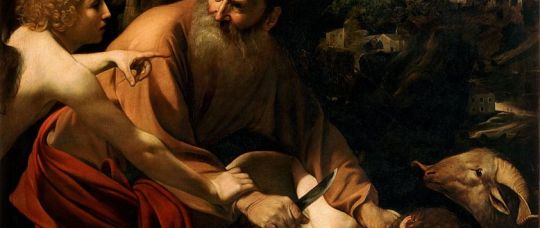
Things move quickly from this point. Abraham builds an altar, lays the wood, binds his son Isaac, and lays him on the sacrificial table.

A father is about to murder his only son. Because a deity said to.

The fact that Abraham doesn’t, in fact, sacrifice his son — an angel stops Abraham and sends a ram, caught in a thicket by its horns. Just as Abraham said God would. “God himself will provide the lamb, my son.”

(There is a LOT of Christian symbolism that can be read into this story — a father sacrificing his only begotten son; a son carrying the wood that he’s to be sacrificed on — but it’s not actually present in the story. This is a Jewish story about a Jewish event. Those Jews who split from Judaism to become Christians would know these Torah stories by memory, and these would, of course, influence the writings of the gospel. But again: the Hebrew Bible isn’t Christian, it’s co-opted.)

Abraham is blessed for his faithfulness — which, again, is often preached as the main message of this story: God may ask you to do the impossible, but he will be with you the whole time. I still don’t care so much for that as a spiritual take-away. There must be other ways for us to demonstrate love and devotion to God (or the Universe or the Sacred Mystery or whatever you are or are not calling the ineffable).

Abraham and Isaac never speak to each other again in the Hebrew Bible. In fact, there’s this curious passage towards the end of this story: “So Abraham returned to his young men, and they arose and went together to Beer-sheba; and Abraham lived at Beer-sheba.”

This event is utterly destabilizing for Isaac. There’s this detail, about how Isaac marries Rebekah in his mother’s tent, and that Rebekah “became his wife, and he loved her; and Isaac was comforted after his mother’s death.” (Gen 24:67) When we see him next, he is an old man, blind, and maybe or maybe not aware that his younger son, Jacob, is heisting the birthright from Esau. Isaac is passive and sad and seemingly cut off from any action — which is what you’d expect from someone who is nearly murdered by his father.

So much care and attention is given to Abraham’s faith and faithfulness. So little is said about what this must have been like for Isaac. “Somewhere there must be more love.”

Categories
Belief Bible Study Genesis Old Testament Tanakh

Lot & His Daughters, or, Hospitality Gone Terribly Wrong

There are Bible stories that aren’t in the Bible, and it occurs to me right now that I could spend a lot of time not writing at all about Lot and his daughters and just talk about how the Bible came to be, well, The Bible. Another time perhaps. Just know that there are more gospels in existence than you may be aware of, and there are extra-Biblical writings that fill in the gaps to a lot of the stories.

For instance.

The rule in Sodom was, “Whosoever giveth bread to a poor person shall be burnt at the stake.” That’s not in the Bible, but in the writings of the Rabbi Rashi, a Talmudic and Tanakhic commentator, who lived in France in the 11th century. (The Talmud is a collection of Jewish scholarship on the Tanakh. The Tanakh is essentially what Christians call the Old Testament, but which we should probably get in the habit of calling the Hebrew Bible.)

Rashi continues: Plotit*, the daughter of Lot, who was married to a prominent Sodomite**, saw a man so poor and so hungry that he was unable even to stand. Feeling sorry for him, each day she would give him a little food she had saved on her way to the water well.

(* Lot’s daughters, and his wife, are not named in the Bible. In the Book of Jasher, which doesn’t exist, but did, because it’s quoted in the Bible and in other texts at the time, Lot has four daughters and no sons. Two of his daughters were married; two were betrothed. Lot’s wife is named Irit.)

(** Not what you’re thinking, gang. This is a reference to someone living in the town of Sodom. Was he gay as pants? The midrash is silent on this.)

People in Sodom soon found themselves wondering how this man, poor and hungry near to death, was not, in fact, dying. Maybe their hope was: he’ll starve to death and we won’t have to worry about not feeding him. Maybe that’s also our hope when we see panhandlers. History doesn’t repeat itself, but it rhymes.

Then, the discovery: that the man wasn’t starving any longer, that Plotit had been secretly feeding him, and for her generosity, she was burned at the stake. Before she died, she cried to heaven: “Master of the World, carry out justice on my behalf!”*

(* In some stories, it’s fire. In others, she’s tied to a tree, drenched in honey, and left to be stung to death by bees. In some stories, JFK is shot by a lone gunman. In other stories, there’s a cabal. There is always more than one story to any one story.)

In the Bible, we need a bit of a prologue before we launch back into the Lot story. There is a man named Abraham. He is 100 years old. He has a wife, named Sarah. She is 90. One day, God appears to Abraham in the form of three men. (“IT’S THE TRINITY!” fundamentalist Christians will say and (a) of all, no, it isn’t; this is a Jewish text. Also, too, the Holy Spirit isn’t necessarily a man. In fact, in Gnostic tradition, the third part of the trinity, the Holy Spirit, is feminine, and possibly God’s wife.)

God has come to Abraham for two reasons: (1) To remind Abraham that his wife Sarah will bear him a son, to be named Isaac; and (2) To investigate Sodom and Gomorrah. “The outcry against Sodom and Gomorrah is so great and their sin so grievous that I will go down and see if what they have done is as bad as the outcry that has reached me. If not, I will know.” (Gen 18:20)

(There’s a wonderful moment in this story where Sarah overhears the visitors when one says that she will have a baby within the year. She laughs — because, again, she’s 90 and her husband is 100. She says, “After I am worn out and my lord is old, will I now have this pleasure?” And God says to Abraham, “Why did Sarah laugh?” And Sarah, in a very human moment, feels embarrassed at being caught laughing at a visitor and says, “I did not laugh.” And God, ever the one to have the last word, says, “You totally did.” This is in Genesis 18:1-15.)

We’re getting to Lot and his daughters. But there’s a little more scene setting. We have to go back to the midrash, because this outcry against Sodom and Gomorrah confused rabbinical scholars.

Why, they wondered, was the singular feminine “her cry” (הַכְּצַעֲקָתָהּ) used instead of the expected (and masculine) “their cry” (הַכְּצַעֲקָתָם)? (The feminine is entirely erased in English translations, using the neuter “the outcry.”)

And now we can begin to introduce Lot, his daughters, and his wife back into the point of it all.

The early interpreters of the Torah said, “‘Her cry’ is the cry of Plotit, crying to God for justice. He heard it, and he came down to Earth to investigate.” Modern scholars might argue that Sodom and Gomorrah are sister cities, and the “her cry” means the city’s own cries for justice. Modern scholars say a lot of things.

God sends two angels — oh boy. I’ll deal real quick-like with angels, but maybe I’ll write about angels fully another time because they are complicated and weird. Often, where the word “angel” appears in the Bible, it really means “messenger.” These were human(ish?) people, with no wings. But sometimes angels mean supernatural beings in extraordinary shapes and that’s not what these angels are, who appear with God before Abraham. In fact, the text is pretty opaque as to whether or not the three visitors to God are all one person (“TRINITY!” NO NO NO. We’ve been OVER THIS.) or if it’s God, and two friends.

Anyway. God sends two angels to Sodom to check things out, and destroy both Sodom and Gomorrah if necessary. (I’m leaving out the whole marvelous bargaining scene between Abraham and God where Abraham says, “But what if there are 50 righteous people?” And God says, “Then I’ll back off.” And Abraham, maybe aware of the reputation of Sodom and Gomorrah, says, “Well, but maybe 40?” And God says, “For 40? Sure.” And Abraham bargains all the way down to 10 righteous people. Keep that number in mind.)

Someone else may ask me to write about homosexuality and the Bible, and I will, even though it makes me tired. When the angels arrive, they meet Lot, who is “at the gate.” He’s a businessman/ambassador, essentially, but he’s also New In Town. (“Excuse me, I am homeless, I am gay, I have AIDS, I’m new in town.”) The Sodomites, who already aren’t known for their stunning hospitality, are also a little frustrated about this out-of-town upstart who has risen pretty high in the heirarchy of Sodom. When Lot ushers the two visiting angels into his home (btw, Lot has no idea that they are angels), “the men of the city, the men of Sodom, both young and old, all the people to the last man, surrounded the house; and they called to Lot, ‘Where are the men who came to you tonight? Bring them out to us, so that we may know them.'”

To “know” someone in the Bible is essentially to fuck them. Just like “feet” in the Bible are almost always a euphemism for dick. Look, I didn’t write the Bible. We’ll talk more about feet, btw, when we get to the Book of Ruth.

And this is where your fundamentalist/literalist/asshole jerks will start with their anti-gay nonsense. What I want to ask you all to do, just for the moment, is say, “Fine.” Say, “The Bible hates homosexuals and homosexuality.” (It doesn’t.) IT DOESN’T MATTER NOW. The Hebrew Bible was not written for us — and that “us” is doing a lot of heavy lifting because I mean “Christians” and “Modern people” mostly. This is how things were in the Olden Timey Days, but cultures grow. Don’t let a book written by people who WOULDN’T LET WOMEN SIT ON COUCHES IF THEY WERE ON THEIR PERIOD dictate your relationship with whatever god you have. (Please don’t recommend “The Red Tent” to me that book is terrible.)

The Sodomites want to sodomite, and Lot wants to be a good host and not allow his guests to be effed in the bee by “all the people to the last man” (which I find hard to believe because I know a LOT of people who won’t leave their house in the evening because once you’ve taken off your daytime toga and put on your nighttime toga you are IN for the DAY) and so he does what any host would do.

He says: “Look, I have two daughters who have not known a man; let me bring them out to you, and do to them as you please; only do nothing to these men, for they have come under the shelter of my roof.” (Gen 19:8)

What do we, as believers — as Christians and Jews — do with this? The Bible is silent in a lot of places where it sure would be nice to have a few additional lines of dialogue. In the Binding of Isaac, it would be nice to know if Abraham and Isaac talked at all on the way back down the mountain, and what did they talk about, and did ANYONE say, “That was…that was weird, right? What we just did? You, my father, trying to slaughter me, your son?” And here, in the Lot story, we don’t hear from the daughters about this bargain.

Scholars of the Ancient Middle East will make a lot out of this idea of the importance of hospitality. And I’m not saying that that’s not valid; I’m just saying that it still isn’t comforting to me, a person in the 21st century. I cannot imagine at any point offering my beloved Little Baby Fosco, Jasper St Jasper (International Cat of Mystery), or Peter the Wicked to my neighbors to rape instead of my guests. (They’re the closest we have to daughters and ugh, you know what’s exhausting? People who get irritated when childless folk call their pets their children. IT’S NOT FOR YOU, PEOPLE WITH CHILDREN.)

And that’s what you want to know, right? How could God allow this? How is Lot a righteous man in the eyes of God if he’s willing to debase his daughters and actively participate in their sexual assault by, again, “all the people to the last man.”

Beloveds, I can’t answer that.

In many ways, as Believers, specifically Christian believers (because I’m not Jewish and cannot speak for the Jews but I do know some Yiddish and my husband is a Jew so: I mean, I layed it all out for you), we need to separate the Bible from our faith. The Bible captures a system of belief of a very specific time, and a very specific place, and of a very specific people, who are nothing like us. The Bible is filled with stories of extraordinary violence — violence committed by man against man, and violence committed by God against people. But it also has the Gospels (for Christians). And it has messages about radical justice for the poor, and the broken, and the lonely. Ultimately, the Bible is a book, and it can be your book, and you can take from it what is meaningful to you and you can ABSOLUTELY leave the rest out, especially if it’s toxic and hurtful to you.

Lot’s daughter, with her dying breath, called out for justice — at least in the midrash. And it’s our difficult task, when we read these passages, to decide if she got justice or not.

The angels, by the way, rescue Lot, his wife, and his two daughters. (Remember, though, that in some stories Lot has four daughters.) Lot tries to convince the two men who are betrothed to his unmarried daughters to come with them, too, but they decline, because they think Lot is joking. God wasn’t able to find his 10 righteous people. He barely found four.

The angels tell Lot and his family to run as far as they can, lest they be consumed by God’s destruction. They also, like a good fairy tale, tell them not to look back.

Imagine. You are fleeing your home. You are fleeing your life. Something extraordinarily violent and horrible and utterly destructive is happening to your city where maybe you had friends. Maybe you had a favorite place to watch the sunset while eating figs. Maybe one of your daughters, or cats, or whoever, is left behind.

You’d look back, right? You couldn’t help but look back. Looking back is such a normal human impulse. It’s even a loving impulse. And Lot’s wife looks back, because. And is immediately turned into a pillar of salt. And maybe that, too, is like a fairy tale, like when Bluebeard’s wife uses the key she’s not supposed to use to open the closet she’s never supposed to open.

There’s a rock formation near the Sanctuary of Agioss Lot, near the Dead Sea, venerated as Lot’s wife as a pillar of salt.

(The end of Lot and his daughters is bonkers. They flee to a town called Zoar, but, for reasons never explained in the Bible, decide they can’t really stay in Zoar. So they flee to a cave in the mountains and Lot’s daughters get Lot drunk, because they want children, and biological clocks, and dad’s right here, and it’s all deeply upsetting, especially if, like me, you’re a Victorian prude about father/daughter incest, and if you’re not, you might enjoy a book called The Kiss by Kathryn Harrison, but please never talk to me about it, I’m very busy. Each daughter fucks the dad, and they both get pregnant [yay?] and that’s the Biblical explanation for the Moabites, because the eldest living daughter had a child named Moab, and the Ammonites, because the younger living daughter has a son named Ammon. We’ll talk a lot about Moabites when we get to the Book of Ruth.)

Categories
Belief Bible Study Genesis God Old Testament Seeking

Evil

Roxanne asked about evil. I’ll tell you now, at the beginning, to save you time if you thought I was going to be able to answer this question: I don’t know how to answer this question. I don’t know what to do about evil.

I’ll start with this poem by Duane Michals, “I Am Much Nicer Than God.”

“It was last Thursday, when I heard that Dennis had finally died, that I realized I was much nicer than God. I would never have let him suffer all those months as he did. I would never have invented cancer in the first place. Nor would I permit children to fall asleep hungry, or old people to cry alone. But if it is true, that I with my petty vanity and selfishness are much nicer than God, then I am in despair. I do not have enough compassion and love to protect. Somewhere there must be more love.”

Evil really isn’t that difficult of a concept to wrap your arms around. We innately know what evil is. Evil is something terrible that happens that leaves you powerless. Of course, sometimes it’s something like an earthquake, or a brushfire, and the earthquake and the brushfire themselves aren’t evil. Sometimes it’s an illness like cancer, or HIV/AIDS, but cancer and AIDS themselves aren’t evil. Evil is cruelty and violence, and it is sometimes disguised as caring and love. We experience the effects of evil; maybe evil is like wind: unseen but felt, always around us and we only notice when we’re blown off course.

God, however, of course, created earthquakes. And brushfires. And cancer. And AIDS. And humans, who exacerbate the problems while also being the victim.

Are people evil? We sure want them to be. We want an explanation for bad behavior, that an evil person did an evil thing because evil is in the world. And sometimes, I guess, that’s true. The problem is, the more we learn about the brain, the more we start to see how little control we actually have over our actions. Where I am with evil: there is a lot of bad in the world, most of it caused by humans, and evil is a way of labeling it, but it’s not a useful designation, because we use it like packing peanuts to couch our discomfort. Calling something evil and then blaming God for not fixing it has not worked as an effective counter to evil or as a deterrent to belief in the Divine.

But why does God allow evil? That’s a question any religion that claims a benevolent, omniscient, omnipotent, and omnipresent deity has to answer. That seems to be an especially Christian p.o.v. God has faults and makes mistakes in the Hebrew Bible ::all the time::, and it doesn’t undercut his standing as the chosen god of the Israelites. (Though there is an interesting development, characterwise, with God in the Hebrew Bible: there seems to be some room for polytheism at the beginning; God references other deities*. He then becomes the most powerful of all the deities. And ::then:: he becomes the ONLY deity. Christianity works some polytheism back into the mix with the trinity concept, which may not have been Christianity’s smartest move, but it was in part to create an answer to the question: Is Noah/Abraham/Moses saved, not having had a Christ-experience? John gives us the answer: yes, because “In the beginning was the Word, and the Word was with God, and the Word was God.” I have been chastened by my pastor for my current thoughts on John so I’ll say no more until I’ve read this book of commentary on it.) Christianity wants a benevolent God to have all the Os — omniscience, omnipotence, omnipresence — but also wants there to be sin. And we get the sin problem because now we have to introduce the concept of Free Will. That makes evil ::our:: problem, not God’s problem, and is a really shitty way to think about evil and God if you ask me.

(* Genesis 1:16 is an interesting place to talk real quick-like about translation and editorializing. It’s a curious little passage; here it is in the NRSV edition: “God made the two great lights—the greater light to rule the day and the lesser light to rule the night—and the stars.” It’s identical in the King James, and essentially identical in the earlier 1599 Geneva translation. The Hebrew translation is also very straight-forward — we don’t have any contextual issues where a Hebrew word has been poorly translated. But the phrasing. “The greater light to rule the day and the lesser light to rule the night.” Why not just say “The sun to rule the day and the moon to rule the night.” And it’s because the names for the sun and the moon at the time this text is written down were also the names of Mesopotamian deities. If you’re world-building as a solo entity, you can’t very well say that God created Utu (sun deity) and Nanna (moon deity), so we’re left with this awkward Hebrew work-around that has stayed with us through the current day.)

(Me again: there is an arm of evangelical Christianity that sees the “lesser light” as referring to Satan and I either have a lot to say about this or nothing to say about this we’ll see.)

Theologically speaking, God is at least aware that evil is a force in the world, whether he created evil or not. In Genesis 2:9, we learn that God has created both a tree of life (which grants immortality), and a tree of the knowledge of good and evil. And that good/evil tree is created ::before:: God has created Adam. So man didn’t bring evil into the world, because evil must already exist if it can be detected via fruit.

Later, God worries about the new state of the humans he’s created. Gen. 3:22: “See, the man has become like one of us, knowing good and evil; and now, he might reach out his hand and take also from the tree of life, and eat, and live forever.” The Gnostics will argue that the serpent doesn’t lie to Eve, but that God does. Because Eve and Adam do not die after eating the fruit. Certain Christian sects will say, “They died spiritually in that moment,” or “They lost the chance at immortality.” But immortality doesn’t seem to be part of God’s initial plan for humanity, anyway, since he’s also forbidden eating from the fruit of the tree of life. So evil exists — maybe even independently of God — and God sees knowing the difference between the two to be a terrible burden that he hopes to protect his new humans from.

(It’s also useful to consider that the Jewish tradition of creation is not “out of nothing” or “ex nihilo.” God brings order to chaos, not creation out of nothing, in Genesis 1. Christianity — specifically the early Church fathers — is the one arguing for Creation Ex Nihilo because I guess no one had anything better to do in the early 100s?)

But I do think evil is ::our:: problem. And I think God — the full complement of whatever that experience is — is such a profound mystery that as humans we may never understand the point of any of what we are doing here. We’re born, we live our days as best we can, sometimes doing good, sometimes doing evil, sometimes happy, sometimes broken entirely, and we die, and: [something even if it’s nothing happens]. I love this Tolstoy quote from War & Peace: “You will die and it will all be over. You will die and find out everything or cease asking.”

I don’t think there will ever be a human definition of evil that will make sense — and certainly, and ironically, religion can’t answer the question because we don’t understand the question, fully, even though I said evil itself isn’t all that difficult of a concept to wrap one’s arms around. Since we know that evil isn’t something God is willing/able/allowed to fix, we’re left on our own. Evil exists because humans exist, and our job that we should assign to ourselves is to bear witness to evil and call it out when we see it, and to do what we can for those who are suffering.

(Donald Trump is absolutely evil. As are his children, even Tiffany, and Mitch McConnell. Ellen is evil. Dick Cheney, too. George W. Bush is evil but we have decided he’s cute because Michelle Obama hugged him once. Capitalism is evil. Orthodoxy that seeks to control/gatekeep is evil. Obviously Hitler.)