
Categories
Mental Health New Testament Old Testament Tanakh The Bible, KJV The Bible, NIV

The Book I’m Not Reading

I own a not insignificant number of copies of Wolf Hall by Hilary Mantel, the best novel ever written in the English language. As a Christian who is saved in Christ (I think?), this fact, and God’s eternal love, are the two things I can depend on.
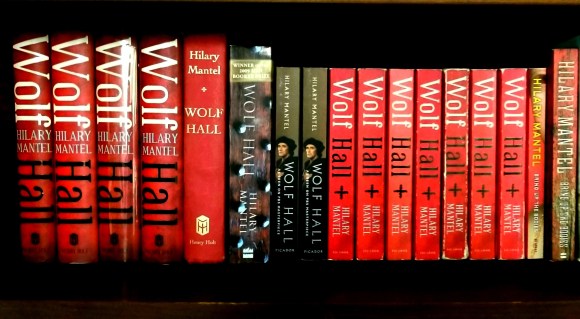
Wolves Hall, Personal Collection

It’s also an example of how I act out some of my mania / treat my depression. If I’m feeling overwhelmed, or just, you know awake at any given moment, and I’m in a bookstore and there’s a copy of Wolf Hall to be had for the having, I’ll have it. (I’m also aided and abetted by my dear friend and platonic plural husband, Jeffrey, who buys used copies everywhere he sees them and then sends them to me. Compare this to another friend who sent me a pack of allegedly “funny” coasters with ’50s housewives saying dirty things and then imagine a yawn that becomes eternity and that’s about how tired that gift made me.) It’s not that I need it. It’s not like I clearly don’t already have [counts under his breath] 1-2-3-4-…-14-15 copies. But there’s something comforting about each book, and I can no more make sense of it than I can the argument that Jesus was both wholly human and wholly divine. (Which I believe, but based only on faith, not on empirical knowledge.)

I also now own three Bibles:

  1. An NIV translation
  2. A KJV translation
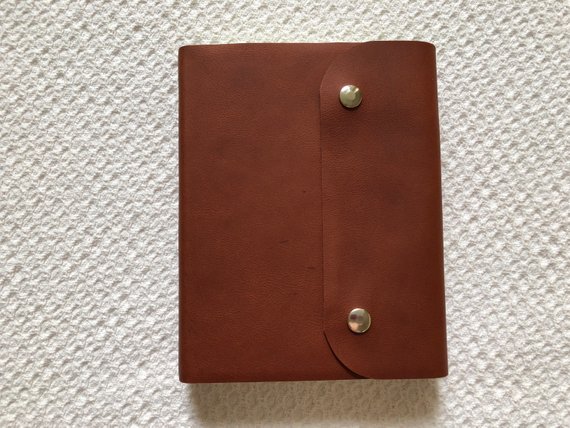
  3. A third one that I’m getting more details on, but it’s gorgeously bound and has snaps, I mean, CAN YOU EVEN BELIEVE THAT? SNAPS?! (Shout-out to Kindra, who should reach out to me because I found the UNFINDABLE and she may be interested.)
il_570xN.1632956735_p2va

The NIV doesn’t get a lot of respect. Purists* feel it is too dumbed down, and that it isn’t translated as carefully as it could be. (This is an argument leveled against Constance Garnett, a Tolstoy translator from the 19th century: we’re told that she was too Victorian, bowdlerized the dirty parts, and haphazardly translated the Russian to make it readable for her English-speaking audience. And to that I say feh. You lay Connie’s translation of War & Peace next to that husband and wife team who are better at Dostoevsky than they are Tolstoy and you’ll see that Garnett got more than enough right.) Uber-purists will want to direct new Bible readers to the KJV, and they’ll go on and on about the majesty of the language and wax rhapsodic over each verilythee, and thou**.

[* Purists can be frustrating, with their belief that there is anything approaching the platonic ideal of perfection. Some of your more dogmatic Christians will try to tell you that the closer in time we get to Christ, the purer the Christianity, but there were schisms and battles that started almost immediately after his crucifixion so ::shrug-emoji::.]

[** Some modern Quakers still practice both plain speech and plain dress and here’s what I want to say about that: it’s entirely none of my business and I love them for their pursuit of/relationship with God. HOWEVER. In the Year of Our Lord 2000 and 18, thees and thines and thous sound anything but plain. They sound affected and draw attention rather than allow the parishioner to not get in the way of the experience. Same for plain dress, which, as it’s practiced today, sometimes veers very closely to Ren Faire attire. I asked one Quaker woman — and you’ll have to trust that I asked this politely — “Why are you dressed like an observant orthodox Jewish woman?” She said, “I get that all the time.” And if you’re being questioned about your dress all the time then IT’S NOT VERY WELL PLAIN IS IT.]

For daily reading — both just to be literate in the Bible and for devotional experiences — I use the New International Version. I agree that the language in the King James Version is beautiful — “Therefore I have uttered what I did not understand” is a gorgeous piece of apology — but I’m not able to focus on the thinking behind the verse. Instead, I’m untangling syntax that isn’t as common today, and muddling through words that don’t tripe easily off the page into my brain.

I read the NIV because I want to understand what the Bible is saying. And, once I feel comfortable with what it’s saying, then I can move on to how to say it in beautifully antiquated English.

If you’re up for some sharing, I’d love to hear how you rank Bibles. What’s your preference for devotional reading? What’s your preference for study? What’s your preference for quoting?


Title Source: “The Book I’m Not Reading” by Patty Larkin
Categories
Belief Finding God Seeking

“Your Belief Undoes Your Disbelief”

After years of no real belief at all, one late fall I felt called to be a Catholic.

Belief is a slippery thing to write about — it can feel instructional, when you’re really just trying to work things out; or self-congratulatory, when you are actually trying to interrogate what it is you believe. Putting your belief(s) in writing can also feel final: It’s in words because now it’s true.

I am not a Catholic. That belief wasn’t true. But I am now a Christian, which, weirdly, feels less certain than when I thought I was Catholic. Everything is a swirl of confusion, and a wrong step or a sharp exhale might collapse, well, all of it.

The call to Catholicism went like this: I had felt, for some time, that I was missing something — some kind of comfort and peace. I was also working on some essays about saints and martyrs, pieces that weren’t really an exploration of my faith, but more just an exercise in memoir couched in stigmata and holy foreskins. I found myself both baffled and moved by these people — these saints and martyrs — so filled with belief and certainty that death came as a welcomed reward.

Francis De Sales
Saint Francis De Sales

My husband was raised Catholic, his childhood church just up the road from us. (He’s now a Won Buddhist.) I didn’t know how to talk to him about these new thoughts I was entertaining — that I needed the comfort of Catholicism, the ritual of incense smoke and wine, liturgy and bread. I didn’t know how to talk about that because I wasn’t actually sure it was what I really needed. I would feel a warm fullness in my heart when I thought about mass (in the abstract; I, to this day, have no real experience with mass), and I began vetting different saints to hire as my Personal Spiritual Guide (probably Francis De Sales, Bishop of Geneva in the late 16th century and patron saint of writers), but I never fully felt that click — the click Brick describes in Cat on a Hot Tin Roof — “The click I get in my head when I’ve had enough of this stuff to make me peaceful.”

catonahottinroof2
Brick: It’s like a switch, clickin’ off in my head. Turns the hot light off and the cool one on, and all of a sudden there’s peace. (Paul Newman in Cat on a Hot Tin Roof, 1958.)

So I was left with this empty feeling, a need for some connection, both spiritual as well as to a community of similar-minded believers. (I went to one catechism class at the Catholic church where F. Scott Fitzgerald is buried and felt immediately alienated from God. There was no room for doubt. Every question had an answer, rather than an opportunity for further reflection. One woman said, “It’s important to remember that we do not worship the Virgin Mary. A lot of people think we do, but we don’t.” She made this clear to us in a room with no less than eight statues of the blessed mother. To leave the church, you have to walk by a giant statue of Mary. Another statue of Mary gleams whitely outside of the church.) I was at a place in my life where I was ready to believe — where my belief unraveled my disbelief — I just didn’t know where to go.

Belief itself is very personal, much like the house rules for Monopoly are different from family to family. What I most needed was a home where not just my belief, but my doubts and questions were equally welcome. I also needed it to not be Unitarian Universalist because I’m not interested in praying to no one in particular. I didn’t want something divorced from spirituality. Zach and I went to a Unitarian Christmas service one year and it was irritating from start to finish. “Are they ever going to talk about why Christmas is important?” I whispered to Zach. He looked at my with pity and then told me to shush.

2000px-Quaker_star-T.svg

So where am I now? I turned to the Quakers — the Religious Society of Friends. (Another time I’ll write about how I put a lot of energy into exploring Santeria. Just know, for now, that I am a Very White Person who speaks zero Spanish beyond phrases that clearly mark me out as illiterate.) It’s church for introverts in a sense. I belong to an unprogrammed sect, which means we have no minister, no assigned readings from the Bible, no choir. We sit in silence for an hour, waiting for the still small voice of God to whisper words of revelation to us. I augment this with my own trek through the Bible, and with my questions, and few answers.

This site is a space for me to work on/through/with questions I have, answers I’m considering, and revelations that come to me. Nothing I write is an explanation, or even an instruction, on how to be a Person of Faith. I am mostly, and narrowly, only describing myself, and my thoughts, which you may read and agree with, or you may read and remain unconvinced. You will know, and be comforted, or you will not, and maybe still be comforted.

“As the African says:
This is my tale which I have told,
if it be sweet, if it be not sweet,
take somewhere else and let some return to me.
This story ends with me still rowing.”

— Anne Sexton, “Rowing


Title Source: “Admonitions to a Special Person” by Anne Sexton