Categories
Belief Bible Study Genesis God Old Testament Seeking

Evil

Roxanne asked about evil. I’ll tell you now, at the beginning, to save you time if you thought I was going to be able to answer this question: I don’t know how to answer this question. I don’t know what to do about evil.

I’ll start with this poem by Duane Michals, “I Am Much Nicer Than God.”

“It was last Thursday, when I heard that Dennis had finally died, that I realized I was much nicer than God. I would never have let him suffer all those months as he did. I would never have invented cancer in the first place. Nor would I permit children to fall asleep hungry, or old people to cry alone. But if it is true, that I with my petty vanity and selfishness are much nicer than God, then I am in despair. I do not have enough compassion and love to protect. Somewhere there must be more love.”

Evil really isn’t that difficult of a concept to wrap your arms around. We innately know what evil is. Evil is something terrible that happens that leaves you powerless. Of course, sometimes it’s something like an earthquake, or a brushfire, and the earthquake and the brushfire themselves aren’t evil. Sometimes it’s an illness like cancer, or HIV/AIDS, but cancer and AIDS themselves aren’t evil. Evil is cruelty and violence, and it is sometimes disguised as caring and love. We experience the effects of evil; maybe evil is like wind: unseen but felt, always around us and we only notice when we’re blown off course.

God, however, of course, created earthquakes. And brushfires. And cancer. And AIDS. And humans, who exacerbate the problems while also being the victim.

Are people evil? We sure want them to be. We want an explanation for bad behavior, that an evil person did an evil thing because evil is in the world. And sometimes, I guess, that’s true. The problem is, the more we learn about the brain, the more we start to see how little control we actually have over our actions. Where I am with evil: there is a lot of bad in the world, most of it caused by humans, and evil is a way of labeling it, but it’s not a useful designation, because we use it like packing peanuts to couch our discomfort. Calling something evil and then blaming God for not fixing it has not worked as an effective counter to evil or as a deterrent to belief in the Divine.

But why does God allow evil? That’s a question any religion that claims a benevolent, omniscient, omnipotent, and omnipresent deity has to answer. That seems to be an especially Christian p.o.v. God has faults and makes mistakes in the Hebrew Bible ::all the time::, and it doesn’t undercut his standing as the chosen god of the Israelites. (Though there is an interesting development, characterwise, with God in the Hebrew Bible: there seems to be some room for polytheism at the beginning; God references other deities*. He then becomes the most powerful of all the deities. And ::then:: he becomes the ONLY deity. Christianity works some polytheism back into the mix with the trinity concept, which may not have been Christianity’s smartest move, but it was in part to create an answer to the question: Is Noah/Abraham/Moses saved, not having had a Christ-experience? John gives us the answer: yes, because “In the beginning was the Word, and the Word was with God, and the Word was God.” I have been chastened by my pastor for my current thoughts on John so I’ll say no more until I’ve read this book of commentary on it.) Christianity wants a benevolent God to have all the Os — omniscience, omnipotence, omnipresence — but also wants there to be sin. And we get the sin problem because now we have to introduce the concept of Free Will. That makes evil ::our:: problem, not God’s problem, and is a really shitty way to think about evil and God if you ask me.

(* Genesis 1:16 is an interesting place to talk real quick-like about translation and editorializing. It’s a curious little passage; here it is in the NRSV edition: “God made the two great lights—the greater light to rule the day and the lesser light to rule the night—and the stars.” It’s identical in the King James, and essentially identical in the earlier 1599 Geneva translation. The Hebrew translation is also very straight-forward — we don’t have any contextual issues where a Hebrew word has been poorly translated. But the phrasing. “The greater light to rule the day and the lesser light to rule the night.” Why not just say “The sun to rule the day and the moon to rule the night.” And it’s because the names for the sun and the moon at the time this text is written down were also the names of Mesopotamian deities. If you’re world-building as a solo entity, you can’t very well say that God created Utu (sun deity) and Nanna (moon deity), so we’re left with this awkward Hebrew work-around that has stayed with us through the current day.)

(Me again: there is an arm of evangelical Christianity that sees the “lesser light” as referring to Satan and I either have a lot to say about this or nothing to say about this we’ll see.)

Theologically speaking, God is at least aware that evil is a force in the world, whether he created evil or not. In Genesis 2:9, we learn that God has created both a tree of life (which grants immortality), and a tree of the knowledge of good and evil. And that good/evil tree is created ::before:: God has created Adam. So man didn’t bring evil into the world, because evil must already exist if it can be detected via fruit.

Later, God worries about the new state of the humans he’s created. Gen. 3:22: “See, the man has become like one of us, knowing good and evil; and now, he might reach out his hand and take also from the tree of life, and eat, and live forever.” The Gnostics will argue that the serpent doesn’t lie to Eve, but that God does. Because Eve and Adam do not die after eating the fruit. Certain Christian sects will say, “They died spiritually in that moment,” or “They lost the chance at immortality.” But immortality doesn’t seem to be part of God’s initial plan for humanity, anyway, since he’s also forbidden eating from the fruit of the tree of life. So evil exists — maybe even independently of God — and God sees knowing the difference between the two to be a terrible burden that he hopes to protect his new humans from.

(It’s also useful to consider that the Jewish tradition of creation is not “out of nothing” or “ex nihilo.” God brings order to chaos, not creation out of nothing, in Genesis 1. Christianity — specifically the early Church fathers — is the one arguing for Creation Ex Nihilo because I guess no one had anything better to do in the early 100s?)

But I do think evil is ::our:: problem. And I think God — the full complement of whatever that experience is — is such a profound mystery that as humans we may never understand the point of any of what we are doing here. We’re born, we live our days as best we can, sometimes doing good, sometimes doing evil, sometimes happy, sometimes broken entirely, and we die, and: [something even if it’s nothing happens]. I love this Tolstoy quote from War & Peace: “You will die and it will all be over. You will die and find out everything or cease asking.”

I don’t think there will ever be a human definition of evil that will make sense — and certainly, and ironically, religion can’t answer the question because we don’t understand the question, fully, even though I said evil itself isn’t all that difficult of a concept to wrap one’s arms around. Since we know that evil isn’t something God is willing/able/allowed to fix, we’re left on our own. Evil exists because humans exist, and our job that we should assign to ourselves is to bear witness to evil and call it out when we see it, and to do what we can for those who are suffering.

(Donald Trump is absolutely evil. As are his children, even Tiffany, and Mitch McConnell. Ellen is evil. Dick Cheney, too. George W. Bush is evil but we have decided he’s cute because Michelle Obama hugged him once. Capitalism is evil. Orthodoxy that seeks to control/gatekeep is evil. Obviously Hitler.)
Categories
1 Thessalonians Baptist Belief God New Testament Seeking

The Good Parts: 1 Thessalonians

But we were gentle among you.

1 Thess 2:7

For you yourselves have been taught by God to love one another; and indeed you do love all the brothers and sisters throughout Macedonia. But we urge you, beloved, to do so more and more.

1 Thess 4:9-10

So then let us not die as others do, but let us keep awake and be sober.

1 Thess 5:6

Rejoice always, pray without ceasing, give thanks in all circumstances; for this is the will of God in Christ Jesus.

1 Thess 5:16

Test everything; hold fast to what is good; abstain from every form of evil.

1 Thess 5:21

May the God of Peace himself sanctify you entirely; and may your spirit and soul and body be kept sound and blameless.

1 Thess 5:23
Categories
Baptist Belief God Seeking

God’s Love as My Love for My Cat

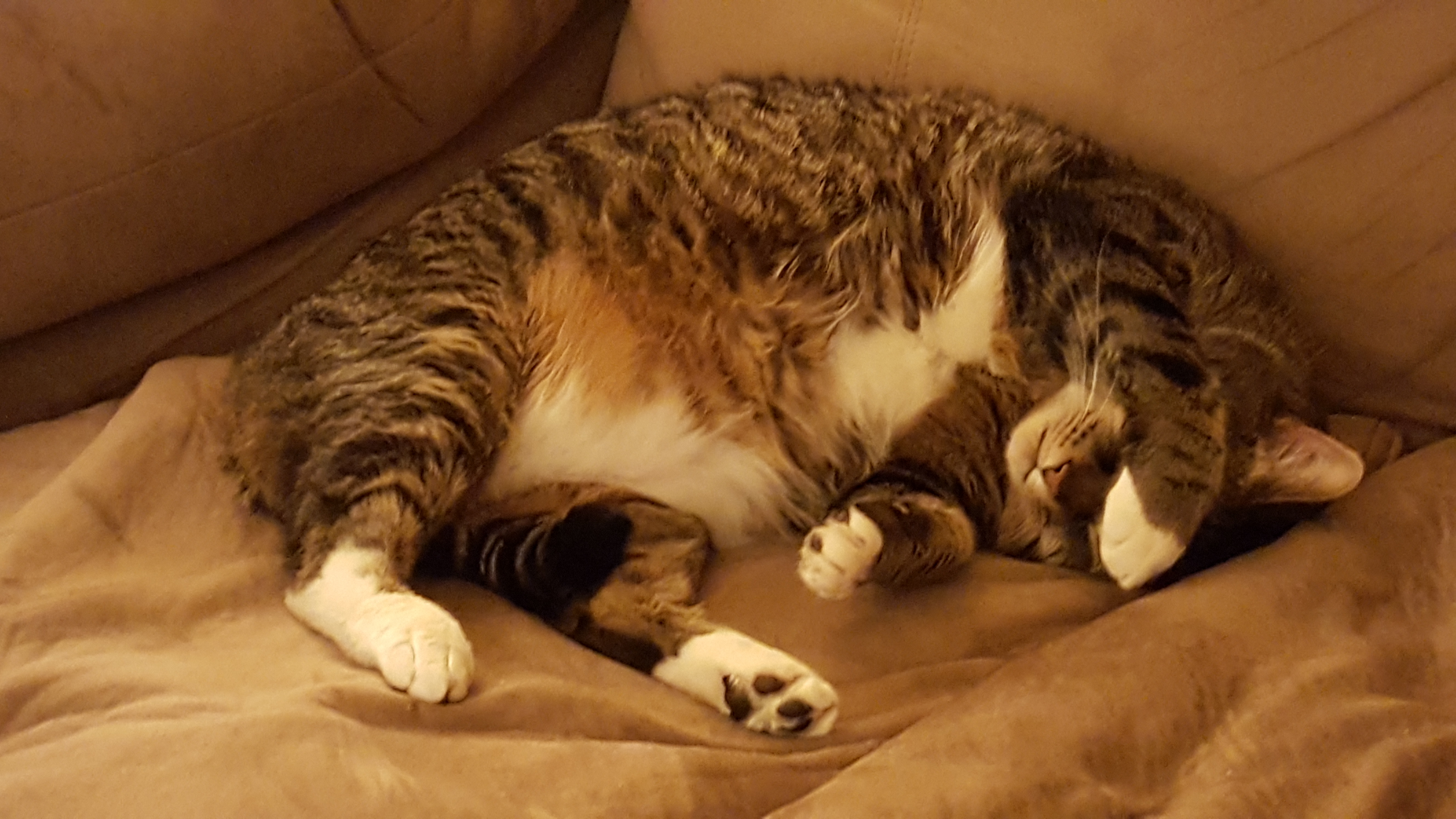
One way I wrap my head around the idea of God’s infinite and unconditional love (as I think of it — you may have an entire different relationship with God that is so personal you only whisper about it to each other and you may also just not have an interest in God even a little and you’re thinking, “Oof. JonBenet Mike was pretty rough; do I want to deal with God Mike too?” And you may not. And I love you anyway) is I think about my cat, Little Baby Fosco, and how it’s impossible he can understand the true depths of my love for him. He just can’t. He’s a cat. I’m a human. For you it may be a dog. My love for Fosco is literally unconditional and all-consuming. I hope to God your love isn’t a lizard.

(Btw, we all wanna say we love our partners with perfect unconditional love, but that’s a metaphor and we all know it. There are always some conditions there.)

There’s nothing that will ever make me stop loving Fosco. L i t e r a l l y nothing. He has pooped on the bathroom floor on ::more:: than one occasion, often out of spite, and Zach would only get maybe TWO accidents like that. See: conditions.

He is my world, this cat. I am MAYBE in his top 20. I don’t care. I love him with no reservations, no agendas, no emotional baggage. Oh, and by the way, there are two other cats in this house here and I love those fuckers equally as much too (except Peter, who I love, but…all of have sinned and fallen short and yadda yadda yadda).

Anyway, all that gushing about my cat is like God and me. I cannot comprehend something like God, or God’s love. I think I feel it, and I’m sure that’s real, and it’s also nowhere near to what God is thinking/feeling about me at any given moment. And God only ::sometimes:: makes it into my Top 50. (I could love God a lot more than I do. We’re still in the “Oh, you load the dishwasher ::that:: way” phase.)

AND GOD DOESN’T CARE. God isn’t holding emotional grudges. What’s being offered to me, to you, (unless you ::really:: don’t want it/don’t believe/are doing good on your own/gave at the office), to all of us is this exceptionally uncomplicated love.

Categories
Interludes Mental Health Seeking

Interlude: Who’s Afraid of Virginia Woolf

A dear friend wrote to me. Is there anything better than a perfect email, with questions tailored specifically tailored to you, so that you can be your Fullest Self? There is not.

She writes, 

Can we talk about Albee’s “Who’s Afraid…”? I just became aware that people think it’s a play of … extremity? Like a once in a lifetime kind of conversation, so brutal and strange. To be watched as a kind of awareness of how bad marriage can get. Uhhh what. A stunning depiction of emotional abuse. Whaaattttt. 

I watched the Elizabeth Burton film on Thanksgiving (naturally) and I don’t know if I am just less concerned with being happy (by which I mean aspiring to be happier than I could possibly be) or “unhealthier” but I realized Albee’s is a profoundly humane vision. To have people who play our games – who learn the rules as quickly as we need to change them – is sort of the ideal, there’s an essential queerness to both relationships, I feel like, that I can’t name. And the frisson and sadism doesn’t feel unkind. I feel really unsatisfied with contemporary interpretations of the play as “emotional abuse” and depicting “unhappiness” rooted in childlessness and untruth — I think it depicts a tolerance for emotive play and… camp? maybe? 

That how I talk. I’d **hate** to have more decorum. I mean, when we watched the film, everyone was laughing and saying, “they’re just like us!” without anxiety. &  I’d hate for people to have more decorum around me. I have running not-exactly-jokes just like they do, mythologies and agreed upon backstories and trauma sinks. It never occurred to me that it was a sort of after school special; seems preposterous. Certainly wasn’t Albee’s intent, but has it really occupied that cultural space? Am I weird? Am I unwittingly abused and too intense, abusing those around me? Do you never want to have “Who’s Afraid of Virginia Woolf?” conversations?

The mild moral panic of the whole thing makes me anxious.


Every word of this email was as manna to mine soul. I’ve been Sick Unto Death, and so close to the very veil of mortality that I have become, in essence, a sibyl, and I now know terrible things, like this show I watched called Apparitions, made by maybe the BBC or some other English-y network, but not Masterpiece Theatre.

Kenny Rogers is Martin Shaw as Father Jacob in the BBC’s Apparitions.

Apparitions stars a guy who looks like a healthier Kenny Rogers as a Catholic priest who plays by his own rules and is an exorcist. He has a gun more often than you’d think he would, because (a) he’s a priest, and (b) this is England. The Wikipedia page for the show says that it’s “more religiously accurate and fact-based” but what isn’t mentioned is that it’s a little anti-Semitic (exorcised demons compare themselves to victims of the Holocaust, and a Jewish man, to get revenge on God, hides his Jewishness and becomes a Catholic priest for reasons that could never be convincingly conveyed) and then there’s an episode where Bosnian Muslims participate in some sort of backwards mass to free a demon from hell by, among many things, throwing a pig off a roof and you should not watch this show. There’s also a complicated episode about abortion that sets every movement — pro life/pro choice — back about 1000 years. There’s only one season, baruch hashem.

But back to the email. I’ll paste my reply to my friend below and then offer this whole post as an opportunity for you, dear reader, to talk to me, dear writer, about this play, by Edward Albee, which I hold dear. My reply follows:

H______! But how wonderful of you to write to me! And about one of my favorite plays of all time.

from l to r: Holly Twyford, Danny Gavigan, Maggie Wilder, and Gregory Linington
Btw, I fled from a party, or, rather, an Evening with Friends, in part because this horrible man talked smack about this particular production and I’m feeling brave enough to name the guy who caused me this psychic distress, but I can’t remem– RICK. His name is Rick and he requires a lot of attention in any social setting.

It hadn’t always been. I had only ever seen the Burton/Taylor picture, with Sandy Dennis, whom I love so much. “I dance like the wind,” said petulantly, is my Love Language.

I saw Woolf as a stage play last year (I think? Or 2016?) at Ford’s Theater, where Lincoln was shot, but of course not at the performance I saw, but an earlier one. And for me, having only seen the movie, the play was a shock and a revelation. The movie is excellent, I think, but it’s not Albee’s play. Burton and Taylor are working out their own issues with each other and with everyone else, and they’re using the script as architecture, and it’s fascinating, and those two do a great job. But, seeing it performed as a play, rather than as a movie — which allows it to be claustrophobic because you’re stuck in that house with those people, rather than the neat reprieve at the roadhouse where Sandy Dennis dances like the wind — changes the very nature of what we’re seeing.

Sandy Dennis

(I’m going to go through and find all your questions — both actual and rhetorical — after I get my own thoughts out in one blow.)

The play is laugh-out-loud funny. (I also saw it with amazing actors. I may have seen it five times.) It’s also, when cast a certain way — less Taylor/Burton, for example — a play that’s about the Nuclear Option. Or tennis. Or nuclear tennis. Up until George and Martha (also the name of this country’s First Parents) walk through the door, George has only returned Martha’s serves. He’s never tried to serve himself. But something is different this night (Walpurgisnacht, Albee calls it), and George comes to the realization that if he continues only returning Martha’s serves, the game will go on forever. And George is tired of the game, and tired of Martha winning. So he does the only thing that’s left for him to do: he destroys the game entirely.

What I love so much about the ending is its lack of resolution. George has killed their son. George has upended their fantasy. And George wants to stay with Martha. But there’s no sense that things will get better — Albee isn’t interested in better. He’s interested in transactions. We don’t know if it changes everything. Heck, there may even be another kid, later — perhaps adopted (from some orphanage of the mind). I think of George and Martha as an updating of The Macbeths, of the Scotland Macbeths. There’s love, desire, and utter unpredictability. (“I have given suck, and know how tender ’tis to love the babe that milks me. I would, while it was smiling in my face, have plucked my nipple from it’s boneless gum and dashed its brains out had I so swore to that.”)

Now. On to your email to me.

1) people think it’s a play of … extremity?

So this question of yours — with its implied contradiction — is fascinating to me. I’m very interested in now thinking about this play not as One Extraordinary Night Where George Has Enough. I’m interested in considering it as “Here’s this relationship. Here’s how it’s navigated.”

I do think it’s a play of extremity. As I described above, when I saw it as a play I felt like I was watching George doing the only thing left for him. He can’t win otherwise; Martha is too smart and too skilled, but only when others follow the rules. (Martha, by the way, is the first to break the rules by mentioning the Unmentionable Son.)

Richard Burton and a Friend

When George is cast with Richard Burton, that dude is imposing. He’s Richard Burton. He’s Camelot. He’s Becket. (He’s also The Exorcist II: The Heretic, and Linda Blair has a tap-dancing scene and I love you so much.) His George is a match for Elizabeth Taylor’s Martha. But the play — the text of the play — doesn’t really show them as equals. Martha has had the upper hand for quite some time. George is nebbishy. That George is willing to kill their son should be both darkly comic (the child doesn’t exist in the first place) and utterly disruptive, and an act of desperation. Richard Burton qua Richard Burton is not desperate or a nebbish.

2) To be watched as a kind of awareness of how bad marriage can get.

Albee doesn’t like heterosexual marriage. (He doesn’t like gay marriage, either. He just hates marriage.) While alive, he’d get super cranky when people tried to say that George and Martha are actually two men. The cattiness and bitchiness play into gay stereotypes that we’re still living with today.

My friend Steve has argued — and I’m pretty convinced — that if Albee wanted to write a play with two gay men, he would have written a play with two gay men. And that is both Incredibly True as well as Needing a Closer Look. And I say that because Albee isn’t always trustworthy, the way none of us are entirely trustworthy, about his motivations. He’s a gay man who loved the provocation of homosexuality, but who also deeply hated homosexuality, too. Albee liked disrupting the norm. But I think he was uncomfortable being thought of only in terms of his sexuality, which is the bastion of the homophobic masc4masc gay guy. (He was in a relationship with the playwright Terrence McNally, and McNally said Albee was impossible to be with, ultimately.)

Terrence McNally (left) and Edward Albee (right)

3) I realized Albee’s is a profoundly humane vision. To have people who play our games – who learn the rules as quickly as we need to change them – is sort of the ideal, there’s an essential queerness to both relationships, I feel like, that I can’t name.

This is a very unexpected reading of the script. And I think you hit on something vital to the play. George and Martha do, deeply, love each other. But by the time we get to the Fatal Night, George has maybe had enough and needs a change and the only way he can affect that change is to burn it all to the ground.

We don’t know if Martha will adapt (the play is very interested in evolution and Survival of the Fittest — more than the movie is, I think?) to these new rules: their son is now dead. But, from what we’ve seen of Martha, who has survived her father and who has survived this marriage, I think she’ll catch on quickly. And, knowing what we know of Martha, she’ll begin to gain the upper hand again. This play is not about tidy endings.

4) I feel really unsatisfied with contemporary interpretations of the play as “emotional abuse” and depicting “unhappiness” rooted in childlessness and untruth — I think it depicts a tolerance for emotive play and… camp? maybe? 

Camp! Yes! And that may be where Albee gets frustrated with gay readings of the play. It’s not gay, it’s camp. And camp has certainly been nurtured and exploited by queer people for about forever. Calling the play a play about gayness misses the entire camp aspect, and I think Albee worked hard at that.

I think there is some emotional abuse going on; but it’s part of the game up to this point. And like you, the play isn’t a meditation on childlessness. I don’t think either George or Martha is all that interested in being parents to a living child. The play is very interested in control, and separating the wheat (George and Martha) from the chaff (Honey and Nick).

Something that occurs to me while thinking about this play now, and writing to you, is that, in a sense, George and Martha are — either wittingly or unwittingly — grooming Nick and Honey to be successors to George and Martha. With G&M, we see a mythology that has been well-established. With N&H, we’re seeing a mythology as it’s forming. If Nick and Honey continue repeating those origin myths, they’ll soon become defining characteristics of that relationship.

5) I have running not-exactly-jokes just like they do, mythologies and agreed upon backstories and trauma sinks. It never occurred to me that it was a sort of after school special; seems preposterous. Certainly wasn’t Albee’s intent, but has it really occupied that cultural space?

Lady Elaine Fairchild from Mister Roger’s Neighborhood

I recently graduated from therapy. My therapist, a man named Tift who has a nose like Lady Elaine Fairchild, was pretty good! He wanted me to go shopping too much. (I once said, “Shopping makes me anxious,” and he took that as a described stressor that Needed Fixing, whereas I just saw it as This is How I Am. We argued about that for quite some time until I sent him an email that said, “I am not interested in fixing that aspect of myself. Can we please focus on xy, and z?” Where xy, and are not terribly interesting except to me, but they’re connected to my Complicated Relationship with My Mother and my Weird Relationship to Responsibility. Fuck. It would have taken me fewer words to just write, “I was in therapy because I was deeply depressed and manic.” But I had already committed so much to the fullness of this parenthetical that we find ourselves here and I won’t delete.) But I bring up Tift, and therapy, because early on he had asked me to describe my childhood and I said, “I was a terrible student.” And he said, “Is that something you know, or is that something that was told to you?” And he explained that things can be said that aren’t true, and if they’re said to you at an early enough age, and with the weight of authority behind it, you, yourself, will stop questioning it and weave it in to your own mythology about yourself. (As it turns out, I was a terrible student. After my mom died, I was cleaning out her bedroom and found several progress reports from high school, all urgent, and all saying a variation of “Michael is not going to graduate at this rate.” But! I’m not a terrible student for anything I was actively doing. I am a terrible student because our school system has two speeds: everyone, and the morbidly slow learners. Those of us in the middle — and there are a LOT of us in the middle — make do for as long as we can, feeling terrible about ourselves and assured by the Weight of Authority that we’re doomed. And I was doomed for longer than I needed to be because I bought into the myth of failure.)

The myth that George and Martha are participating in is one they’ve built together. Again: the marriage, in its own weird and wobbly way, works. It’s not the marriage that’s in question — it really is the rules of the game. Like you, I don’t think Albee is interested in describing working marriages, giving us an odd map that, rather than pointing us in the right direction, instead points to all the hazards to avoid.

People are inherently lazy, though, and sometimes art can ask so much of us that we beg off the opportunity. We say, “This is a play about a marriage falling apart.” We say, “This is what is Wrong with Middle Class America.” But neither is true and both are overly simple. 

The play in eight words? “George and Martha are going to be fine.”

(I OF COURSE WANT ALWAYS TO TALK ABOUT THIS PLAY THANK YOU SO MUCH FOR THIS OPPORTUNITY DO YOU VALIDATE PARKING AND I GUESS I’LL HEAR FROM YOU IF I’M THE RIGHT CANDIDATE FOR THIS JOB.)

Categories
Belief Finding God Old Testament Seeking

When Your Cat May Also Be God

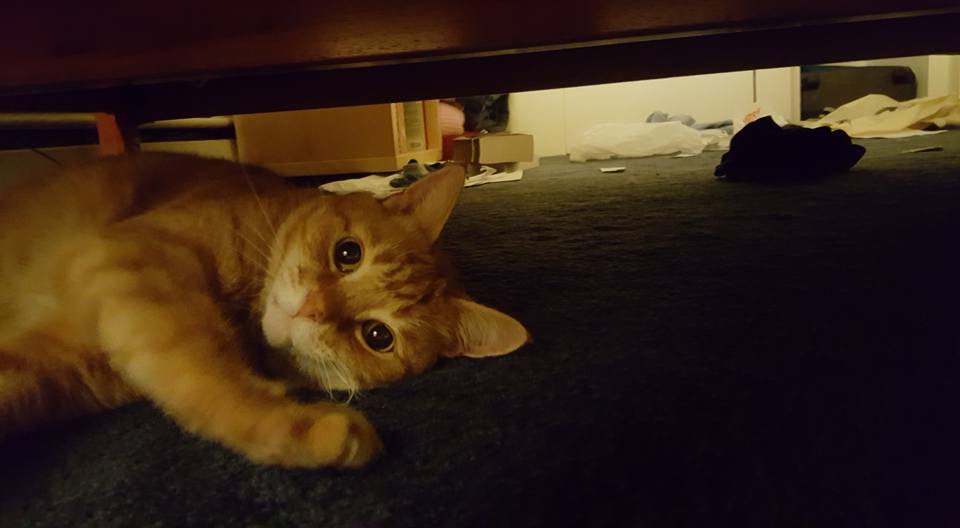
20170122_224258_001

you say “more?” and he says “yes” and then you say “even more?” and he says “yes” and you say “i have no more left” and he says “yes” and you say “but i cannot stop?” and he says

yes