One way I wrap my head around the idea of God’s infinite and unconditional love (as I think of it — you may have an entire different relationship with God that is so personal you only whisper about it to each other and you may also just not have an interest in God even a little and you’re thinking, “Oof. JonBenet Mike was pretty rough; do I want to deal with God Mike too?” And you may not. And I love you anyway) is I think about my cat, Little Baby Fosco, and how it’s impossible he can understand the true depths of my love for him. He just can’t. He’s a cat. I’m a human. For you it may be a dog. My love for Fosco is literally unconditional and all-consuming. I hope to God your love isn’t a lizard.
(Btw, we all wanna say we love our partners with perfect unconditional love, but that’s a metaphor and we all know it. There are always some conditions there.)
There’s nothing that will ever make me stop loving Fosco. L i t e r a l l y nothing. He has pooped on the bathroom floor on ::more:: than one occasion, often out of spite, and Zach would only get maybe TWO accidents like that. See: conditions.
He is my world, this cat. I am MAYBE in his top 20. I don’t care. I love him with no reservations, no agendas, no emotional baggage. Oh, and by the way, there are two other cats in this house here and I love those fuckers equally as much too (except Peter, who I love, but…all of have sinned and fallen short and yadda yadda yadda).
Anyway, all that gushing about my cat is like God and me. I cannot comprehend something like God, or God’s love. I think I feel it, and I’m sure that’s real, and it’s also nowhere near to what God is thinking/feeling about me at any given moment. And God only ::sometimes:: makes it into my Top 50. (I could love God a lot more than I do. We’re still in the “Oh, you load the dishwasher ::that:: way” phase.)
AND GOD DOESN’T CARE. God isn’t holding emotional grudges. What’s being offered to me, to you, (unless you ::really:: don’t want it/don’t believe/are doing good on your own/gave at the office), to all of us is this exceptionally uncomplicated love.
I’m going to start with the easy stuff before it all falls apart.
These are 10 important books to me:
Wolf Hall by Hilary Mantel. I think her exploration of power, and its intersection with personal animus, is thrilling. Will she ever finish the trilogy? She is my generation’s George R.R. Martin. (I also appreciate her portrait of Henry, who too often is a caricature of a horny monster. Antonia Fraiser, who has written a lot about Henry and his wives, made the great point that while we know Henry is going to marry six women — and kill two of them — Henry doesn’t know this about himself. Each marriage was the answer in his head.)
Independent People by Haldor Laxness. It’s grim, and Icelandic, and is so achingly human about despair and disappointment. Zach recommended it to me when I was looking for non-English novels to assign to my group.
The Makioka Sisters by Jun’ichiro Tanizaki. Painfully, achingly human and blackly funny. It’s a grim Jane Austen novel with more diarrhea. It’s set in Japan right before World War II, and explores modernity in a country on the brink of being decimated by atomic bombs.
Religion and the Decline of Magic by Keith Thomas. He’s looking at 15h and 16th systems of magic, and then how that is incorporated into traditional religious belief. Thomas doesn’t question people’s vocation. If someone identified as a necromancer, he calls them a necromancer and then doesn’t feel the need to whisper to us in the next sentence, “Of course necromancers do not exist.” He trusts his readers enough. I read a book about Madame Blavatsky and the guy writing it was so mean about her weight, and personal appearance, and sneered at everything Blavatsky did. I am not attempting, in a list of beloved books, to rehabilitate the life and career of Blavatsky. But I don’t need that guy in my ear being a jerk.
The Complete Flannery O’Connor by Flannery O’Connor. Her religious world view is singular and fierce and very Old Testament. (A mentally handicapped boy is drowned in a pond as a kind of baptism and that’s considered a happy ending for that kid.) My personal bible is engraved with this quote from O’Connor: “Grace changes us and the change is painful.”
The Complete Gerard Manley Hopkins by Gerard Manley Hopkins. His descriptions of nature — “skies of couple-colour as a brinded cow”, “my heart in hiding stirred for a bird”, “Goldengrove unleaving” — feel essential to me. My friend Steve gets so mad about Hopkins seemingly giving up his poetry for his life as a Jesuit, so anytime we talk about Hopkins, we talk about that. But I’d rather discuss the poems.
Dickens: A Biography by Peter Ackroyd. It is as long as two Dickens novel, and there are several sections where Ackroyd imagines conversations with Dickens and his comrades that can get a little smurfy. But for someone like me, with a fascination with the 19th century (my lectures tend to focus on Victorian society, culture, literature, morality), it’s such a densely rich package of information. And you can’t understand England in the 19th century without understanding Dickens.
The Woman in White by Wilkie Collins. About 20 years ago, I picked up a copy of The Woman in White at a used bookstore and was hooked from the opening line. (“This is the story of what a Woman’s patience can endure, and what a Man’s resolution can achieve.”) After finishing it (oh! One of my favorite reading moments in my life is being on the Metro to work and reading a scene in the novel where you find out that someone wicked has read someone else’s diary and how that is revealed was so shocking to me that I honestly gasped and put the book down and the woman sitting next to me asked if I was okay. “No, I am not,” I said. “Something scandalous happened in my book”) I wanted to learn more about Wilkie Collins, a man I’d never heard of until that moment. So I got a bio of him and that’s when I started to unravel a lot of bad, received wisdom about the 19th century. The Victorians are used as a strawman for prudery and repression, but reading the lived lives of those 19th century denizens really solidified my belief in Performed Morality (what we profess publicly so others will think we’re good) and Actual Morality (what we do in the shadows), and that we in the 21st century are not much different from our Victorian cousins except we dress for comfort and don’t die from cholera as often.
Alice in Wonderland by Lewis Carroll. The first chapter book I remember falling in love with. I’ve read it countless times. I think it’s what defines me as a reader. When I taught it several years ago (I keep using the word “teach” and it occurs to me that I need to clear some stuff up and I’ll do that after this list), and really thought about the book and my relationship to it, I was surprised to realize that when I read it as a boy in, what? The 1980s? I had no idea it was an Old Book. Alice dressed differently than I did in the illustrations, but there was no sense that we were separated by 100 or so years.
Life of the Beloved by Henri Nouwen. It’s a spiritual book that didn’t make me feel cringey while reading it.
Now. More About Mike.
I am a college drop-out. I never finished. I tried, but I was both Too Poor and Too Mentally Ill in my late teens and early 20s. What I know, I know from self-teaching and listening to people smarter than I am. My day job is in financial regulatory compliance (I explain laws and regulations to people in the debt industry to make sure they’re on the right side of consumer law in their acts and practices), and I’ve cobbled together a side-gig as a teacher for adult continuing education. I didn’t want to leave you with the impression that I am something — a college graduate or some other sort of papered smart person — that I am not.
Now, to our Darker Purpose. I want to start by saying that I am about five steps behind you in all of this. I think you are incredibly well-educated in the language of rhetoric and philosophy, and I’m just very handsome and Trying My Best. This isn’t me asserting false modesty, or looking for some affirmations in return. I just want to be honest about where I am able to meet you w/r/t this conversation.
1) “we’re probably approaching the question of religion with two completely different paradigmatic approaches – mine seems to be more coldly philosophical, and yours seems more intent on finding meaning and happiness.”
I think, embarrassingly, this could also be described as, “You, John David, have given this all much more thought than I have; I’m just making my way through by feeling.” Because I don’t feel the pressing need to proselytize or convert, I also don’t feel the need to defend my faith from anything other than gross simplifications and lazy talking points. (This is ironic, of course, because I just got finished suggesting that I am a lazy, unthinking believer. We’ll just have to embrace this mystery!)
I approach religion as something I want to live with (and you will say, “No, I get it, but why?”), and you approach it as something you want to make sense of. You bring up Kierkegaard at some point and I raised both hands above my head in the universal sign for “this child needs help” and Zach kind of explained it to me, but I guess what I’m saying is, “Meet your new best friend Mike Bevel who takes Leaps of Faith all the time!”
2) “if you’ll grant me the liberty, I wanted to ask some deep and probing questions about what you said in your last e-mail. As I hope you know, absolutely nothing has the purpose of offending you. I’ve been really delighted to share in this correspondence with someone so kind and thoughtful, so I’m genuinely interesting in learning something about how you might approach these questions other than what you might consider to be my cool, objective, distant approach.”
I have only been delighted with every interaction we’ve had, and at no point do I feel you’ve been offensive. You can ask, and argue, and push back, and even express frustration. You are at 100% trust right now.
3) “I’m assuming that you’ve heard the saying that ‘anecdotes do not constitute data.'”
I didn’t list this with the other books (I don’t think the whole book is as strong as its thesis), but have you read Wendy Kaminer’s Sleeping with Extraterrestrials? She argues that, somewhere along the way, this deformed sense of propriety infected discourse and we have stopped asking follow-up questions to extraordinary claims. If someone says “I was taken aboard an alien spacecraft” or “Jesus appeared in my room last night” we (the universal “we”) worry that we’re rude if we say, “I don’t know if I believe that.” Kaminer wants us to ask more questions.
4) “What about your mystical experiences, if anything, led to you in the direction of a different conclusion – keeping in mind of course, that when someone tells you they were abducted by aliens, you would be likely to question their sanity, not engage them in rational discussion…”
Because I wanted it to be God. I think that’s probably a frustrating answer. I’m not using rationalism — and I think you are much more developed along that line. Because it felt like what I had always imagined God would feel like. (Have you seen Russian Doll on Netflix? One character attempts to bring up morality as a cause for the time loop they’re in, and another says, “The universe is moral and just happens to have your ideas about morality?”) But there isn’t anything rational about the experience.
Language fails me a little when we get here. I don’t believe that God is a person. I don’t believe that there is a place we go after this life that matches the artistic ideals of Heaven. I think God wants us to live this life here, and live it as well as we can, doing as little harm to those around us and trying as much as we can to love everyone, or at least to respect the belovedness in them. I don’t believe in miracles. I don’t believe intercessory prayer works. I think there’s a force in the universe that is good, and I want to align myself with that goodness in the universe.
(But man would I love an afterlife. It’s my narcissism. I think that I am so important that of course I should continue to live, just as I am, for all of eternity. I know it’s not true, but I want it to be true.)
5) “You said in your last email that the connection ‘with what I’ve decided to experience as God … has encouraged me to continue as a believer. Specifically, I’d like to ask this. What about that experience led you to believe that it was God?”
This is question 4 again, and I remain just as unable to describe it to you. I always get anxious in these situations because I don’t want to give the impression that my not being able to answer it means that it’s unanswerable. (It might very well be unanswerable.) It just means I am not yet smart enough to explain it. (And I may reach a point where I am smart enough and then the answer will be, “Oh, you did all this for nothing.”) And maybe that’s why faith is: the belief that you’ll eventually be able to explain the unexplainable.
“But why do you love carrot cake so much?” you could also ask, and I could only answer, “Because it tastes incredibly delicious and I am not a monster.” Why do I think it was God? Because it checked all my boxes for what God would feel like. The experience felt large and ineffable, but also suffused with love. I’d never experienced it before.
I’ll show a chink in my Armor of Faith: There are times where, especially when I dip into a depressive state, and I don’t feel that experience of God, where I begin to doubt, well, a lot of things. I doubt God. I doubt myself as a believer. I doubt the experience itself. I don’t know if I’ll ever live a comprehensive life of untroubled belief. That doesn’t worry me.
6) “If it was really a God, why doesn’t It/He/She want everyone to know that It exists, and why does It so readily reveal itself to some people and hide itself from others?”
I have two answers for this.
Mike Bevel: Christian — God reveals himself* to everyone, all the time, and is always talking to us and making himself known. We just don’t listen. God is love, and that gets in the way of our selfishness. There was a parody ad Y E A R S ago, with a woman on screen, showing a face of distress, with an anvil on her head. She says to the camera, “The pressure is unbearable. I feel it here, and here, and here. I struggle with how to deal with this pain.” And an off-camera voice says, “Have you ever thought about taking the anvil off your head?” And she says, “No, I hadn’t. But I’m willing to try anything.” There’s a screen-wipe to show the passing of time, and the woman is back on screen, this time looking calm and happy, and with no anvil on her head. She says, “It’s gone. The pressure’s gone. The agonizing pain. All of it. Gone.” And the off-camera voice says, “Would you try taking the anvil off your head again?” And she says, hopefully, “Yes! Yes I would take the anvil off my head.” It’s a parable, John David.
[* I am not great at un-gendering my language around God. I don’t believe that God has a gender of any kind; but I think of him in male terms because that’s what I grew up believing and hearing. It’s not great.]
Mike Bevel: Doubting Thomas — Yeah. I don’t know. That’s a good question. God is a Chatty Cathy throughout so much of the Old Testament*, and now we seem to have more silence than anything. It can feel devastating.
[* I am a Baptist. But I have a LOT of affinity for the Gnostics. And I’m more Marcion in my reading of the Bible than not.]
7) “You’ve said something that I’m afraid not many Christians are willing to admit: ‘I believe God exists not for any tangible reason.’ Is there any other arena of decision-making or thought aside from the spiritual/theological where this assertion would not be scoffed at?”
I guess I’d ask back how do you handle personal preferences in your worldview? Because that seems to be an irrational exception rationalists make. Here, for instance, is a list of foods I hate:
Cantaloupe
Eggplant
Celery
Cooked Celery
Cooked Carrots
Hominy
Green Peppers
Any Cooked Peppers
Chocolate
Unidentifiable Chunks of Things That Cause the Texture of a Dish to be Upsetting
8) “Your assertion that ‘I believe evolution is wrong not for any tangible reason’ is going to be met with utter bewilderment by scientists.”
I was VERY worried that at some point I expressed some creationist sympathies. I think you’re making a hypothetical point here. And I just want to go on the record to you, friend to friend: I 100% believe in evolution.
But.
I don’t understand at all how it works. I accept it on faith. I accept that smarter people than I am have a handle on it. I think we’re refining our ideas about it all the time because our science gets better and better. (We can’t really say that about religion, though, can we? Religion more often than not wants to firmly entrench itself in dogmatism and doesn’t take kindly to, “Well, here’s some new information you may want to incorporate.”)
I sometimes find myself deeply depressed and embarrassed that so much of how the world works is as much an article of faith for me as my belief in religion. I am not saying that religion and science themselves are two sides of the same coin; I’m just saying that in my thieves’ pouch, they are. (I will watch the fuck out of a science documentary, btw.)
9) “I think you have said perhaps one thing that is incorrect, and I want to see what you have to say in response. You said, ‘I’m making choices toward belief because my years of disbelief left me sad and depressed and empty.’ I’m certainly glad that you’re no longer experiencing those emotions anymore. However, in the very sentence before that, you said ‘God may or may not exist.’ Do you think that your psychological state was so vastly improved by the existence of something you haven’t even convinced yourself of? If you’d had said ‘God exists, I know him, and I can feel him,’ then I would be much more convinced of that feeling being responsible for your (what I hope is now non-existent) sadness and depression. However, how can that sadness and depression be conclusively gone if you haven’t even fully convinced yourself that the cause of your happiness even exists?”
This is a complicated question. They’re all complicated, actually, as far as I am concerned. But this one. Whoo-boy.
I am mentally ill. I am mentally ill and treated, right now, and it’s going great, thank you for asking. I am prone to:
Depression
Anxiety
Intrusive violent thoughts
Obsessive-compulsive ideation
Some of that might be genetic. Some of it might be nurture. (My childhood Wasn’t Great.) And it’s so easy (whether it’s correct or not) to write off my experiences as “Ohhhhhh. [makes spiral gesture around ear] Got it.” God didn’t take any of that away — that was all Western medicine and talk therapy. (Psychiatry, by the way. I mean, talk about taking things on faith. “Let’s just see what happens when this medication originally developed for avian diabetes gets into your brain” is as nutty as any religious belief.)
When I say that God may or may not exist, I think what I’m trying to do is provide a space for the other person to feel safe in their disbelief. I don’t want to convert someone through conversation. So, I believe God exists, but I am not troubled at all being fully in communion (heh) with someone who doesn’t believe in God at all. Like, for instance, Zach. He’s an atheistic Buddhist. He does not share any of my religious beliefs. I love that guy so fucking much.
My sadness and depression may never truly be gone, because I may just not have a brain that makes the typical amount of whatever, we’ve established I’m no scientist. But what I’m getting better at, both with my belief in God, and just through trusting myself, is not blaming myself for my feelings. That’s a fun game I run: Oh, I am sad, must be because I did something super shitty and this is the way the world works. Why I’m not a Calvinist I don’t know. If I ever start talking like a Calvinist, that should be your cue that I’m on the road to Self Harm.
John David: I love these emails with you so much. Thank you for your kindness, patience, curiosity, and deep intelligence. This continues to be such a pleasure. I’m so glad we met.
God said:
Let there be a dome amid the waters,
And let it separate waters from waters!
God made the dome
And separated the waters that were below the dome from the waters that were above the dome.
It was so.
God called the dome: Heaven!
— Everett Fox, The Five Books of Moses
What does it mean to find something good? I hadn’t even really thought about that question at all until I realized there are three places where God isn’t pleased. Not angry, necessarily, but not announcing that “it was good” either.
On the first day (Gen 1:3-5), when God separates the light from the darkness — (by the way, I am sure that there are a frillion midrash stories from old rabbis that have made this point; I also can’t be sure that I came up with this point all on my own; it’s possible I read it somewhere and it germinated in the back of my conscious) — that doesn’t get a corresponding “and it was good.” There’s an “it was good” for the creation of light (Gen 1:4), but no “it was good” for separating.
On the second day, God separates waters from waters, and this is also not labeled as “good.” Here, we get a perfunctory “it was so.”
On the sixth day God creates humans, separated into male and female. The humans are blessed (Gen 1:28) — but that’s not the same as being called “good,” is it? Because God sees that “the wildlife of the earth after their kind, and the herd-animals after their kind, and all crawling things of the soil after their kind” were good (Gen 1:25); humans, though, are not singled out for goodness, only a blessing. Their lives are about to become impossibly hard, with a final separation of human from garden.
I think it’s the act of separation that’s being commented on, obliquely, by shrugging a little out of the “good” light and into the “doing your best” column. Separation is not creation.
Fox in a footnote says that this is an example of “God bringing order out of chaos, not creation out of nothing.” (Cf n 2, p 13)
Creation out of nothing has been a frequent argument used by atheists — or “people who exhaust me at any party” — to explain the alleged (dare I use the word) jejune philosophy and cosmology of Genesis. “How can something come from nothing?”
(Jejune is one of those words I read when smart people write and I think I’m using it correctly, but maybe you’ll gently correct me in the comments if I meant some other word entirely.)
This isn’t helped when theologians and Bible scholars use phrases like ex nihilio — a fancy, Latinate (?) way of saying “out of nothing” — to describe what the Bible itself doesn’t say. This isn’t creation out of nothing, and we might misread the Bible if we think of creation in this way.
It can be a translation issue, too. Fox’s translation gives us an earth that exists, but is an unorganized wild waste. The King James, New Revised Standard Version, and the New International version all use some form of the phrase “formless and void” (or “empty” or “without form”). And it’s those translations that have fed this orthodox idea of creation ex nihilio.
(“Orthodox” is a key idea here. Just because something is orthodox doesn’t make it immediately suspect, just like radical readings of the Bible also have value. I’m using “orthodox” in more of a “received wisdom” way; but the Bible is for reading and interpreting.)
But we have a chance to read this passage differently. It’s order out of chaos. I almost want to say that order out of chaos represents a moral universe; however, when we get to Eve’s temptation (Gen 3:1-6), I think something else is being said about aesthetics and morality, and order out of chaos has the objective trappings of aesthetics. Order isn’t necessarily moral.
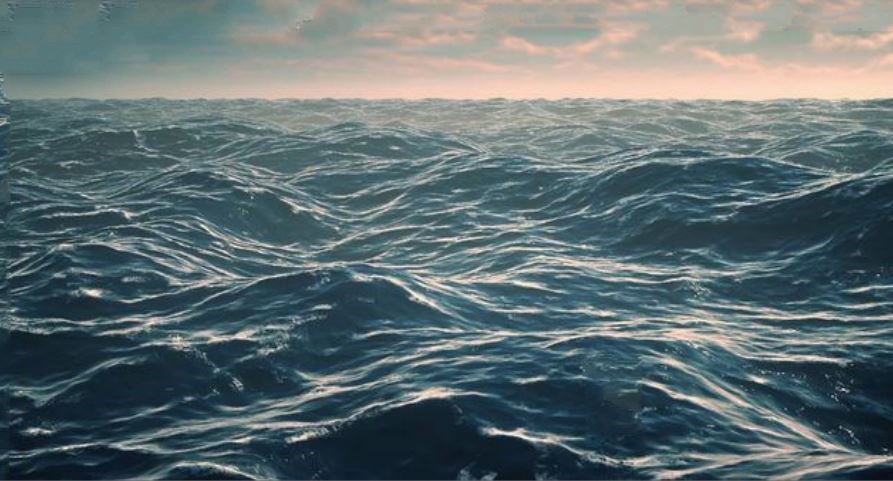
We’re left, though, with creation out of something: out of the wild and waste. Out of Ocean*. Out of whatever darkness is. We have to be willing to read with new eyes.
[* Fox notes (n 2, p 13) that Ocean, capitalized, could refer to a “divine image” of the primeval waters. It’s also useful to note that when god separates waters so that land and water are separated, he calls them seas, rather than Ocean, because he does not want to recognize/invoke another deity. This is also why the Bible uses the clumsy designation “greater light” and “lesser light” rather than Sun and Moon. Those words, in Hebrew, are the names of deities, and the Bible wants to impart a monotheistic vision.]
The Parable of the Workers in the Vineyard (Matthew 20:1-16)
“For the kingdom of heaven is like a landowner who went out early in the morning to hire workers for his vineyard. 2 He agreed to pay them a denarius for the day and sent them into his vineyard.
3 “About nine in the morning he went out and saw others standing in the marketplace doing nothing. 4 He told them, ‘You also go and work in my vineyard, and I will pay you whatever is right.’ 5 So they went.
“He went out again about noon and about three in the afternoon and did the same thing. 6 About five in the afternoon he went out and found still others standing around. He asked them, ‘Why have you been standing here all day long doing nothing?’
7 “‘Because no one has hired us,’ they answered.
“He said to them, ‘You also go and work in my vineyard.’
8 “When evening came, the owner of the vineyard said to his foreman, ‘Call the workers and pay them their wages, beginning with the last ones hired and going on to the first.’
9 “The workers who were hired about five in the afternoon came and each received a denarius. 10 So when those came who were hired first, they expected to receive more. But each one of them also received a denarius. 11 When they received it, they began to grumble against the landowner. 12 ‘These who were hired last worked only one hour,’ they said, ‘and you have made them equal to us who have borne the burden of the work and the heat of the day.’
13 “But he answered one of them, ‘I am not being unfair to you, friend. Didn’t you agree to work for a denarius? 14 Take your pay and go. I want to give the one who was hired last the same as I gave you. 15 Don’t I have the right to do what I want with my own money? Or are you envious because I am generous?’
16 “So the last will be first, and the first will be last.”
Matthew is the only one who tells this story. There aren’t enough demons in it for Mark; Luke, the tax collector, could never wrap his head around the message; and if anyone ever figures out what John is saying every moment that he says it please never tell me my heart thrills for mystery.
* * * * *
This Parable of the Vineyard Workers invites us to imagine being paid the same wage for one hour’s worth of work as someone working eight hours. (It also invites us to really pay attention to contracts.) Matthew’s radical message, delivered by Jesus, is that the reward is the same for the person who has made a life-long profession of love for God as it is for the person who has only made an hour’s worth of profession. It is radical communism. And it’s upsetting.
(Pastor Jill brought the parable up to modern times, relating about an early job experience where, as a young professional with no family and no calls on her time, she was able to work long hours. She learned, however, that a colleague performing the same job function as Pastor Jill, who was also a single mother, with two kids who needed ferrying to school and then to whatever kids do after school, was paid the same amount for fewer hours. And what never occurred to Pastor Jill, or even to the people who promoted her for her performed extra work, is that unaccounted labor a single parent has to provide. All labor should be compensated.)
I think the parable wants us to get comfortable with the fact that Jesus spends most of his limited time on earth concerned — and getting others to be as concerned — with how we love our neighbor, rather than with, “Am I getting into heaven? Have I done enough? Is there a chance I could be found wanting?”
You cannot be found wanting. Heaven is already guaranteed. If we wipe all that accounting off the recknoning board, we’re left wondering, “Then why do any good works? Why should I care about what happens to anyone else within my sphere of even limited influence?” And you do it because not doing good (never mind if you are good) will cause you suffering. You can say, “Mike.” You don’t have to believe what I believe. “You do not have to walk on your knees for a hundred miles through the desert repenting.” But you should do goodness and give lovingkindness because it is good for your soul. Because not only is it decreasing your own suffering, it is decreasing the suffering of another human being. Because Jesus tells us to love our neighbor as he has loved us.
* * * * *
Peter Singer
The utilitarian philosopher Peter Singer argues that $30k a year is actually sufficient for anyone to live on; we just happen to be in a paradigm where millionaires control a lot of our well-being. Everything over $30k should be donated to social service networks and given directly to the poor.
This is a terrifying prospect for many to grasp. It puts us all at the same risk for needing assistance from time to time. But why is that seen as a weakness? Why isn’t our need a gift for those who have? Why are we unwilling to be humble and accept grace and charity? Why do we only feel as if we can give if we have extra, when what is expected is that we’ll give because it is needed. Think of any canned food drive you’ve ever participated in and consider what you donated. It was likely food you yourself weren’t all that crazy about eating. Was that an act of charity? They’ve likely been hungry longer than you’ve been hungry. How will you work out this moral calculus?
* * * * *
Whirling Dervishes
There’s a poem, attributed to Rumi, who is the Abraham Lincoln of Sufi mystics in that too many things get tagged with his name when he may or may not have actually said it. (He’s like Jesus and Paul in that way, too.)
Come, come
whoerver you are
wanderer
worshippper
lover of leaving it doesn’t matter!
Ours is not a caravan of despair.
Come, even if you have broken your vows a thousand times.
Come.
Come yet again.
Come.
That’s what the Parable of the Vineyard Workers is teaching us: even if we have broken our vows a thousand times, we are as worthy and deserving of God’s love the thousand-and-first time as we were at the beginning. Even yet again.







 How to Read: with Mike Bevel