Categories
Belief Bible Study Genesis Old Testament Tanakh

Lot & His Daughters, or, Hospitality Gone Terribly Wrong

There are Bible stories that aren’t in the Bible, and it occurs to me right now that I could spend a lot of time not writing at all about Lot and his daughters and just talk about how the Bible came to be, well, The Bible. Another time perhaps. Just know that there are more gospels in existence than you may be aware of, and there are extra-Biblical writings that fill in the gaps to a lot of the stories.

For instance.

The rule in Sodom was, “Whosoever giveth bread to a poor person shall be burnt at the stake.” That’s not in the Bible, but in the writings of the Rabbi Rashi, a Talmudic and Tanakhic commentator, who lived in France in the 11th century. (The Talmud is a collection of Jewish scholarship on the Tanakh. The Tanakh is essentially what Christians call the Old Testament, but which we should probably get in the habit of calling the Hebrew Bible.)

Rashi continues: Plotit*, the daughter of Lot, who was married to a prominent Sodomite**, saw a man so poor and so hungry that he was unable even to stand. Feeling sorry for him, each day she would give him a little food she had saved on her way to the water well.

(* Lot’s daughters, and his wife, are not named in the Bible. In the Book of Jasher, which doesn’t exist, but did, because it’s quoted in the Bible and in other texts at the time, Lot has four daughters and no sons. Two of his daughters were married; two were betrothed. Lot’s wife is named Irit.)

(** Not what you’re thinking, gang. This is a reference to someone living in the town of Sodom. Was he gay as pants? The midrash is silent on this.)

People in Sodom soon found themselves wondering how this man, poor and hungry near to death, was not, in fact, dying. Maybe their hope was: he’ll starve to death and we won’t have to worry about not feeding him. Maybe that’s also our hope when we see panhandlers. History doesn’t repeat itself, but it rhymes.

Then, the discovery: that the man wasn’t starving any longer, that Plotit had been secretly feeding him, and for her generosity, she was burned at the stake. Before she died, she cried to heaven: “Master of the World, carry out justice on my behalf!”*

(* In some stories, it’s fire. In others, she’s tied to a tree, drenched in honey, and left to be stung to death by bees. In some stories, JFK is shot by a lone gunman. In other stories, there’s a cabal. There is always more than one story to any one story.)

In the Bible, we need a bit of a prologue before we launch back into the Lot story. There is a man named Abraham. He is 100 years old. He has a wife, named Sarah. She is 90. One day, God appears to Abraham in the form of three men. (“IT’S THE TRINITY!” fundamentalist Christians will say and (a) of all, no, it isn’t; this is a Jewish text. Also, too, the Holy Spirit isn’t necessarily a man. In fact, in Gnostic tradition, the third part of the trinity, the Holy Spirit, is feminine, and possibly God’s wife.)

God has come to Abraham for two reasons: (1) To remind Abraham that his wife Sarah will bear him a son, to be named Isaac; and (2) To investigate Sodom and Gomorrah. “The outcry against Sodom and Gomorrah is so great and their sin so grievous that I will go down and see if what they have done is as bad as the outcry that has reached me. If not, I will know.” (Gen 18:20)

(There’s a wonderful moment in this story where Sarah overhears the visitors when one says that she will have a baby within the year. She laughs — because, again, she’s 90 and her husband is 100. She says, “After I am worn out and my lord is old, will I now have this pleasure?” And God says to Abraham, “Why did Sarah laugh?” And Sarah, in a very human moment, feels embarrassed at being caught laughing at a visitor and says, “I did not laugh.” And God, ever the one to have the last word, says, “You totally did.” This is in Genesis 18:1-15.)

We’re getting to Lot and his daughters. But there’s a little more scene setting. We have to go back to the midrash, because this outcry against Sodom and Gomorrah confused rabbinical scholars.

Why, they wondered, was the singular feminine “her cry” (הַכְּצַעֲקָתָהּ) used instead of the expected (and masculine) “their cry” (הַכְּצַעֲקָתָם)? (The feminine is entirely erased in English translations, using the neuter “the outcry.”)

And now we can begin to introduce Lot, his daughters, and his wife back into the point of it all.

The early interpreters of the Torah said, “‘Her cry’ is the cry of Plotit, crying to God for justice. He heard it, and he came down to Earth to investigate.” Modern scholars might argue that Sodom and Gomorrah are sister cities, and the “her cry” means the city’s own cries for justice. Modern scholars say a lot of things.

God sends two angels — oh boy. I’ll deal real quick-like with angels, but maybe I’ll write about angels fully another time because they are complicated and weird. Often, where the word “angel” appears in the Bible, it really means “messenger.” These were human(ish?) people, with no wings. But sometimes angels mean supernatural beings in extraordinary shapes and that’s not what these angels are, who appear with God before Abraham. In fact, the text is pretty opaque as to whether or not the three visitors to God are all one person (“TRINITY!” NO NO NO. We’ve been OVER THIS.) or if it’s God, and two friends.

Anyway. God sends two angels to Sodom to check things out, and destroy both Sodom and Gomorrah if necessary. (I’m leaving out the whole marvelous bargaining scene between Abraham and God where Abraham says, “But what if there are 50 righteous people?” And God says, “Then I’ll back off.” And Abraham, maybe aware of the reputation of Sodom and Gomorrah, says, “Well, but maybe 40?” And God says, “For 40? Sure.” And Abraham bargains all the way down to 10 righteous people. Keep that number in mind.)

Someone else may ask me to write about homosexuality and the Bible, and I will, even though it makes me tired. When the angels arrive, they meet Lot, who is “at the gate.” He’s a businessman/ambassador, essentially, but he’s also New In Town. (“Excuse me, I am homeless, I am gay, I have AIDS, I’m new in town.”) The Sodomites, who already aren’t known for their stunning hospitality, are also a little frustrated about this out-of-town upstart who has risen pretty high in the heirarchy of Sodom. When Lot ushers the two visiting angels into his home (btw, Lot has no idea that they are angels), “the men of the city, the men of Sodom, both young and old, all the people to the last man, surrounded the house; and they called to Lot, ‘Where are the men who came to you tonight? Bring them out to us, so that we may know them.'”

To “know” someone in the Bible is essentially to fuck them. Just like “feet” in the Bible are almost always a euphemism for dick. Look, I didn’t write the Bible. We’ll talk more about feet, btw, when we get to the Book of Ruth.

And this is where your fundamentalist/literalist/asshole jerks will start with their anti-gay nonsense. What I want to ask you all to do, just for the moment, is say, “Fine.” Say, “The Bible hates homosexuals and homosexuality.” (It doesn’t.) IT DOESN’T MATTER NOW. The Hebrew Bible was not written for us — and that “us” is doing a lot of heavy lifting because I mean “Christians” and “Modern people” mostly. This is how things were in the Olden Timey Days, but cultures grow. Don’t let a book written by people who WOULDN’T LET WOMEN SIT ON COUCHES IF THEY WERE ON THEIR PERIOD dictate your relationship with whatever god you have. (Please don’t recommend “The Red Tent” to me that book is terrible.)

The Sodomites want to sodomite, and Lot wants to be a good host and not allow his guests to be effed in the bee by “all the people to the last man” (which I find hard to believe because I know a LOT of people who won’t leave their house in the evening because once you’ve taken off your daytime toga and put on your nighttime toga you are IN for the DAY) and so he does what any host would do.

He says: “Look, I have two daughters who have not known a man; let me bring them out to you, and do to them as you please; only do nothing to these men, for they have come under the shelter of my roof.” (Gen 19:8)

What do we, as believers — as Christians and Jews — do with this? The Bible is silent in a lot of places where it sure would be nice to have a few additional lines of dialogue. In the Binding of Isaac, it would be nice to know if Abraham and Isaac talked at all on the way back down the mountain, and what did they talk about, and did ANYONE say, “That was…that was weird, right? What we just did? You, my father, trying to slaughter me, your son?” And here, in the Lot story, we don’t hear from the daughters about this bargain.

Scholars of the Ancient Middle East will make a lot out of this idea of the importance of hospitality. And I’m not saying that that’s not valid; I’m just saying that it still isn’t comforting to me, a person in the 21st century. I cannot imagine at any point offering my beloved Little Baby Fosco, Jasper St Jasper (International Cat of Mystery), or Peter the Wicked to my neighbors to rape instead of my guests. (They’re the closest we have to daughters and ugh, you know what’s exhausting? People who get irritated when childless folk call their pets their children. IT’S NOT FOR YOU, PEOPLE WITH CHILDREN.)

And that’s what you want to know, right? How could God allow this? How is Lot a righteous man in the eyes of God if he’s willing to debase his daughters and actively participate in their sexual assault by, again, “all the people to the last man.”

Beloveds, I can’t answer that.

In many ways, as Believers, specifically Christian believers (because I’m not Jewish and cannot speak for the Jews but I do know some Yiddish and my husband is a Jew so: I mean, I layed it all out for you), we need to separate the Bible from our faith. The Bible captures a system of belief of a very specific time, and a very specific place, and of a very specific people, who are nothing like us. The Bible is filled with stories of extraordinary violence — violence committed by man against man, and violence committed by God against people. But it also has the Gospels (for Christians). And it has messages about radical justice for the poor, and the broken, and the lonely. Ultimately, the Bible is a book, and it can be your book, and you can take from it what is meaningful to you and you can ABSOLUTELY leave the rest out, especially if it’s toxic and hurtful to you.

Lot’s daughter, with her dying breath, called out for justice — at least in the midrash. And it’s our difficult task, when we read these passages, to decide if she got justice or not.

The angels, by the way, rescue Lot, his wife, and his two daughters. (Remember, though, that in some stories Lot has four daughters.) Lot tries to convince the two men who are betrothed to his unmarried daughters to come with them, too, but they decline, because they think Lot is joking. God wasn’t able to find his 10 righteous people. He barely found four.

The angels tell Lot and his family to run as far as they can, lest they be consumed by God’s destruction. They also, like a good fairy tale, tell them not to look back.

Imagine. You are fleeing your home. You are fleeing your life. Something extraordinarily violent and horrible and utterly destructive is happening to your city where maybe you had friends. Maybe you had a favorite place to watch the sunset while eating figs. Maybe one of your daughters, or cats, or whoever, is left behind.

You’d look back, right? You couldn’t help but look back. Looking back is such a normal human impulse. It’s even a loving impulse. And Lot’s wife looks back, because. And is immediately turned into a pillar of salt. And maybe that, too, is like a fairy tale, like when Bluebeard’s wife uses the key she’s not supposed to use to open the closet she’s never supposed to open.

There’s a rock formation near the Sanctuary of Agioss Lot, near the Dead Sea, venerated as Lot’s wife as a pillar of salt.

(The end of Lot and his daughters is bonkers. They flee to a town called Zoar, but, for reasons never explained in the Bible, decide they can’t really stay in Zoar. So they flee to a cave in the mountains and Lot’s daughters get Lot drunk, because they want children, and biological clocks, and dad’s right here, and it’s all deeply upsetting, especially if, like me, you’re a Victorian prude about father/daughter incest, and if you’re not, you might enjoy a book called The Kiss by Kathryn Harrison, but please never talk to me about it, I’m very busy. Each daughter fucks the dad, and they both get pregnant [yay?] and that’s the Biblical explanation for the Moabites, because the eldest living daughter had a child named Moab, and the Ammonites, because the younger living daughter has a son named Ammon. We’ll talk a lot about Moabites when we get to the Book of Ruth.)
Categories
Belief Bible Study Job Old Testament Tanakh

“An Infinity of Silence”: The Book of Job

One of my favorite passages in the entire Bible is Job 42:3: “Therefore I have uttered what I did not understand, things too wonderful for me, which I did not know.”

Job is apologizing to God, after God has spent several chapters How-Even-Dare-You?’ing Job, because Job had the audacity to ask God a question. And that question is Why?

Why is almost always troublesome.” — Barbara Brenner, Hemi: A Mule

Job is a righteous man. He’s so righteous that he gets name-checked by the prophet Ezekiel: “The word of the Lord came to me: Mortal, when a land sins against me by acting faithlessly, and I stretch out my hand against it, and break its staff of bread and send famine upon it, and cut off from it human beings and animals, even if Noah, Daniel, and Job, these three, were in it, they would save only their own lives by their righteousness, says the Lord God.” (Ez. 14:14)

(HERESY BREAK: Marcionism: Marcion of Sinope is often included in writings about the Gnostics, but he’s really more Gnostic-adjacent. Gnosticism in a pinch: God is a secret and only those who can work it out will discover the Kingdom. I’ll write more about gnosticism another time. The Marcion Heresy is this: the God (YHWH) of the Hebrew Bible/(Old Testament) is a completely different god than the God of the New Testament. So, it’s pretty anti-Semitic because Marcion is essentially arguing that Jews worship an unloving, vengeful god, and that YHWH would not be able to produce someone like Jesus. For Marcionites, God/Jesus have always existed, and have always been good; and YHWH was a false god who governed by fear and retribution. Again, it’s anti-Semitic. But also, the God of the Hebrew Bible is often cranky. Like in that passage above? Anyway, though Marcion was labeled a heretic, and his teachings dismissed as heretical, Marcion was also the first person to put together a proto-version of the New Testament. So, we hate him because he’s a heretic, but we owe a debt to him, because he who publishes first wins.)

Job is such a righteous man that God boasts about his righteousness to Satan. “Have you considered my servant Job? There is no one like him on the earth, a blameless and upright man who fears God and turns away from evil.” (Job 1-8) And Satan counters with, “What does Job have to be frightened of? His life is nothing but blessings.” Actually, why am I trying to re-write the dialogue: “Does Job fear God for nothing? Have you not put a fence around him and his house and all that he has, on every side? You have blessed the work of his hands, and his possessions have increased in the land. But stretch out your hand now, and touch all that he has, and he will curse you to your face.” (Job 1:9-11)

And God says, “Deal.” And then tells Satan that he has full rein on everything of Job’s except Job himself. (One thing to be VERY clear about here: This is not the Satan of Christianity. Satan is functioning as God’s opposing counsel.)

Job loses his seven sons and his seven daughters. He loses all his livestock. His servants are murdered. And Job’s response is to rend his robe, shave his head, fall to the ground, and worship God.

(There’s a story that originates with Elie Wiesel: Jews in a concentration camp put God on trial. There’s a prosecutor, and a defense, and the case is laid out over several days, and God is found guilty. He is pronounced guilty by this group of Jews who are in a Nazi concentration camp of crimes against creation and humankind. And then, after an “infinity of silence,” a rabbi looks at the sky and says, “It’s time for evening prayers.”)

The Book of Job is told as a parable or fable. It has that kind of cadence to it. In Job 1, we’re told, “One day the heavenly beings came to present themselves before the Lord, and Satan also came among them. The Lord said to Satan, ‘Where have you come from?’ Satan answered the Lord, ‘From going to and fro on the earth, and from walking up and down on it. The Lord said to Satan, ‘Have you considered my servant Job? There is no one like him on the earth, a blameless and upright man who fears God and turns away from evil.’”

Job 2 starts almost exactly the same way, except this time when God says, “Have you considered my servant Job,” he adds, “He still persists in his integrity, although you incited me against him, to destroy him for no reason.” (Job 2:3)

What you do, as a reader of this story, with God sort of shifting blame and responsibility off of himself and onto Satan is your own precious journey and know I love you so much. I think it’s fucked.

This time Satan says, “But stretch out your hand now and touch his bone and his flesh, and he will curse you to your face.” And God, again, says, “Deal.” But he tells Satan that he cannot kill Job. He can only make his physical being unbearable. (“Though his bark cannot be lost/Yet it shall be tempest-tossed.” — Macbeth, 1.3)

And Satan throws everything at Job. He strikes him with boils. His wife, who I VERY MUCH identify with, says, “Do you still persist in your integrity? Curse God, and die.” (Job 2:9) And Job, who I do not identify with much in this moment, says, “Shall we receive the good at the hand of God, and not receive the bad?” (Job 2:10)

(There’s a counter-echo here, even if it’s only faint, of Abraham’s bargaining with God about Sodom and Gomorrah: “Far be it from you to do such a thing—to kill the righteous with the wicked, treating the righteous and the wicked alike. Far be it from you! Will not the Judge of all the earth do right?” (Gen 18:25) And it’s all an interesting confluence with the Ezekiel section from above. God will protect the righteous — but you have to be absoLUTELY righteous.)

We talked about evil yesterday, and the Book of Job is definitely part of that conversation. When Job dares to ask God, “But why did you do this all to me?” it’s a legit question, and one that God doesn’t answer. Instead, God berates and belittles Job, says, “Where were you when I was making the universe?” and never at any point explains why Job had to suffer (because of a bet), or what divine justice can even be like from such a mercurial deity.

All Job knows to do in the end is to apologize. “Therefore I have uttered what I did not understand, things too wonderful for me, which I did not know.” He’s left the way I often leave Zach when we argue: bewildered, confused, and still not sure what he did “wrong.” (Nothing, by the way. He usually has done absolutely nothing wrong and I just have one emotional setting and it’s ALL OF IT.)

And, after an infinity of silence, we say our evening prayer.

Categories
Belief Bible Study Genesis God Old Testament Seeking

Evil

Roxanne asked about evil. I’ll tell you now, at the beginning, to save you time if you thought I was going to be able to answer this question: I don’t know how to answer this question. I don’t know what to do about evil.

I’ll start with this poem by Duane Michals, “I Am Much Nicer Than God.”

“It was last Thursday, when I heard that Dennis had finally died, that I realized I was much nicer than God. I would never have let him suffer all those months as he did. I would never have invented cancer in the first place. Nor would I permit children to fall asleep hungry, or old people to cry alone. But if it is true, that I with my petty vanity and selfishness are much nicer than God, then I am in despair. I do not have enough compassion and love to protect. Somewhere there must be more love.”

Evil really isn’t that difficult of a concept to wrap your arms around. We innately know what evil is. Evil is something terrible that happens that leaves you powerless. Of course, sometimes it’s something like an earthquake, or a brushfire, and the earthquake and the brushfire themselves aren’t evil. Sometimes it’s an illness like cancer, or HIV/AIDS, but cancer and AIDS themselves aren’t evil. Evil is cruelty and violence, and it is sometimes disguised as caring and love. We experience the effects of evil; maybe evil is like wind: unseen but felt, always around us and we only notice when we’re blown off course.

God, however, of course, created earthquakes. And brushfires. And cancer. And AIDS. And humans, who exacerbate the problems while also being the victim.

Are people evil? We sure want them to be. We want an explanation for bad behavior, that an evil person did an evil thing because evil is in the world. And sometimes, I guess, that’s true. The problem is, the more we learn about the brain, the more we start to see how little control we actually have over our actions. Where I am with evil: there is a lot of bad in the world, most of it caused by humans, and evil is a way of labeling it, but it’s not a useful designation, because we use it like packing peanuts to couch our discomfort. Calling something evil and then blaming God for not fixing it has not worked as an effective counter to evil or as a deterrent to belief in the Divine.

But why does God allow evil? That’s a question any religion that claims a benevolent, omniscient, omnipotent, and omnipresent deity has to answer. That seems to be an especially Christian p.o.v. God has faults and makes mistakes in the Hebrew Bible ::all the time::, and it doesn’t undercut his standing as the chosen god of the Israelites. (Though there is an interesting development, characterwise, with God in the Hebrew Bible: there seems to be some room for polytheism at the beginning; God references other deities*. He then becomes the most powerful of all the deities. And ::then:: he becomes the ONLY deity. Christianity works some polytheism back into the mix with the trinity concept, which may not have been Christianity’s smartest move, but it was in part to create an answer to the question: Is Noah/Abraham/Moses saved, not having had a Christ-experience? John gives us the answer: yes, because “In the beginning was the Word, and the Word was with God, and the Word was God.” I have been chastened by my pastor for my current thoughts on John so I’ll say no more until I’ve read this book of commentary on it.) Christianity wants a benevolent God to have all the Os — omniscience, omnipotence, omnipresence — but also wants there to be sin. And we get the sin problem because now we have to introduce the concept of Free Will. That makes evil ::our:: problem, not God’s problem, and is a really shitty way to think about evil and God if you ask me.

(* Genesis 1:16 is an interesting place to talk real quick-like about translation and editorializing. It’s a curious little passage; here it is in the NRSV edition: “God made the two great lights—the greater light to rule the day and the lesser light to rule the night—and the stars.” It’s identical in the King James, and essentially identical in the earlier 1599 Geneva translation. The Hebrew translation is also very straight-forward — we don’t have any contextual issues where a Hebrew word has been poorly translated. But the phrasing. “The greater light to rule the day and the lesser light to rule the night.” Why not just say “The sun to rule the day and the moon to rule the night.” And it’s because the names for the sun and the moon at the time this text is written down were also the names of Mesopotamian deities. If you’re world-building as a solo entity, you can’t very well say that God created Utu (sun deity) and Nanna (moon deity), so we’re left with this awkward Hebrew work-around that has stayed with us through the current day.)

(Me again: there is an arm of evangelical Christianity that sees the “lesser light” as referring to Satan and I either have a lot to say about this or nothing to say about this we’ll see.)

Theologically speaking, God is at least aware that evil is a force in the world, whether he created evil or not. In Genesis 2:9, we learn that God has created both a tree of life (which grants immortality), and a tree of the knowledge of good and evil. And that good/evil tree is created ::before:: God has created Adam. So man didn’t bring evil into the world, because evil must already exist if it can be detected via fruit.

Later, God worries about the new state of the humans he’s created. Gen. 3:22: “See, the man has become like one of us, knowing good and evil; and now, he might reach out his hand and take also from the tree of life, and eat, and live forever.” The Gnostics will argue that the serpent doesn’t lie to Eve, but that God does. Because Eve and Adam do not die after eating the fruit. Certain Christian sects will say, “They died spiritually in that moment,” or “They lost the chance at immortality.” But immortality doesn’t seem to be part of God’s initial plan for humanity, anyway, since he’s also forbidden eating from the fruit of the tree of life. So evil exists — maybe even independently of God — and God sees knowing the difference between the two to be a terrible burden that he hopes to protect his new humans from.

(It’s also useful to consider that the Jewish tradition of creation is not “out of nothing” or “ex nihilo.” God brings order to chaos, not creation out of nothing, in Genesis 1. Christianity — specifically the early Church fathers — is the one arguing for Creation Ex Nihilo because I guess no one had anything better to do in the early 100s?)

But I do think evil is ::our:: problem. And I think God — the full complement of whatever that experience is — is such a profound mystery that as humans we may never understand the point of any of what we are doing here. We’re born, we live our days as best we can, sometimes doing good, sometimes doing evil, sometimes happy, sometimes broken entirely, and we die, and: [something even if it’s nothing happens]. I love this Tolstoy quote from War & Peace: “You will die and it will all be over. You will die and find out everything or cease asking.”

I don’t think there will ever be a human definition of evil that will make sense — and certainly, and ironically, religion can’t answer the question because we don’t understand the question, fully, even though I said evil itself isn’t all that difficult of a concept to wrap one’s arms around. Since we know that evil isn’t something God is willing/able/allowed to fix, we’re left on our own. Evil exists because humans exist, and our job that we should assign to ourselves is to bear witness to evil and call it out when we see it, and to do what we can for those who are suffering.

(Donald Trump is absolutely evil. As are his children, even Tiffany, and Mitch McConnell. Ellen is evil. Dick Cheney, too. George W. Bush is evil but we have decided he’s cute because Michelle Obama hugged him once. Capitalism is evil. Orthodoxy that seeks to control/gatekeep is evil. Obviously Hitler.)

Categories
1 Thessalonians Baptist Belief God New Testament Seeking

The Good Parts: 1 Thessalonians

But we were gentle among you.

1 Thess 2:7

For you yourselves have been taught by God to love one another; and indeed you do love all the brothers and sisters throughout Macedonia. But we urge you, beloved, to do so more and more.

1 Thess 4:9-10

So then let us not die as others do, but let us keep awake and be sober.

1 Thess 5:6

Rejoice always, pray without ceasing, give thanks in all circumstances; for this is the will of God in Christ Jesus.

1 Thess 5:16

Test everything; hold fast to what is good; abstain from every form of evil.

1 Thess 5:21

May the God of Peace himself sanctify you entirely; and may your spirit and soul and body be kept sound and blameless.

1 Thess 5:23
Categories
Belief New Testament

Martha

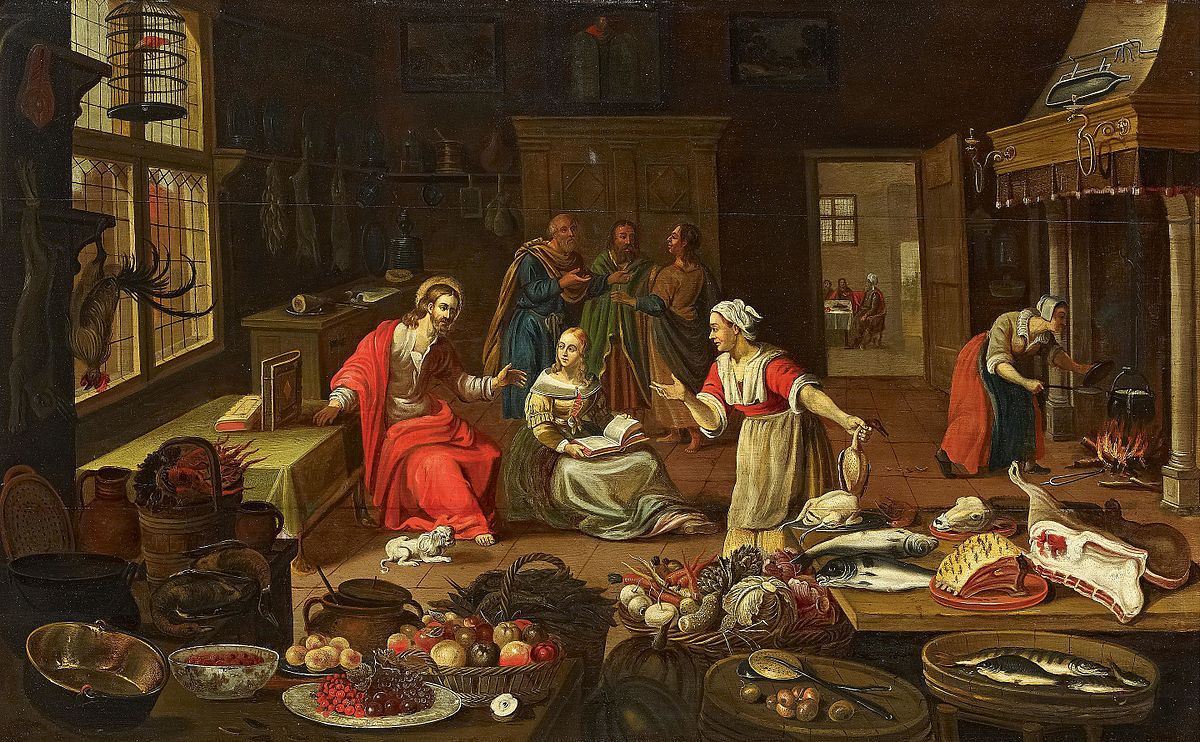
Luke tells us the story of Mary and Martha. This is when Jesus drops in for an impromptu visit and Martha says, “I sure could use some help in the kitchen” and Jesus says, “No you don’t. Be more like Mary.”

It’s not a favorite story of mine from the gospels. It can sometimes be framed as a competition between the two women: Mary, who does right, sits at Jesus’s feet for his teaching; and Martha, who does wrong, refills glasses, wipes up a spill, looks at the pile of dishes like her own Golgotha.

Now. Mary’s action — to sit at the feet of Jesus — is radical. “This is extraordinary,” my pastor explained when she preached on the topic several weeks ago. And it is! It is extraordinary! And wonderfully gnostic, because the Gnostics were VERY open to women engaging with teaching, and teaching as well. Again, though, this isn’t a competition. Martha shouldn’t lose because Mary won.

Some things we can guess, just by being intelligent readers of Luke 10:38-42:

1) Jesus arrives with his disciples. Not necessarily just the 12 we know of. There were numbers of followers who weren’t the 12 Disciples. But let’s just say that it was only the 12 at this repast. That’s still a LOT of people, unannounced, to show up for a visit.

2) The text doesn’t suggest this was a planned visit. I don’t know that Martha had, say, Tuesday, circled in red on her calendar, with “Jesus, etc., for lunch.” So a guy shows up with a bunch of people, and Martha welcomes them into her home.

3) And it’s MARTHA’S home. That’s something to note. The text says, “a woman named Martha welcomed them into her home.” Not her husband’s home. And it isn’t her husband granting permission. Martha has done that. In the middle of this story I don’t care much for is this wonderful detail about how Jesus’s mission is not just to men. Women were vital all the way through his ministry.

4) Some fuller context, re: Mary and Martha. They are the sisters of Lazarus, raised by the dead by Jesus. So it’s not like Mary and Martha welcomed a total stranger into the home. They welcomed a man who has performed the most astonishing miracle ever. Their brother, whom Jesus described as “only sleeping,” is back from the dead.

5) So you’re going to break out the good china, right? You’re going to — even though you know there is no literal way to — repay this man as much as you can because of the miracle he bestowed on your family. Your dead brother is impossibly, but also literally, alive.

6) The text tells us that Mary was “at the Lord’s feet,” listening “to what he was saying.” But we don’t know what he was saying. We don’t get to know the nature of the lesson he was giving.

7) But maybe there was something in Jesus’s message — something maybe about serving, which is something Jesus talks about with some regularity — that made Martha say, “Hey. Speaking of.”

Here’s the thing. I’ll lay out all my cards here. I’m a Martha. VERY much a Martha. And women for almost 100% of history have been relegated to the Martha role. SOMEONE needs to prepare the olives and make sure there’s enough goat and refill the hummus bowls. It’s all very well to say, as Jesus says to Martha, “You are worried and distracted by many things.” YEAH. Roughly 12+ other things who are now in my house expecting food and hospitality and I’m ONE WOMAN even though there are MANY OF US IN HERE and no one is helping me.

And, I love Jesus — Lord knows I do — but this is also a man who cursed a fig tree for not doing its job so you can forgive Martha and me for assuming that he’d also be pretty angry if we started running low on pita bread.

We need Marthas. There’s a woman named Judy who sets up the after-church spread every Sunday. If Judy didn’t do it, someone else would have to. There is ALWAYS a need for a Martha. Things don’t get done without Marthas. “LET’S PUT ON A SHOW!” You’re gonna need a Martha. And I just think it’s sort of crummy that Jesus says to her, “Martha, be more like Mary. Choose ‘the better part.'” And all Martha wanted was someone to help wash a dish or fill some wine glasses. “Yeah, I’d like to sit and listen but none of you are tidying up after yourself.”

(We men can live in a privileged bubble of [waves hand at pile of logistical work] “things will work out” because they rely on, without acknowledging, the Marthas of the world. I work with a guy who depends on the fact that there are Marthas here to fill in blanks for him, and mind calendars, and cross t’s/dot i’s.)

And in closing, what makes this so infuriating, to me, a Martha, is this: JESUS LITERALLY FED THOUSANDS OF PEOPLE and I feel he could have said to Martha, “Oh, sorry — I’ve got this.” And then Martha would have felt like she had the space to sit and listen with Mary.

You sometimes have to take ministry TO the people who need it.