Categories
Bible Study New Testament

The Skull of Mary Magdalene, Who Wasn’t a Prostitute, Blame Gregory, He Got it Wrong

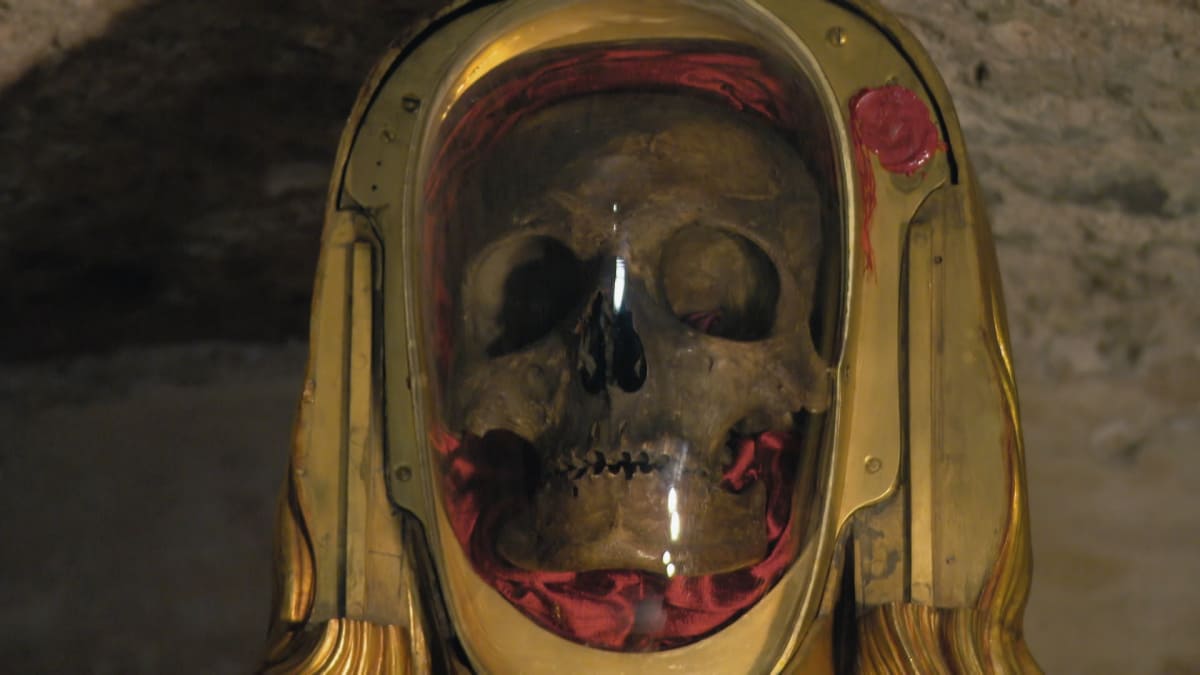
If you’re visiting the South of France, you’ll of course want to stop by Saint-Maximin-la-Sainte-Baume. They have the skull of Mary Magdalene.

There are a lot of Marys in the Bible — specifically, in the New Testament. (There are no Marys in the Hebrew scriptures, but Myriam is the Hebrew version of Mary; and she is Maryam in Aramaic, the language Jesus et al spoke. The Greek translation of the Bible uses Mariam, and in the New Testament, the Greek is Maria.)

Mary Magdalene is not the prostitute. In fact, to make this easy, let’s run through the list of Marys in the New Testament:

1) Mary, the mother of Jesus.

2) Mary Magdalene, or Mary of Magdala. She is not the prostitute. She is a woman whom Jesus heals by casting seven demons out of her. She is described as one of the disciples of Christ, and is a woman of wealth. She financed a lot of Jesus’s ministry work.

3) Mary of Bethany. She is the sister of Martha and Lazarus, who you may remember was raised from the dead by Jesus.

4) Mary of Clopas. Too complicated to get into here. She only appears once, as one of the four women at the cross. James Tabor believes that Mary of Clopas is actually Marym, the mother of Jesus, under her new married name, to a man named Cleopas.

5) Mary, the mother of James and Joseph.

6) Mary, mother of John Mark.

There is also a woman, in the Book of John, who is “caught in the very act of committing adultery” (John 8:4). We don’t know her name. But her story gives us the oft-used quote “Let he who is without sin cast the first stone.” Somehow (and I’ll tell you how in a titch), Mary of Magdala, who just had a case of the demons, got conflated with the woman caught in adultery. And the poor woman caught in adultery somehow (again, in a titch, hold tight) also became a prostitute.

We can blame this on Pope Gregory I.

Gregory was a 6th century Christian, and the 64th pope (not counting the anti-popes). He is known mainly for two things: converting a lot of pagans to Christianity, and, in a series of Easter sermons in 581, rolling Mary Magdalene, Mary of Bethany, and the adulturous woman all into one Mary, who was also a prostitute.

Gregory was wrong to do this.

(Btw, you can visit Gregory’s tomb at St Peter’s Basilica in Rome. He died at the age of 64 without much muss or fuss.)

But back to Mary Magdalene’s skull, kept in the South of France, in the Church of Saint-Maximin-la-Sainte-Baume.

Is it Mary Magdalene’s skull? Maybe! None of our bones, it turns out, have “property of [your name here]” helpfully stamped on them. One thing about religion: it doesn’t have to be true to be believed. And if enough people believe that that skull with the weird golden wig is Mary Magdalene, then, much like the Velveteen Rabbit, it becomes, in a sense, the skull of Mary Magdalene. A sort of transubstatiation, if you will; and if you’re Catholic, you definitely won’t. As it turns out, Truth is less objective than we are probably comfortable admitting. Truth is Time + Consensus.

Humans are a meaning-finding phenomenon in the universe. Something about our brains, maybe, and how we developed consciousness. And meaning shifts, over time, through stresses and accumulation. Certain trees were sacred to certain spirits. Certain wells were tended by gods or faeries or spirits of some kind or other. And there is a transition that starts to happen, historically, in Europe, where Christianity starts to edge out magic as the system of belief. Healing pools that once might belong to a naiad, say, were converted to sites sacred to the Blessed Virgin. Churches were built over spaces that had been previously claimed by other gods. The magic, for what it’s worth, was still in effect; it was just now attributed to Someone Else. Miracle sites were converted from their pagan origins to Christian ones. “You can still worship here, but here is how you will now worship.”

Saint-Maximin-la-Sainte-Baume has Mary Magdalene’s skull. But who knows what god is effecting the miracles attributed to her? The Romans were there before the Christians, and the Romans themselves displaced a Celtic population. The universe is vast and lovely and filled with mystery, and how you pray is how you pray.

Categories
Baptist Belief Finding Seeking

How Necessary Was the Crucifixion, or, How I Am Maybe Not a Christian

Last night I mentioned to Zach that I’m sort of “meh” about the crucifixion.

That came out terribly wrong.

No one should be crucified. I’m not ambivalent about the act of crucifixion. There are no great ways to be executed; each, like a Cabbage Patch Kid, comes with its own unique problems. But crucifixion is up there for me with “burned at the stake” and “beheading” as far as Terrible Ways to Go That Aren’t Natural Causes Like Dying Peacefully in My Sleep. When I say I’m “meh” on the crucifixion, what I mean is: I don’t think it’s necessary to Christian faith.

That also came out terribly wrong.

Of course the crucifixion is necessary to the Christian faith. Christianity is based on the birth (at least in Matthew and Luke), life (all four gospels), ministry (again, all four gospels) and state-mandated execution of Jesus of Nazareth. For some sects, the crucifixion is muy importante because Jesus is a sacrifice to atone for…something.

I mean, I know what the “something” traditionally is, but I don’t believe in Original Sin, so Jesus’s death can’t be for that, at least for me. I don’t believe humans need redemption via capital punishment as much as they need the love and care of each other to make it through any given day.

What I am saying, though, is that the crucifixion is not the salvific mechanism that establishes a relationship between you, the person who is pursuing Christianity, and God.

Sacrifice is a complicated concept to follow through both the Hebrew and Christian scriptures. One of the things that made the Israelites unique in the Ancient Middle East is that their God eschewed human sacrifice. That is, allegedly, one of the “morals” of the Abraham and Isaac story: it looks like God is asking for a human sacrifice, but last-minute he pulls the worst PSYCHE! of them all and Isaac is spared, if not saved. “We don’t sacrifice people,” the Israelites said.

There is a story in the Hebrew scriptures, in the Book of Judges, about a man named Jephthah who, for job security reasons, swears aloud that “Whoever comes out from the doors of my house to meet me when I return in peace from the Ammonites shall be the LORD’s, and I will offer it up for a burnt offering.”

You know how this story ends, even if you don’t know how this story ends. Jephthah returns, triumphant, and sees his daughter (who isn’t named in the text, like most women aren’t named in the text) running out of the door of his house. And because he has made this oath, aloud and publicly, to God, he has no choice.

This is human sacrifice; however, it’s not God-mandated human sacrifice. God didn’t ask Jephthah for his daughter’s ritual murder (in the Liber Antiquitatum Biblicarum, a first century re-write of the Hebrew scriptures, she is given a name, Seila); that was something Jephthah came up with all on his own.

There is another story about an evil king named Ahaz (who still ends up listed in Jesus’s genealogy in the Matthew*) who sacrifices his children to Moloch, a Canaanite god. But again, within the narrative of the Hebrew scriptures, God didn’t ask Ahaz to sacrifice his children to Moloch. That’s something Ahaz thought to do all on his own.

(* I will write a longer piece about this, but quickly: there are two versions of Jesus’s genealogy in the Christian scriptures: one in Matthew, which starts with Abraham and ends with Mary and Joseph. In Luke, Jesus’s genealogy is traced back to Adam. Both gospel writers have an agenda behind their genealogies. Mark doesn’t list a genealogy for Jesus at all — and doesn’t even bother with a birth narrative. John comes along, very late in the game, and doesn’t bother with a genealogy at all, and instead claims that the Christ — and there’s a difference between Jesus and Christ — was present with God at the very beginning of everything.)

So why would God ask for a human sacrifice when we get to the New Testament? He hasn’t required human sacrifice up to this point. Some might argue that the taint of Original Sin is so thick on humanity that a human sacrifice of a maybe divine being is what is necessary to clear the slate. I’m not convinced. I worry that we place too much faith in buckets of blood.

(There is this wonderful back-and-forth between two Puritan theologians in the Olden Timey times where witches were hanged and we called people Goody Osburn or Goodman Brown and the devil was everywhere. Roger Williams writes a tract titled “The Bloody Tenet of Persecution for Cause of Conscience.” Which causes a man named John Cotton to reply with his own tract, titled, “The Bloody Tenet Washed and Made White in the Blood of the Lamb.” Williams responds — and essentially drops the mic — with, “The Bloody Tenet Made Yet More Bloody by Mr Cotton’s Endeavor to Wash it White.” In my household we stan Roger Williams. John Cotton can choke on a bloody cloth.)

I think, as believers in God — and by God what I really mean is the Divine Mystery surrounding us all — and followers/fans of Jesus, who said a lot of great things about caring for the poor and needy, and opening his heart and life to everyone, we should sit down for a spell and really think about the crucifixion. Why are we so eager to pin salvation on the state-mandated capital punishment of a brown-skinned Middle Eastern Jew? Why is this incredible theological gift of universal love capped by murder? And what does that say about us as believers? Are we working backwards from the execution of Jesus in order to make him fulfill the promise of The Christ?

Which is where I am. Not sure about the necessity of the crucifixion. Not convinced about the Divine Origin of Jesus (but very convinced by his acts and his works). Not sold on the resurrection — but also not not sold at the same time. Probably, actually, if I give it my whole thought, not even really a Christian.

I deeply believe in God — or however you name the Divine Mystery. Maybe it’s Nature. Maybe it’s Pan. Maybe it’s whatever you need it to be when you stare at the night sky in all its dark crystalline wonder and hope something out there cares as much for you as you care for it. Maybe it’s science. Maybe it’s magic. But what I mostly want it to be is Love.

Categories
Belief Bible Study Genesis Old Testament Tanakh

On the Origin of Navels and Other Things

Did Adam and Eve have navels is a silly question. They didn’t, for several reasons:

1) Adam was fashioned out of earth, not in a womb, with an umbilical cord. And Eve was fashioned out of Adam’s rib.

2) We think they had navels because in all the paintings of Eden and the first family, Adam and Eve are shown with navels, probably because the models being used for those paintings had navels.

3) Adam and Eve never existed. It’s a folk-tale.

But this navel question has troubled theologians forever, because each question comes value-packed with a bunch of other questions, too.

Question: When Adam was formed from the dust of the ground — how old was he? I mean, yes, sure, technically he was 1 day old. But did God create an infant? Did God create a young man?

Question: If God created Adam as an adult, what memories would he have? Does he have memories? Did Adam and Eve dream at all? That first night’s first sleep — what was that like?

(There’s a midrash about Cain’s offering of the first of the field to God — that Cain, hearing of his parent’s banishment from the Garden, to which they could never return, and which they ached for daily, planted a new Garden, one that he knew would not be perfect, but would maybe be perfect enough. And its the fruits of this harvest that Cain brings to God, and which God rejects, for reasons that are only knowable to God.)

An Even Better Question: Why a penis? Why a vagina? Were the first humans supposed to be procreative? Or did God just have this Peaceable Kingdom in mind with only these exhibits? Adam and Eve never get a chance to have sex, let alone get Eve pregnant, before the Fall. And after the Fall, God’s punishment for Eve is pain in childbirth. How was childbirth expected to happen in the Garden of Eden? Does God decide that making humans is something he’s not good at, so he leaves it to us? Are we any better at making humans?

There are two creation stories in Genesis. Biblical literalists will say that there is only one, told from two points of view, and it would do none of us any good to try to convince them otherwise. But there are two creation stories that don’t entirely line up.

Genesis 1 was written at some point after Genesis 2. Genesis 1 is more liturgical in its tone, with its measured refrain. Genesis 2 is a folktale that was likely already fairly old when it was written down. The Bible — both the Hebrew and Christian texts — didn’t come to us from God in the order that we have it. (And it didn’t come to us from God anyway, but you get what I’m saying.) The Bible that we have now is a political document edited together to make a certain point. (Or, actually, points.)

Interestingly, Genesis 1 and Genesis 2 may not even necessarily be about the same God. When God is written about in Genesis 1, the word used for God is “ʼĕlôhîym” or, less complicatedly, elohim (אֱלֹהִים). Elohim usually refers to the Jewish god, but at other times in the Bible it refers to plural deities. This in itself is interesting because it points us in the direction of a sophisticated way of conceptualizing the divine: it suggests polytheism, because ʼĕlôhîym is plural, in a monotheistic culture/deity: Our God is All gods.

The God of Genesis 2 is referred to as YHWH ʼĕlôhîym. YHWH is also known as the Tetragrammaton. It is believed to be the actual name of God, and is never pronounced out loud. Also, we really can’t pronounce it out loud because Hebrew has consonants but no vowels. The best guess is Yahweh. However, you may notice in your Bible, if you’re a Bible reader, that sometimes the word LORD shows up in all-caps. That’s where the Tetragrammaton appears in the original Hebrew. When Jews are reading their Torah portions in synagogue, they won’t say Yahweh, or spell out Y, H, W, H. Instead they may say “Adonai,” or “HaShem,” or “hakadosh baruch hu” which translates to “The Holy One, Blessed Be He.”)

(Names are a powerful component of magic. Knowing something’s name gives you certain powers over it. If anyone knew and could utter the actual living name of God, it’s not clear entirely what would happen, but it would probably not be good.)

So, we have this majestic opening account, where creation is ordered and systematic. First this, and it was good, then this, and it was good. Actually, in Genesis 1, there are three places where the Bible doesn’t close with “and it was good”:

1) On the first day (Gen 1:3-5), when God separates the light from the darkness, that doesn’t get a corresponding “and it was good.” “it was good” for separating. (Separating isn’t creative, it’s ordering. As Sister Aloysius says in ::Doubt::, “When you take a step to address wrongdoing, you are taking a step away from God, but in His service.”)

2) On the second day, God separates waters from waters, and this is also not labeled as “good.” Here, we get a perfunctory “it was so.”

3) On the sixth day God creates humans, separated into male and female. The humans are blessed (Gen 1:28) — but that’s not the same as being called “good,” is it? Because God sees that “the wildlife of the earth after their kind, and the herd-animals after their kind, and all crawling things of the soil after their kind” were good (Gen 1:25); but humans, though, are not singled out for goodness, only a blessing. Their lives are about to become impossibly hard, with a final separation of human from garden.

In Genesis 2, though, we get the Creation Story as if it were a folktale. And we get some initial challenges to God’s omniscience — a concept that has been read ::into:: the Bible, but is not necessarily verified by the text of the Bible.

After God creates Adam — without a belly-button because Adam has no need of a belly-button — he notices that Adam seems lonely. So God says, “I’ll make a helpmate for Adam.” And he creates animals. And in the story, God proudly presents Adam with a new creature and sort of nods expectantly, like, “Huh? Right? Isn’t this what you’ve been missing?” And Adam, who is very polite, greets each creature with platonic love, names it, and then sort of shrugs sadly at God because while this rhinoceros is very cool, as was the peacock before it and the nudibranch that needed to ::immediately:: be put into water, none of these are helpmates. Put more coarsely: he can’t fuck these animals. He can’t talk to them, tell them about his day (which started literally 15 minutes earlier), sleep cradled together like commas. And then, finally, God says, “Well, let’s try this.” And from Adam’s rib, he makes an Eve.

(Or he makes Lilith, but not out of a rib, and this is from a later tradition than the Garden story. Once upon a time, God created Adam and Lilith, both out of the dust of the ground. Lilith refused to be subservient to Adam, which, good for her; but, however, she’s banished and becomes a demon and/or fucks the archangel Samael, who will later wrestle with Jacob, only I don’t think that happened, I think Jacob actually wrestles with Esau, and we’ll talk about that another time when I feel like it.)

God breaths the Breath of Life — or a soul — into Adam. We don’t know if God breathed a soul into Eve or not. The Bible doesn’t say. She has an innate curiosity and confidence that Adam doesn’t appear to have. The Gnostics revered her as the champion of Wisdom and Knowledge. Christians have used her to blame women for everything forever.

(A final bit of trivia, on the subject of navels: When God is haranguing Job for daring to ask “why?”, God says, “Behold now behemoth, which I made with thee; he eateth grass as an ox. Lo now, his strength is in his loins, and his force is in the navel of his belly.”)

Categories
Bible Study Genesis Old Testament Tanakh

Abraham & Isaac

Once upon a time, in the Bible, God and Abraham were having a conversation. God was explaining how he needed to destroy Sodom and Gomorrah, and Abraham was explaining how he shouldn’t do it.

It’s the afternoon, we’ll say, and there is a beautiful sunset, and God and Abraham are standing on a small rise that looks out over a wide plain, and down towards Sodom. This image would hold some significance for Abraham. He has been promised, on multiple occasions, that God will make of him a Great Nation. He has asked Abraham to count the stars in the sky. He has asked him to number the grains of sand. He has shown him wide vistas and said, “This is all for you and your descendants.” All of these are approximations of the legacy Abraham will leave behind. God has asked Abraham to count the stars and number the grains of sand, but at the point of this conversation, this bargaining with God, Abraham has only one child, a boy, Ishmael, whom he fathered with his wife’s handmaid, Hagar. Also, during this conversation, Abraham is 100 years old and his wife, Sarah, is 90.

Earlier in the day, when God appeared to Abraham as three visitors, God tells Abraham that within the year, Sarah will have given birth to a son. Sarah, overhearing this, laughs a little, laughs the quiet part out loud, because, as she says, “I am past childbearing age, and my husband is very old. Am I to have this great pleasure?” But God insists, and tells Abraham that there is a child on the way, and he will be named Isaac.

God then, in need of a listening ear, maybe, or just in the way sometimes God gets lonely (he calls out plaintively for Adam and Eve when they have hidden themselves, and their nakedness, from him) and needs companionship, reveals the plan to destroy Sodom and Gomorrah. The sins in these cities are too great, God says. Something has to be done, God says. Raze it all and salt the earth. Abraham argues, though, that if there are 50 righteous people in Sodom, that it should be spared. That if there are 45 righteous people, that it should be spared. And we go to 40, and then 30, and then 20, and then 10. And God says, “For the sake of 10 righteous people, I will not destroy it.”

Abraham, who has lied twice about his wife being his sister (which is not technically a lie since she is his half-sister) so as to avoid any kind of punishment or murdering because of how beautiful his wife is, has the audacity to question God, and even chide God a little: “Far be it from you to do such a thing—to kill the righteous with the wicked, treating the righteous and the wicked alike. Far be it from you! Will not the Judge of all the earth do right?” This has to sting a little, because, actually, yes, God did, at one point in his history, kill the righteous with the wicked when he flooded the whole earth to punish mankind. God is at his most human in the Hebrew Bible.

Sarah does have a baby, a boy, and she does name him Isaac, which means “laughter” or “he laughs.” It’s a bit of a joke, reminding Sarah that she laughed at the idea of ever having a child of her own. But Sarah also describes Isaac this way: “God has brought me laughter, and everyone who hears about this will laugh with me.”

(How important are Bible citations to you? I’m running through this essay without them because I think they can be interruptive. But if you need ’em, let me know.)

Like most family stories, this one is messy. We’re not even really going to touch on the whole Ishmael of it all, but there’s Ishmael, Abraham’s son, whom Sarah wants banished after the birth of Isaac. All of Sarah’s attention, and all of Abraham’s attention, is on Isaac. (This is a little exaggerated. When Abraham is told by God that Sarah is going to bear a son, Abraham says, “If only Ishmael would live before You!” — in a sense, saying, “I am perfectly happy having Ishmael as my heir. I don’t need another. But God insists, the way God do.)

The most important thing to know about Isaac is that he will soon become entirely a product of trauma. We can read these stories and look for nuggets of hidden truths and Biblical understanding; but we can also just read these stories as stories. Here is a family, here is a terrible request, and on the other side there isn’t a family any longer.

God calls to Abraham, and Abraham says, “Here I am.” God tells Abraham, “Take your son, your only son Isaac, whom you love, and go to the land of Moriah, and offer him there as a burnt offering on one of the mountains that I shall show you.”

And, again, the messiness of the family dynamics ring so true, even to modern ears. God himself ignores Ishmael, and calls Isaac Abraham’s only son. Sons do not fair well in the Hebrew Bible, especially first-born sons. Cain and Abel couldn’t work it out. Ishmael is not considered Abraham’s heir, but Isaac is. Isaac’s sons, Jacob and Esau, are also at odds with each other. Then we get to Joseph and no one likes him. This denial of Ishmael will have consequences later.

God calls to Abraham, tells him to offer his son as a burnt sacrifice, and Abraham sets off the next morning. There is no bargaining this time with God. Why? There is no countering or arguing; no demand for an explanation as to how, exactly, Abraham is going to establish a strong line when one son is banished and the other is dead.

Religious scholars and a certain type of church-y person will say that the story of the Binding of Isaac is about Abraham’s absolute trust in God, and Abraham’s willingness to do anything asked of him. And it might be about that — but this is not a God one should worship. This is cruelty. Sarah says, “God has brought me laughter, and everyone who hears about this will laugh with me.” God says, “Ritually murder your son on a mountain for me.”

A common refrain I have is that the Bible is not the Word of God. The Bible is a composition of a variety of writings, each with a political agenda. I have to remind myself of that when I read about Isaac, or poor Job, or Jephthah and Jephthah’s daughter (more on them in a bit). They describe a certain kind of relationship God has, but it may not be described accurately. In the Hebrew Bible, God says that to show your willingness to follow him, you must sacrifice your son. In the New Testament, Jesus will say to the Rich Young Man, “Sell all your things to follow me.” Of those two sacrifices, one is more moral than the other, at least in my mind.

The sacrificial party is Abraham, Isaac, and two of Abraham’s men. They walk for three days, and we have no idea what they talked about. How much does anyone know on this walk? What is on Abraham’s heart each step that takes him closer to Moriah?

On the third day, Abraham stops and tells his two men to wait for him: “Stay here with the donkey; the boy and I will go over there; we will worship, and then we will come back to you.”

Let’s talk about the word the word “we” is doing here. For those who want to argue that Abraham knew all along that God wasn’t really going to make him sacrifice Isaac, they’ll point to how Abraham says “we will worship” and “we will come back to you.” Why say we, they ask, if Abraham knew he was going to kill his son and return alone.

(An ogre and a child are walking into the woods. The child looks to the ogre and says “Gee, it sure is awfully dark out here and i’m getting scared.” And the ogre says back to the child, “You think you’re scared? I have to walk out of here alone!”)

But it could also be a small lie, this “we” there and “we” back — and Abraham has told small lies before for self-protection. If he said, “We’re going to worship, and then I’ll come back,” he would have to answer some uncomfortable questions and risk being stopped in his divine mission. “We” is a polite fiction to grease the wheels of worship.

This next part in the story is also worth a little digging:

“Abraham took the wood of the burnt offering and laid it on his son Isaac, and he himself carried the fire and the knife. So the two of them walked on together.”

Sacrifices must be pure. They must be unmarked and unblemished. Abraham lets Isaac carry the wood, but not the knife, and not the fire, because if Isaac were to nick himself, or singe his skin, he would no longer be a Good Offering to God.

Sacrifices are also usually from the first-born of the flock. And Isaac is the second-born son. Why doesn’t God ask for Ishmael? And here we enter into a debate between Islam and Judaism and I, a white Baptist, am just the person to tell you about it.

Some Muslims believe that it actually was Ishmael whom Abraham was supposed to sacrifice. There’s a lot of quibbling about the phrase “take thy only son.” Some Muslim scholars say that Ishmael is the only one that could ever have been an “only son” because he was an only son for 14 years, until the birth of Isaac. And Isaac would never have the experience of being an only son, since he is the second born.

The midrash on this story captures some of this uncertainty. Here is a record of the “full” conversation:

God: Take your son
Ibrahaim: I’ve got two sons
God: Your only son.
Ibrahaim: Each son is an only son to his mother.
God: The one whom you love.
Ibrahim: But I love both of them.
God: Ishaq.

(This actually sounds more like the Abraham we know from the Sodom and Gomorrah story.)

In the Bible, Isaac only speaks to his father once. “Father! The fire and the wood are here, but where is the lamb for a burnt offering?” And Abraham answers, “God himself will provide the lamb for a burnt offering, my son.”

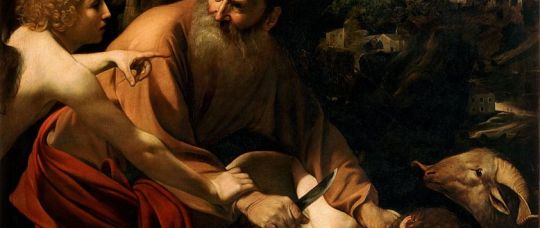
Things move quickly from this point. Abraham builds an altar, lays the wood, binds his son Isaac, and lays him on the sacrificial table.

A father is about to murder his only son. Because a deity said to.

The fact that Abraham doesn’t, in fact, sacrifice his son — an angel stops Abraham and sends a ram, caught in a thicket by its horns. Just as Abraham said God would. “God himself will provide the lamb, my son.”

(There is a LOT of Christian symbolism that can be read into this story — a father sacrificing his only begotten son; a son carrying the wood that he’s to be sacrificed on — but it’s not actually present in the story. This is a Jewish story about a Jewish event. Those Jews who split from Judaism to become Christians would know these Torah stories by memory, and these would, of course, influence the writings of the gospel. But again: the Hebrew Bible isn’t Christian, it’s co-opted.)

Abraham is blessed for his faithfulness — which, again, is often preached as the main message of this story: God may ask you to do the impossible, but he will be with you the whole time. I still don’t care so much for that as a spiritual take-away. There must be other ways for us to demonstrate love and devotion to God (or the Universe or the Sacred Mystery or whatever you are or are not calling the ineffable).

Abraham and Isaac never speak to each other again in the Hebrew Bible. In fact, there’s this curious passage towards the end of this story: “So Abraham returned to his young men, and they arose and went together to Beer-sheba; and Abraham lived at Beer-sheba.”

This event is utterly destabilizing for Isaac. There’s this detail, about how Isaac marries Rebekah in his mother’s tent, and that Rebekah “became his wife, and he loved her; and Isaac was comforted after his mother’s death.” (Gen 24:67) When we see him next, he is an old man, blind, and maybe or maybe not aware that his younger son, Jacob, is heisting the birthright from Esau. Isaac is passive and sad and seemingly cut off from any action — which is what you’d expect from someone who is nearly murdered by his father.

So much care and attention is given to Abraham’s faith and faithfulness. So little is said about what this must have been like for Isaac. “Somewhere there must be more love.”

Categories
Belief Bible Study Finding Ghosts God Purgatory Seeking Souls

Souls, Purgatory, and Ghosts (with an explanation of Plumber Porn as a chaser)

SOULS

Do you have a soul?

We have to start with what a soul is, which should be easy, it’s only four letters, but the thing is, it’s not easy, even if it were three letters. We don’t have a unilateral definition of the soul.

We don’t know where the soul “lives” in the body. We don’t know if the soul is separate from our earthly experiences. All we have is a hopeful maybe.

In the Bible, the first mention of a soul actually comes right at the beginning: “In the beginning when God created the heavens and the earth, the earth was a formless void and darkness covered the face of the deep, while a wind from God swept over the face of the waters.” (Gen 1:1-2)

(I love this passage from Anne Sexton’s poem, “The Earth”:

God loafs around heaven,
without a shape
but He would like to smoke His cigar
or bite His fingernails
and so forth.)

The Bible is a translated work. The Hebrew Bible is written in Hebrew; the New Testament in Greek. Sometimes we know pretty exactly what a phrase means; the translation is easy. But In Gen 1:2, we have this phrase, “formless and void” — tohu wabohu/תֹ֙הוּ֙ וָבֹ֔הוּ in transliterated Hebrew. Only that’s not quite the right phrase. It’s one of those untranslatable terms that we get the sense of, but not the meaning of. Tohu, for instance, can mean “desert, emptiness, nothing.” But it can also mean “vanity” (which is how the prophet Isaiah uses it) — similar to how we use the term “shallow” as both a measurement of physical depth and personal/intellectual depth. The Hebrew Bible and the New Testament are already complicated enough in their original languages; what we’re getting, as modern English readers, is just a lot of fingers-crossed guesses. It’s one of the reasons why my personal theology is not very Bible-based.

That “wind from God” — or “Ruach Elohim” in the Orthodox Jewish Bible, or “the Spirit of God” in King James — is God’s soul, per your good friend Mike Bevel. Or God’s breath. It depends on how you conceive of God. For a lot of Christians, God is wholly spirit, and without a soul, so it’s his spirit that hovers over the waters. I’m okay with a God with a soul, and like this imagery more. The Bible was made for people, not people for the Bible.

(I also prefer the verb “brooding” rather than “hovering,” which might be a better translation of the Hebrew verb rachaph/מְרַחֶ֖פֶת anyway. It gets at the genderfulness of God, who is all genders and no genders and all sexualities and no sexualities. Here God is, brooding over the waters, like a hen with her chicks.)

In Genesis 2, we get an account of a soul entering a body when God breaths the breath of life into adam — the name of the first man, yes, but also the Hebrew word for earth. God has fashioned a man — Adam — out of the earth — adam — and he then breathes his ruach — his Divine Breath — into that earth. And the earth becomes flesh. And the earth was flesh.

I think we have souls. I think we call it consciousness when we’re not interested in/compelled by any sort of spiritual direction. We might call it memory. But I think there is something — some awareness, some sense of “me”-ness — that exists in, well, everything. Which makes me a Shinto Baptist, I guess, so let’s go wake up some books and bid goodbye to those that do not bring us joy oh look we can start with these books on the Vietnam war I was sure I was going to read but then that manic phase passed and they do not bring me joy.

I think we all have souls. Something of this experience that we’re all having on this planet is immortal and mutable and keeps going. In our current physical bodies? We’ll get to that, but my sneak-peek answer for you is no, it won’t be in physical bodies.

The question of a soul, and its use, has been a religious irritation for as long as we have conceived of an afterlife. Especially if your conception of the afterlife has a Good Section and a Bad Section. We know our literal physical bodies age, and fail, and die, and decompose. So the physical body can’t be what is judged. (Except, of course, for those sects who believe in a full-on full-body resurrection where we are all returned to the bodies we’ve always had and there are some questions about that that’ll get to later in this piece.) We also became pretty aware that people have personalities, and ways of doing things that sometimes accord with the status quo, and sometimes do not, and what causes that other than our souls? So souls become the metaphor of our holiness (or lack of holiness), and some souls are judged to be good souls, and go to Heaven (everyone is going to Heaven, by the way); and some souls are bad souls and they are sent to Hell. (I don’t believe in Hell and I barely believe in Heaven.)

More than anything, I am ego-bound to my experiences. I have a great deal of earthly attachment. And I desperately want to keep going. I do not want death to be the end of me, and my experiences. I am working on calming my mind to the idea that these years given to me to see and feel and love and hurt and dream and fail and succeed and just be alive to all of the mystery are finite. And that once I die, that is it. And maybe in death that purpose will become clear, why I had to be here, and why my life had to go the way it went. (I am not complaining about my life, to be clear. It is my own, my own, my own; and, like, say, a novel by Dickens or Tolstoy, could it use some editing? Absolutely; but I have no idea what to cut.) But truthfully, even in the very moment of typing this sentence — in every letter — there is this mini-hope that everything doesn’t end forever with my death. That it will be something akin to falling asleep and then, waking. And some period of time has passed, maybe just a few minutes or a few millennia, but to me it would be only a blink.

I want Zach to be there, when I…what? Resurrect? Yes, because I love him, and he makes sense of the world for me when I am not always able. I want all the people I love to be near me. I just don’t know where that “here” is. Christianity, as an example, has this concept of heaven which sounds interminable. As Mark Twain describes it in “Letters from the Earth,” in which Satan travels the planet and sends dispatches back to the other angels:

“In man’s heaven everybody sings! The man who did not sing on earth sings there; the man who could not sing on earth is able to do it there. The universal singing is not casual, not occasional, not relieved by intervals of quiet; it goes on, all day long, and every day, during a stretch of twelve hours. And everybody stays; whereas in the earth the place would be empty in two hours. The singing is of hymns alone. Nay, it is of one hymn alone. The words are always the same, in number they are only about a dozen, there is no rhyme, there is no poetry: ‘Hosannah, hosannah, hosannah, Lord God of Sabaoth, ‘rah! ‘rah! ‘rah! siss! — boom! … a-a-ah!’

“Meantime, every person is playing on a harp — those millions and millions! — whereas not more than twenty in the thousand of them could play an instrument in the earth, or ever wanted to.

“Consider the deafening hurricane of sound — millions and millions of voices screaming at once and millions and millions of harps gritting their teeth at the same time! I ask you: is it hideous, is it odious, is it horrible?

“Consider further: it is a praise service; a service of compliment, of flattery, of adulation! Do you ask who it is that is willing to endure this strange compliment, this insane compliment; and who not only endures it, but likes it, enjoys it, requires if, commands it? Hold your breath!

“It is God! This race’s god, I mean. He sits on his throne, attended by his four and twenty elders and some other dignitaries pertaining to his court, and looks out over his miles and miles of tempestuous worshipers, and smiles, and purrs, and nods his satisfaction northward, eastward, southward; as quaint and nave a spectacle as has yet been imagined in this universe, I take it.”

For those who believe in a bodily resurrection — and it’s a popular bit of theology — there are a host of uncomfortable questions that really highlight our society’s centering of abelism and whatever “normal” means. Bodily resurrection means you, in your body, with your soul, are resurrected to live with God in wherever heaven is. It’s boring to focus too much on the possibility of this — through God, anything is possible — but it’s useful to think about the mechanics of bodily resurrection.

I watched a YouTube video from the “Sex Stories with Wyoh Lee” channel about a young man named Carson Tueller who is (a) gay; (b) former Mormon; and (c) a quadrapalegic due to an accident on a trampoline and when will we finally realize that trampolines are dangerous death-traps and the only reason every person hasn’t broken their neck on one is that there are two reasons: (1) not everyone has access to a trampoline, Baruch Hashem; and (2) each person has been assigned an angel to catch you when you fuck up a flip, but sometimes that angel isn’t good at its job, like when I’m asked to change the toner in the printer.

Carson Tueller speaks about relearning his body and his life and his sexuality post-Mormonism and post-neck trauma. His experience of the erotic and the sensual is mapped differently than someone who is not either/both of those things. He has had to re-learn the world. And, because of the nature of his accident, he has had to make peace with accepting that this is his life: in a wheelchair, essentially paralyzed from the chest down.

How is he resurrected, if we’re going to believe in resurrection? Is he resurrected “whole”? Then what does that say about the time he has spent becoming comfortable in his current body? Would everyone wheelchair bound be resurrected in whole bodies? Doesn’t that just value only a certain type of experience? Don’t we miss out, in our collective consciousness, this unique perspective? And we can ask this about blind people, and the deaf community, and autistic folks, and those of us on that spectrum.

Would my mental illness be “cured” in my resurrected body? I actually hope not. The Mike Bevel you interact with — either here, online, or in person — is a Mike Bevel entirely informed by my mental illness. And it’s uncomfortable, sometimes, and scary, and lonely, and utterly baffling. But it is also all me. Mike Bevel without mental illness is not Mike Bevel. He’s some other Mike, who may or may not be just as lovely as I am. Maybe lovelier. But that Mike Bevel is not ::this:: Mike Bevel.

“If your eye gets poked out in this life, will it be waiting up in heaven with your wife?” — Crash Test Dummies, “God Shuffled His Feet.”

This idea of heaven isn’t super appealing to me as a Christian.

But I do believe there is a “next” after this life. It just won’t be anything we can understand now. If we are disintegrated down to a pile of atoms, each of those atoms (the average body, by the way, has seven billion billion billion atoms in it) could go on to become a part of something else, and each one of those “something elses” will carry the entirety of our experiences with it. Maybe. We will die and we will know, or we will die and cease asking.

There are many kinds of Christians out there. My kind is the kind that doesn’t know what happens next, doesn’t necessarily believe in the blood atonement of Christ, but thinks we’re here to help each other get to the end with as much grace, dignity, and love as we can.

PURGATORY

Purgatory was invented by late-12th-century Christians. You won’t find a mention of the word “purgatory” in either the Hebrew Bible or the Christian Bible. It doesn’t show up in any extra-Biblical texts, nor do the Gnostics write about it.

Purgatory is this liminal space between Hell and Heaven where some Christians — primarily Catholics, but also some Anglicans, Lutherans, and Methodists — believe that souls go to, in a sense, finish getting it right. Yeats tells us that faeries are “fallen angels who were not good enough to be saved, nor bad enough to be lost.”

Anne Sexton uses this bit of country folklore as the heading to her poem, “The Fallen Angels”:

“Who are they?”
“Fallen angels who were not good enough to be saved,
nor bad enough to be lost” say the peasantry.

They come on to my clean
sheet of paper and leave a Rorschach blot.
They do not do this to be mean,
they do it to give me a sign
they want me, as Aubrey Beardsley once said,
to shove it around till something comes.
Clumsy as I am,
I do it.
For I am like them –
both saved and lost,
tumbling downward like Humpty Dumpty
off the alphabet.

Each morning I push them off my bed
and when they get in the salad
rolling in it like a dog,
I pick each one out
just the way my daughter
picks out the anchovies.
In May they dance on the jonquils,
wearing out their toes,
laughing like fish.
In November, the dread month,
they suck the childhood out of the berries
and turn them sour and inedible.

Yet they keep me company.
They wiggle up life.
They pass out their magic
like Assorted Lifesavers.
They go with me to the dentist
and protect me form the drill.
At the same time,
they go to class with me
and lie to my students.

O fallen angel,
the companion within me,
whisper something holy
before you pinch me
into the grave.

I write a lot about the Bible(s), and scripture, and what things might or might not mean, but I do not think that the Bible is infallible (and I especially do not think I am infallible — take everything I write to you with the largest salt-lick you can find). And I do not think a relationship with scripture is required at all to be worthwhile or needed in the Family of God. So much of the Bible seems to be an explanation for an explanation that has mopped a believer into a corner. Purgatory is one of those explanations.

We have a Christian theology that says Heaven is a reward for good behavior on earth, and Hell is the punishment for bad behavior. And then, like Job, someone says, “Why?” And this why is, “Why isn’t there sort of a middle place, like Arizona, where you go if you weren’t super bad, but could have been a little more gooder?” And voila, we get this concept of Purgatory, where souls go to improve their test scores.

But Purgatory is dependent on the idea of Heaven and Hell being actual places that actually exist. It’s an explanation to make reason and logic out of ineffable things. We see this a lot in the writings of the early Church Fathers, and, I would argue, in some of the gospels. Specifically, I’m thinking about the Gospel of John and how he alone of the evangelists argues that Christ was present at the very beginning of everything. And this argument is necessary because the question “Why?” came up again: “Why would the patriarchs — Abraham, Isaac, Jacob — be saved if they did not have an encounter with Christ, pre- or post-crucifixion?” And the answer is: they did, because “In the beginning was the Word, and the Word was with God, and the Word was God.” (John 1:1)

Matthew and Luke do a little bit of ret-conning, too; they both start their gospels with genealogies proving a continuous line from Adam through the Patriarchs and King David. Matthew and Luke also both contain a version of the Divine Birth Narrative. Mark, the oldest of the gospels, doesn’t start with Christ’s genealogy at all. Mark just starts with, “The beginning of the good news of Jesus Christ, the Son of God.” It’s as if Matthew and Luke felt like they need to fill in some of the gaps Mark, in his enthusiasm to rant on and on about demons, left out. Why is Jesus called the Son of God in Mark? Because his birth was foretold by God, which Matthew and Luke include. And John, the last of the gospels in the New Testament to be written*, decides he needs to answer the question of ::when:: exactly Christ came into being. (An argument that continues to this day in many churches and denominations is: was Jesus a man who became divine, was he a divine who became man, or was he both? Did Jesus exist before his birth in some form or other, or was the Jesus Event (which the writer Jack Miles calls “a crisis in the life of God”) the first time the idea of Jesus is made manifest?)

(* I’ll make this point a lot in my writings about the Bible: there are more books of the Bible, and more gospels, and books of wisdom, and psalms, and prayers, than are contained in the Bible we currently use. The New Testament we have is ::entirely:: a political document that is interested in establishing and maintaining orthodoxy and the power structure to protect that orthodoxy. Books of the Bible that did not seem to follow the idea of Peter being the “rock” upon which Christ’s church was to be built/maintained/governed were sidelined as heresies. The strength of your testimony about Christ was based on your proximity to the actual Christ Event itself.)

The Bible is weakest when it seeks to reaffirm orthodox thinking and moves away from the mysterious and ineffable.

(I recorded some of my thoughts about this topic while I was cleaning the kitchen and I had a section about the relative smartness of the Israelites putting their god in Heaven, a non-tangible place, as opposed to the Greeks, who put their gods on Mount Olympus, because, “People can climb Mount Olympus, can’t they? That exists? (You should probably make sure that exists.)” And it does exist, and it’s 9,573 feet tall.)

Purgatory is also a challenging concept because no one agrees on when Heaven happens. Do we die and immediately go to Heaven? (Or Purgatory, or Hell?) Or do we die, there’s a period where we’re just dead, and then we’re resurrected in some form or other, to await a judgment of some kind that sends us to Heaven, Purgatory, or Hell? The more we try to make human sense of Whatever Happens Next, the more we muddy the water, and find ourselves tired and disgusted with the whole process. We maybe aren’t meant to figure any of this out.

What I know for sure is that, if there is a heaven, even if you’re a little bit Hitler, you are going to go there. Universal Salvation. There is no unredeemable sin in my theology. We do cause suffering, and we suffer in turn, and that could be what Hell or Purgatory is: knowing that we were never as kind as we could have been, as loving as was necessary, or as giving as is expected of us, and we spend our time coming to some sort of peace with that — fully loving our fully human selves but also recognizing and accepting responsibility for the suffering we have caused.

(I also don’t believe that the crucifixion was necessary as a mechanism for Christ’s divine grace. I frankly find it repugnant that we empower political murder with salvation. And I think it’s ::especially:: suspect how much meaning white people get from a brown-skinned Middle Eastern man being murdered by the state. It empowers capital punishment and violence. There is a LOT we need to consider if we are going to profess a Theology of Crucifixion.)

Related to Purgatory, we also have Limbo, brought to us by the Catholic Church, and it is bonkers. Hell has four quadrants — or, rather, had, but I’m getting ahead of myself — Hell of the Damned, Purgatory, Limbo of the Fathers or Patriarchs, and Limbo of the Infants. Limbo of Infants was set aside for babies who died before they could be baptized. Limbo was a part of Catholic doctrine for several hundred — if not a couple thousand — years. Until 2007 when Pope John Paul II said, “[shrug]” about Limbo and wrote, “The Hope of Salvation for Infants Who Die without Being Baptized.” Infants prior to 2007, who were assumed to be in Limbo, could be prayed out of Limbo by the prayers of the faithful. After 2007, John Paul II said, “Well, we sure hope those babies are saved, but we are no longer preaching that babies are sent to Limbo, which no longer exists.” Popes can do these kinds of things.

What happened to the babies who were in Limbo, the day after John Paul II published “The Hope of Salvation for Infants Who Die without Being Baptized.” Better yet, what happened to those parents who were offered the comfort of Limbo for their child; and a mechanism, prayer, for getting their child out of Limbo? In a sense, where did their babies go? Where did that faith and fear and belief and hope go, the paltry hope though it was, that is in Limbo? I think this would only cause me deep despair.

Religion is weakest when it offers answers, rather than comfort. It is useless to us because those answers can, and do, become obsolete. They can also lead us to dogmatic practices that minimize the human in favor of the ritual. In Mark 3:4, Jesus asks, “Is it lawful to do good or to do harm on the sabbath, to save life or to kill?” The point of the Sabbath is to reacquaint ourselves with God. Do we do this by following the rules of Shabbat or do we do this by being God in the world?

(And we’re leaning dangerously close to anti-Semitism here. Much of the New Testament is an answer or a counter to Judaism, and positions itself as the continuation of God’s word. But the Jews, rightfully, believe they have the complete word and they will follow the rules prescribed by the Torah. We, as Christians, have to be careful in how we make assertions about our theology, because theology is not a one-size-fits-all philosophy and our religion stands on the back of another religion.)

The reason I do not necessarily believe at least in Hell and Purgatory is that it goes against my conception of God as all-loving. And if we look at Crucifixion Theology and Resurrection Theology, we have to ask ourselves: if Jesus was willing to offer his body and his blood, in the form of bread and wine, to Peter, who would deny him three times, and to Judas, who had ::already betrayed him::, then what need do we have of Hell? Why Purgatory? If Christ is a Salvation Event in our history, he is a salvation event for all. (And the reason he’s even seen as a Salvation Event is because some nutter came up with this idea of Original Sin that we need to be purged of, so we take this Christ Event, attached Blood Atonement to it, and Bob’s your uncle. Only I don’t believe in Original Sin. I don’t think I, or you, or the worst person you know needs to justify themselves to God, needs to prove that they washed off Original Sin, are ever not invited and included at the Table of God. Original Sin was an early attempt to explain the existence of Evil in the world. And it’s not a good explanation at that.)

GHOSTS

[from the recording, in an embarrassed tone] “Oh, man, I believe in them.

I know I probably shouldn’t, and it drives my husband crazy that I do. (Except he has also Seen Things — or, rather, ::not:: seen things, but seen doors open or close and once he felt a cat jump up on his bed when there were no cats to jump so what about ::that::, Science?) I don’t know what they are. They might be the souls of people who are hanging around earth for some reason. They were initially understood as a kind of supernatural creature that could take the shape of someone. So, in Hamlet, the ghost of Hamlet’s father isn’t Hamlet’s father’s soul returned as a ghost; it’s a shape-shifting entity called a ghost that is now in the shape of Hamlet’s father.

I think I saw a ghost at the beach, but she wasn’t aware of me at all. It was almost as if I were watching a memory happen. Ghosts seem metaphysical, and supernatural, now, only because we can’t explain the “why” of them. “Why do they wear clothes?” Zach asks. “With what are they making footstep noises?” Maybe in the future, a less-rapey Neil deGrasse Tyson-type will figure the “why” out about ghosts and then they’ll just be something else scientific we now know. Maybe science is just magic that we know the rules to.

(Bonus Content from the Tapes: Mike on Plumber Porn: “I have a theory that there is probably more Plumber Porn for heterosexuals than for homosexuals because Plumber Porn is for men who look like pudgy dads and just want to be able to stay in the industry for a little while longer, and also too for the men watching who want to see someone who has lived their fitness journey.” This whole thing came about because I find it weird in fantasy novels where something magical happens and people are amazed — like a wizard does a wizardy thing and people lose their minds and I wonder, “But why? They’re wizards. They do magic.” Like, if I called a plumber to fix my pipes I’m not going to be amazed that a plumber fixed my pipes. That’s what plumbers do. At least, plumbers not in porn. Which brings me to my Theory of Plumbers in Porn.)

A quick wrap-up:

Souls: Yes
Purgatory: No
Ghosts: Yes