SOULS
Do you have a soul?
We have to start with what a soul is, which should be easy, it’s only four letters, but the thing is, it’s not easy, even if it were three letters. We don’t have a unilateral definition of the soul.
We don’t know where the soul “lives” in the body. We don’t know if the soul is separate from our earthly experiences. All we have is a hopeful maybe.
In the Bible, the first mention of a soul actually comes right at the beginning: “In the beginning when God created the heavens and the earth, the earth was a formless void and darkness covered the face of the deep, while a wind from God swept over the face of the waters.” (Gen 1:1-2)
(I love this passage from Anne Sexton’s poem, “The Earth”:
God loafs around heaven,
without a shape
but He would like to smoke His cigar
or bite His fingernails
and so forth.)
The Bible is a translated work. The Hebrew Bible is written in Hebrew; the New Testament in Greek. Sometimes we know pretty exactly what a phrase means; the translation is easy. But In Gen 1:2, we have this phrase, “formless and void” — tohu wabohu/תֹ֙הוּ֙ וָבֹ֔הוּ in transliterated Hebrew. Only that’s not quite the right phrase. It’s one of those untranslatable terms that we get the sense of, but not the meaning of. Tohu, for instance, can mean “desert, emptiness, nothing.” But it can also mean “vanity” (which is how the prophet Isaiah uses it) — similar to how we use the term “shallow” as both a measurement of physical depth and personal/intellectual depth. The Hebrew Bible and the New Testament are already complicated enough in their original languages; what we’re getting, as modern English readers, is just a lot of fingers-crossed guesses. It’s one of the reasons why my personal theology is not very Bible-based.
That “wind from God” — or “Ruach Elohim” in the Orthodox Jewish Bible, or “the Spirit of God” in King James — is God’s soul, per your good friend Mike Bevel. Or God’s breath. It depends on how you conceive of God. For a lot of Christians, God is wholly spirit, and without a soul, so it’s his spirit that hovers over the waters. I’m okay with a God with a soul, and like this imagery more. The Bible was made for people, not people for the Bible.
(I also prefer the verb “brooding” rather than “hovering,” which might be a better translation of the Hebrew verb rachaph/מְרַחֶ֖פֶת anyway. It gets at the genderfulness of God, who is all genders and no genders and all sexualities and no sexualities. Here God is, brooding over the waters, like a hen with her chicks.)
In Genesis 2, we get an account of a soul entering a body when God breaths the breath of life into adam — the name of the first man, yes, but also the Hebrew word for earth. God has fashioned a man — Adam — out of the earth — adam — and he then breathes his ruach — his Divine Breath — into that earth. And the earth becomes flesh. And the earth was flesh.
I think we have souls. I think we call it consciousness when we’re not interested in/compelled by any sort of spiritual direction. We might call it memory. But I think there is something — some awareness, some sense of “me”-ness — that exists in, well, everything. Which makes me a Shinto Baptist, I guess, so let’s go wake up some books and bid goodbye to those that do not bring us joy oh look we can start with these books on the Vietnam war I was sure I was going to read but then that manic phase passed and they do not bring me joy.
I think we all have souls. Something of this experience that we’re all having on this planet is immortal and mutable and keeps going. In our current physical bodies? We’ll get to that, but my sneak-peek answer for you is no, it won’t be in physical bodies.
The question of a soul, and its use, has been a religious irritation for as long as we have conceived of an afterlife. Especially if your conception of the afterlife has a Good Section and a Bad Section. We know our literal physical bodies age, and fail, and die, and decompose. So the physical body can’t be what is judged. (Except, of course, for those sects who believe in a full-on full-body resurrection where we are all returned to the bodies we’ve always had and there are some questions about that that’ll get to later in this piece.) We also became pretty aware that people have personalities, and ways of doing things that sometimes accord with the status quo, and sometimes do not, and what causes that other than our souls? So souls become the metaphor of our holiness (or lack of holiness), and some souls are judged to be good souls, and go to Heaven (everyone is going to Heaven, by the way); and some souls are bad souls and they are sent to Hell. (I don’t believe in Hell and I barely believe in Heaven.)
More than anything, I am ego-bound to my experiences. I have a great deal of earthly attachment. And I desperately want to keep going. I do not want death to be the end of me, and my experiences. I am working on calming my mind to the idea that these years given to me to see and feel and love and hurt and dream and fail and succeed and just be alive to all of the mystery are finite. And that once I die, that is it. And maybe in death that purpose will become clear, why I had to be here, and why my life had to go the way it went. (I am not complaining about my life, to be clear. It is my own, my own, my own; and, like, say, a novel by Dickens or Tolstoy, could it use some editing? Absolutely; but I have no idea what to cut.) But truthfully, even in the very moment of typing this sentence — in every letter — there is this mini-hope that everything doesn’t end forever with my death. That it will be something akin to falling asleep and then, waking. And some period of time has passed, maybe just a few minutes or a few millennia, but to me it would be only a blink.
I want Zach to be there, when I…what? Resurrect? Yes, because I love him, and he makes sense of the world for me when I am not always able. I want all the people I love to be near me. I just don’t know where that “here” is. Christianity, as an example, has this concept of heaven which sounds interminable. As Mark Twain describes it in “Letters from the Earth,” in which Satan travels the planet and sends dispatches back to the other angels:
“In man’s heaven everybody sings! The man who did not sing on earth sings there; the man who could not sing on earth is able to do it there. The universal singing is not casual, not occasional, not relieved by intervals of quiet; it goes on, all day long, and every day, during a stretch of twelve hours. And everybody stays; whereas in the earth the place would be empty in two hours. The singing is of hymns alone. Nay, it is of one hymn alone. The words are always the same, in number they are only about a dozen, there is no rhyme, there is no poetry: ‘Hosannah, hosannah, hosannah, Lord God of Sabaoth, ‘rah! ‘rah! ‘rah! siss! — boom! … a-a-ah!’
“Meantime, every person is playing on a harp — those millions and millions! — whereas not more than twenty in the thousand of them could play an instrument in the earth, or ever wanted to.
“Consider the deafening hurricane of sound — millions and millions of voices screaming at once and millions and millions of harps gritting their teeth at the same time! I ask you: is it hideous, is it odious, is it horrible?
“Consider further: it is a praise service; a service of compliment, of flattery, of adulation! Do you ask who it is that is willing to endure this strange compliment, this insane compliment; and who not only endures it, but likes it, enjoys it, requires if, commands it? Hold your breath!
“It is God! This race’s god, I mean. He sits on his throne, attended by his four and twenty elders and some other dignitaries pertaining to his court, and looks out over his miles and miles of tempestuous worshipers, and smiles, and purrs, and nods his satisfaction northward, eastward, southward; as quaint and nave a spectacle as has yet been imagined in this universe, I take it.”
For those who believe in a bodily resurrection — and it’s a popular bit of theology — there are a host of uncomfortable questions that really highlight our society’s centering of abelism and whatever “normal” means. Bodily resurrection means you, in your body, with your soul, are resurrected to live with God in wherever heaven is. It’s boring to focus too much on the possibility of this — through God, anything is possible — but it’s useful to think about the mechanics of bodily resurrection.
I watched a YouTube video from the “Sex Stories with Wyoh Lee” channel about a young man named Carson Tueller who is (a) gay; (b) former Mormon; and (c) a quadrapalegic due to an accident on a trampoline and when will we finally realize that trampolines are dangerous death-traps and the only reason every person hasn’t broken their neck on one is that there are two reasons: (1) not everyone has access to a trampoline, Baruch Hashem; and (2) each person has been assigned an angel to catch you when you fuck up a flip, but sometimes that angel isn’t good at its job, like when I’m asked to change the toner in the printer.
Carson Tueller speaks about relearning his body and his life and his sexuality post-Mormonism and post-neck trauma. His experience of the erotic and the sensual is mapped differently than someone who is not either/both of those things. He has had to re-learn the world. And, because of the nature of his accident, he has had to make peace with accepting that this is his life: in a wheelchair, essentially paralyzed from the chest down.
How is he resurrected, if we’re going to believe in resurrection? Is he resurrected “whole”? Then what does that say about the time he has spent becoming comfortable in his current body? Would everyone wheelchair bound be resurrected in whole bodies? Doesn’t that just value only a certain type of experience? Don’t we miss out, in our collective consciousness, this unique perspective? And we can ask this about blind people, and the deaf community, and autistic folks, and those of us on that spectrum.
Would my mental illness be “cured” in my resurrected body? I actually hope not. The Mike Bevel you interact with — either here, online, or in person — is a Mike Bevel entirely informed by my mental illness. And it’s uncomfortable, sometimes, and scary, and lonely, and utterly baffling. But it is also all me. Mike Bevel without mental illness is not Mike Bevel. He’s some other Mike, who may or may not be just as lovely as I am. Maybe lovelier. But that Mike Bevel is not ::this:: Mike Bevel.
“If your eye gets poked out in this life, will it be waiting up in heaven with your wife?” — Crash Test Dummies, “God Shuffled His Feet.”
This idea of heaven isn’t super appealing to me as a Christian.
But I do believe there is a “next” after this life. It just won’t be anything we can understand now. If we are disintegrated down to a pile of atoms, each of those atoms (the average body, by the way, has seven billion billion billion atoms in it) could go on to become a part of something else, and each one of those “something elses” will carry the entirety of our experiences with it. Maybe. We will die and we will know, or we will die and cease asking.
There are many kinds of Christians out there. My kind is the kind that doesn’t know what happens next, doesn’t necessarily believe in the blood atonement of Christ, but thinks we’re here to help each other get to the end with as much grace, dignity, and love as we can.
PURGATORY
Purgatory was invented by late-12th-century Christians. You won’t find a mention of the word “purgatory” in either the Hebrew Bible or the Christian Bible. It doesn’t show up in any extra-Biblical texts, nor do the Gnostics write about it.
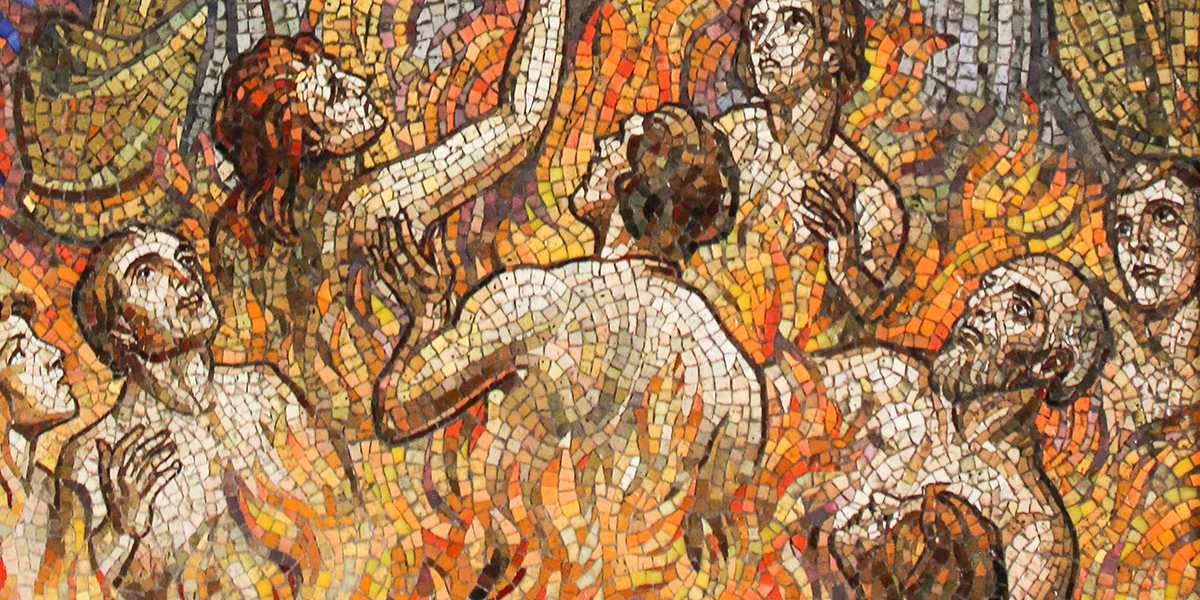
Purgatory is this liminal space between Hell and Heaven where some Christians — primarily Catholics, but also some Anglicans, Lutherans, and Methodists — believe that souls go to, in a sense, finish getting it right. Yeats tells us that faeries are “fallen angels who were not good enough to be saved, nor bad enough to be lost.”
Anne Sexton uses this bit of country folklore as the heading to her poem, “The Fallen Angels”:
“Who are they?”
“Fallen angels who were not good enough to be saved,
nor bad enough to be lost” say the peasantry.
They come on to my clean
sheet of paper and leave a Rorschach blot.
They do not do this to be mean,
they do it to give me a sign
they want me, as Aubrey Beardsley once said,
to shove it around till something comes.
Clumsy as I am,
I do it.
For I am like them –
both saved and lost,
tumbling downward like Humpty Dumpty
off the alphabet.
Each morning I push them off my bed
and when they get in the salad
rolling in it like a dog,
I pick each one out
just the way my daughter
picks out the anchovies.
In May they dance on the jonquils,
wearing out their toes,
laughing like fish.
In November, the dread month,
they suck the childhood out of the berries
and turn them sour and inedible.
Yet they keep me company.
They wiggle up life.
They pass out their magic
like Assorted Lifesavers.
They go with me to the dentist
and protect me form the drill.
At the same time,
they go to class with me
and lie to my students.
O fallen angel,
the companion within me,
whisper something holy
before you pinch me
into the grave.
I write a lot about the Bible(s), and scripture, and what things might or might not mean, but I do not think that the Bible is infallible (and I especially do not think I am infallible — take everything I write to you with the largest salt-lick you can find). And I do not think a relationship with scripture is required at all to be worthwhile or needed in the Family of God. So much of the Bible seems to be an explanation for an explanation that has mopped a believer into a corner. Purgatory is one of those explanations.
We have a Christian theology that says Heaven is a reward for good behavior on earth, and Hell is the punishment for bad behavior. And then, like Job, someone says, “Why?” And this why is, “Why isn’t there sort of a middle place, like Arizona, where you go if you weren’t super bad, but could have been a little more gooder?” And voila, we get this concept of Purgatory, where souls go to improve their test scores.
But Purgatory is dependent on the idea of Heaven and Hell being actual places that actually exist. It’s an explanation to make reason and logic out of ineffable things. We see this a lot in the writings of the early Church Fathers, and, I would argue, in some of the gospels. Specifically, I’m thinking about the Gospel of John and how he alone of the evangelists argues that Christ was present at the very beginning of everything. And this argument is necessary because the question “Why?” came up again: “Why would the patriarchs — Abraham, Isaac, Jacob — be saved if they did not have an encounter with Christ, pre- or post-crucifixion?” And the answer is: they did, because “In the beginning was the Word, and the Word was with God, and the Word was God.” (John 1:1)
Matthew and Luke do a little bit of ret-conning, too; they both start their gospels with genealogies proving a continuous line from Adam through the Patriarchs and King David. Matthew and Luke also both contain a version of the Divine Birth Narrative. Mark, the oldest of the gospels, doesn’t start with Christ’s genealogy at all. Mark just starts with, “The beginning of the good news of Jesus Christ, the Son of God.” It’s as if Matthew and Luke felt like they need to fill in some of the gaps Mark, in his enthusiasm to rant on and on about demons, left out. Why is Jesus called the Son of God in Mark? Because his birth was foretold by God, which Matthew and Luke include. And John, the last of the gospels in the New Testament to be written*, decides he needs to answer the question of ::when:: exactly Christ came into being. (An argument that continues to this day in many churches and denominations is: was Jesus a man who became divine, was he a divine who became man, or was he both? Did Jesus exist before his birth in some form or other, or was the Jesus Event (which the writer Jack Miles calls “a crisis in the life of God”) the first time the idea of Jesus is made manifest?)
(* I’ll make this point a lot in my writings about the Bible: there are more books of the Bible, and more gospels, and books of wisdom, and psalms, and prayers, than are contained in the Bible we currently use. The New Testament we have is ::entirely:: a political document that is interested in establishing and maintaining orthodoxy and the power structure to protect that orthodoxy. Books of the Bible that did not seem to follow the idea of Peter being the “rock” upon which Christ’s church was to be built/maintained/governed were sidelined as heresies. The strength of your testimony about Christ was based on your proximity to the actual Christ Event itself.)
The Bible is weakest when it seeks to reaffirm orthodox thinking and moves away from the mysterious and ineffable.
(I recorded some of my thoughts about this topic while I was cleaning the kitchen and I had a section about the relative smartness of the Israelites putting their god in Heaven, a non-tangible place, as opposed to the Greeks, who put their gods on Mount Olympus, because, “People can climb Mount Olympus, can’t they? That exists? (You should probably make sure that exists.)” And it does exist, and it’s 9,573 feet tall.)
Purgatory is also a challenging concept because no one agrees on when Heaven happens. Do we die and immediately go to Heaven? (Or Purgatory, or Hell?) Or do we die, there’s a period where we’re just dead, and then we’re resurrected in some form or other, to await a judgment of some kind that sends us to Heaven, Purgatory, or Hell? The more we try to make human sense of Whatever Happens Next, the more we muddy the water, and find ourselves tired and disgusted with the whole process. We maybe aren’t meant to figure any of this out.
What I know for sure is that, if there is a heaven, even if you’re a little bit Hitler, you are going to go there. Universal Salvation. There is no unredeemable sin in my theology. We do cause suffering, and we suffer in turn, and that could be what Hell or Purgatory is: knowing that we were never as kind as we could have been, as loving as was necessary, or as giving as is expected of us, and we spend our time coming to some sort of peace with that — fully loving our fully human selves but also recognizing and accepting responsibility for the suffering we have caused.
(I also don’t believe that the crucifixion was necessary as a mechanism for Christ’s divine grace. I frankly find it repugnant that we empower political murder with salvation. And I think it’s ::especially:: suspect how much meaning white people get from a brown-skinned Middle Eastern man being murdered by the state. It empowers capital punishment and violence. There is a LOT we need to consider if we are going to profess a Theology of Crucifixion.)
Related to Purgatory, we also have Limbo, brought to us by the Catholic Church, and it is bonkers. Hell has four quadrants — or, rather, had, but I’m getting ahead of myself — Hell of the Damned, Purgatory, Limbo of the Fathers or Patriarchs, and Limbo of the Infants. Limbo of Infants was set aside for babies who died before they could be baptized. Limbo was a part of Catholic doctrine for several hundred — if not a couple thousand — years. Until 2007 when Pope John Paul II said, “[shrug]” about Limbo and wrote, “The Hope of Salvation for Infants Who Die without Being Baptized.” Infants prior to 2007, who were assumed to be in Limbo, could be prayed out of Limbo by the prayers of the faithful. After 2007, John Paul II said, “Well, we sure hope those babies are saved, but we are no longer preaching that babies are sent to Limbo, which no longer exists.” Popes can do these kinds of things.
What happened to the babies who were in Limbo, the day after John Paul II published “The Hope of Salvation for Infants Who Die without Being Baptized.” Better yet, what happened to those parents who were offered the comfort of Limbo for their child; and a mechanism, prayer, for getting their child out of Limbo? In a sense, where did their babies go? Where did that faith and fear and belief and hope go, the paltry hope though it was, that is in Limbo? I think this would only cause me deep despair.
Religion is weakest when it offers answers, rather than comfort. It is useless to us because those answers can, and do, become obsolete. They can also lead us to dogmatic practices that minimize the human in favor of the ritual. In Mark 3:4, Jesus asks, “Is it lawful to do good or to do harm on the sabbath, to save life or to kill?” The point of the Sabbath is to reacquaint ourselves with God. Do we do this by following the rules of Shabbat or do we do this by being God in the world?
(And we’re leaning dangerously close to anti-Semitism here. Much of the New Testament is an answer or a counter to Judaism, and positions itself as the continuation of God’s word. But the Jews, rightfully, believe they have the complete word and they will follow the rules prescribed by the Torah. We, as Christians, have to be careful in how we make assertions about our theology, because theology is not a one-size-fits-all philosophy and our religion stands on the back of another religion.)
The reason I do not necessarily believe at least in Hell and Purgatory is that it goes against my conception of God as all-loving. And if we look at Crucifixion Theology and Resurrection Theology, we have to ask ourselves: if Jesus was willing to offer his body and his blood, in the form of bread and wine, to Peter, who would deny him three times, and to Judas, who had ::already betrayed him::, then what need do we have of Hell? Why Purgatory? If Christ is a Salvation Event in our history, he is a salvation event for all. (And the reason he’s even seen as a Salvation Event is because some nutter came up with this idea of Original Sin that we need to be purged of, so we take this Christ Event, attached Blood Atonement to it, and Bob’s your uncle. Only I don’t believe in Original Sin. I don’t think I, or you, or the worst person you know needs to justify themselves to God, needs to prove that they washed off Original Sin, are ever not invited and included at the Table of God. Original Sin was an early attempt to explain the existence of Evil in the world. And it’s not a good explanation at that.)
GHOSTS
[from the recording, in an embarrassed tone] “Oh, man, I believe in them.“
I know I probably shouldn’t, and it drives my husband crazy that I do. (Except he has also Seen Things — or, rather, ::not:: seen things, but seen doors open or close and once he felt a cat jump up on his bed when there were no cats to jump so what about ::that::, Science?) I don’t know what they are. They might be the souls of people who are hanging around earth for some reason. They were initially understood as a kind of supernatural creature that could take the shape of someone. So, in Hamlet, the ghost of Hamlet’s father isn’t Hamlet’s father’s soul returned as a ghost; it’s a shape-shifting entity called a ghost that is now in the shape of Hamlet’s father.
I think I saw a ghost at the beach, but she wasn’t aware of me at all. It was almost as if I were watching a memory happen. Ghosts seem metaphysical, and supernatural, now, only because we can’t explain the “why” of them. “Why do they wear clothes?” Zach asks. “With what are they making footstep noises?” Maybe in the future, a less-rapey Neil deGrasse Tyson-type will figure the “why” out about ghosts and then they’ll just be something else scientific we now know. Maybe science is just magic that we know the rules to.
(Bonus Content from the Tapes: Mike on Plumber Porn: “I have a theory that there is probably more Plumber Porn for heterosexuals than for homosexuals because Plumber Porn is for men who look like pudgy dads and just want to be able to stay in the industry for a little while longer, and also too for the men watching who want to see someone who has lived their fitness journey.” This whole thing came about because I find it weird in fantasy novels where something magical happens and people are amazed — like a wizard does a wizardy thing and people lose their minds and I wonder, “But why? They’re wizards. They do magic.” Like, if I called a plumber to fix my pipes I’m not going to be amazed that a plumber fixed my pipes. That’s what plumbers do. At least, plumbers not in porn. Which brings me to my Theory of Plumbers in Porn.)
A quick wrap-up:
Souls: Yes
Purgatory: No
Ghosts: Yes


 How to Read: with Mike Bevel