Categories
Bible Study Finding New Testament Seeking Uncategorized

“See what large letters I make”: The Humanness of Paul

There’s Paul, the alleged homophobe, yes, and his writing is often weaponized against gay people, I get it, but Paul also describes himself as an expectant mother and queerness is everywhere if you just look for it. (Galatians 4:19)

Towards the end of Galatians, after yelling about circumcision, and faith over works, and fornication, and then some more about circumcision (Paul yells a LOT in Galatians), there’s this heartbreaking human moment from Paul.

Paul interrupts his letter/harangue to say, “See what large letters I make when I am writing in my own hand.” (Galatians 6:11) And it’s an admission of vulnerability that out of the blue completely humanizes Paul, at least for me, a gay man who has to work a little extra hard at loving Paul. (It can also be argued that Paul is referring to emphasis, rather than literal larger letters. But that doesn’t work out for me. Paul relied on a variety of amanuenses to write his letters, and rarely wrote them himself; and you’d think that if he were pointing out an emphasis it would have been earlier. The consensus is that Paul’s eyesight was affected in some way — some argue by the experience on the road to Damascus — and that he had trouble seeing.)

The first time Zach & I went to Amsterdam, we went to the Van Gogh museum. And there was a painting that was almost too perfectly Van Gogh; like, too sunflowers? Too something. But then I saw this red border painted around the edges of the canvas. And the painting went from being sort of a too-perfect approximation/facsimile of a Van Gogh to being, all of a sudden, very human. I can’t explain it better. This thick line of red spoke to the artist’s presence more than the entire painting did.

And that’s what Paul’s weak eyes do for me. Snap this lofty, semi-fictional, grumpy, foreskin-obsessed weirdo into a human shape with human frailties. “See what large letters I make when I am writing in my own hand.” And what makes it even more poignant, in my mind, is that Paul feels the body as a betrayal all throughout his letters. The body is a curse and a temple and such a source of erotic confusion for him. To have his eyes failing, too, it’s all almost too much.

Categories
Bible Study New Testament Old Testament Tanakh

Satan & Scripture

This momentary president’s son said a dumb thing on Twitter: “Likelihood of Nancy Pelosi praying for Trump is about the same as the likelihood of Satan running around quoting the Scriptures.” And this got both Theology and Theology-Adjacent twitter worked up because Junior displays an unsurprising unfamiliarity with any part of the Bible — Hebrew or Christian.

One response that really interested me was this: “The Serpent quotes Scripture in Genesis 3, so he doesn’t even have to wait that long.”

I am MADLY in love with this tweet because there are several kinds of grappling we get to do. In brief:

1) Is the serpent Satan?

2) Is the serpent quoting scripture, or just quoting God?

3) Is Satan evil?

So let’s get started.

1) Is the Serpent Satan?

Maybe! But that’s not always how the serpent in the story was understood. For the early Israelites, there would be no connection of Serpent/Satan. Genesis is written–roughly; dating the Bible is tough am I right ladies?–somewhere between 900-700 BCE.

There are some scholars who connect the serpent in Genesis with the Hebrew word/concept יֵצֶר הַרַע (yetzer hara) — which is sort of man’s innate inclination to do evil. Most importantly, the serpent in Genesis is a Jewish idea that is appropriated by Christians. Christians believe that man’s inclination to do evil is a side-effect. Early Jews realized that people are just sometimes terrible.

The serpent as a personification of Satan is a Christian invention, and the idea behind Original Sin. But this is really only true for orthodox Christianity. The Gnostics–whom I love dearly–saw the serpent as a deliverer of Wisdom, connecting it with Sophia (σοφία).

(The Gnostics are very complicated about God, and Jesus, and some developed this idea that the trinity is God, Jesus, and Sophia (wisdom) rather than the Holy Spirit — and that Wisdom is the wife of God.)

2) Is the Serpent Quoting Scripture?

This has nothing to do, really, with theology, and more to do with how we read a text. I’m of the mind that the serpent is ::not:: quoting scripture in Genesis 3, because in the moment the serpent is speaking, scripture doesn’t exist yet.

(Oh, by the way, for #2 we’re going with the orthodox Christian idea that the serpent is synonymous with Satan.)

In the New Testament/Christian Bible, however, Satan definitely quotes scripture, specifically in places like Matt 4:6, where Satan is quoting from Psalm 91:11-12. But it’s interesting to think about the evolution of Satan as a character in the Bible.

3) Is Satan Evil?

For the Jews, “satan” is more of a job title. The sâtan’s (ha-satan) job is to be an adversary to test humans. The satan’s big scene is in Job, where he is under God’s employ. It’s generally agreed that Job is the oldest piece of writing in the Hebrew Bible.

It’s usually dated to the 2nd millennium BCE — so by the time we get to the Gospels, written in the 1st century CE, ha-satan has gone through a pretty extensive evolution. By the time Christians are writing their gospels, ha-satan has become Satan, and is the source of evil and the primary antagonist of God. Elaine Pagels’s book, “The Origins of Satan,” is an incredibly useful book if any of this interested you at all.

And that’s it for today.

Categories
Bible Study New Testament

Servants & Deacons

(much much MUCH credit to my pastor and friend, Jill McCrory)

In Mark, the first miracle Jesus performs is an exorcism (Mk 1:21-28). It’s a super unsettling scene; the demon, invading the synagogue where Jesus is preaching, speaks through the possessed man and asks “What have you to do with ::us::?” (“Us” in this case being “demons.”)

And this is a theme throughout Mark — the first to recognize Jesus for who he is are not the people in the synagogue, or even the disciples, it’s the demons.

(I do not believe in demons, btw. But if you have a demon story of course I want to hear it.)

The second miracle Jesus performs in Mark is healing Peter’s mother-in-law. And that’s really the point of this post, this healing. I just open with the demon thing because Mark’s gospel is haunted by demons throughout and I’m fascinated by that. Again, if you have a demon story you MUST share it with me.

The healing of Peter’s mother-in-law is at Mk 1:29-31. Depending on your edition–NIV, NRSV, KJV, The Message–you’ll have a different translated verb.

NIV: “she began to wait on them”
NRSV: “she began to serve them”
KJV: “she ministered unto them”
Mess: “she was up fixing dinner for them.”

In my study Bible — an NIV with lines in the margins for note-taking — I wrote, “Of course she did,” because I read “serve” in the same sense that The Message Bible presents it and I’m still bitter about the treatment of Martha in the Book of Luke. #JUSTICEFORMARTHA

But if we look at the Greek — which is the language Mark is written in — the verb used is διάκονος, which is where we get the word “deacon.” And this can change the entire sense of what this passage might mean, and what role Peter’s mother-in-law had in Jesus’s ministry.

If we take off our Patriarchy Lenses and just look at the words, it just might could be that Peter’s mother-in-law isn’t “fixing dinner for them” or “serving” them. The King James version might get us closer to what is really happening: she ministers to them — as a deacon.

If we let ourselves read this passage in this light, Peter’s mother-in-law becomes another disciple of Jesus — becomes someone whose service isn’t domestic, but spiritual.

Later, in the New Testament, (but ironically much earlier, chronologically; Paul’s writings are the earliest writings in the New Testament, even though they come after the Gospels and Acts) in Paul’s Epistle to the Romans, we read of another deacon, a woman named Phoebe. (Rom 16:1-2)

The same Greek is used–διάκονος. Here it is in those same 4 editions.

NIV/NRSV: “I commend to you our sister Phoebe, a deacon”
KJV: “I commend unto you Phebe our sister, which is a servant of the church”
Mess: “Be sure to welcome our friend Phoebe…a key representative”

The Greek in Romans is translated as an active member of the church — not a woman who serves dinner. And the Greek in Mark is often translated as a hostess, not a woman who can also preach the good news.

I prefer the Greek of Paul. Peter’s mother-in-law is an active disciple of Jesus. Galatians 3:28: “There is neither Jew nor Gentile, neither slave nor free, nor is there male and female, for you are all one in Christ Jesus.”

Categories
1 Thessalonians Baptist Belief God New Testament Seeking

The Good Parts: 1 Thessalonians

But we were gentle among you.

1 Thess 2:7

For you yourselves have been taught by God to love one another; and indeed you do love all the brothers and sisters throughout Macedonia. But we urge you, beloved, to do so more and more.

1 Thess 4:9-10

So then let us not die as others do, but let us keep awake and be sober.

1 Thess 5:6

Rejoice always, pray without ceasing, give thanks in all circumstances; for this is the will of God in Christ Jesus.

1 Thess 5:16

Test everything; hold fast to what is good; abstain from every form of evil.

1 Thess 5:21

May the God of Peace himself sanctify you entirely; and may your spirit and soul and body be kept sound and blameless.

1 Thess 5:23
Categories
Belief New Testament

Martha

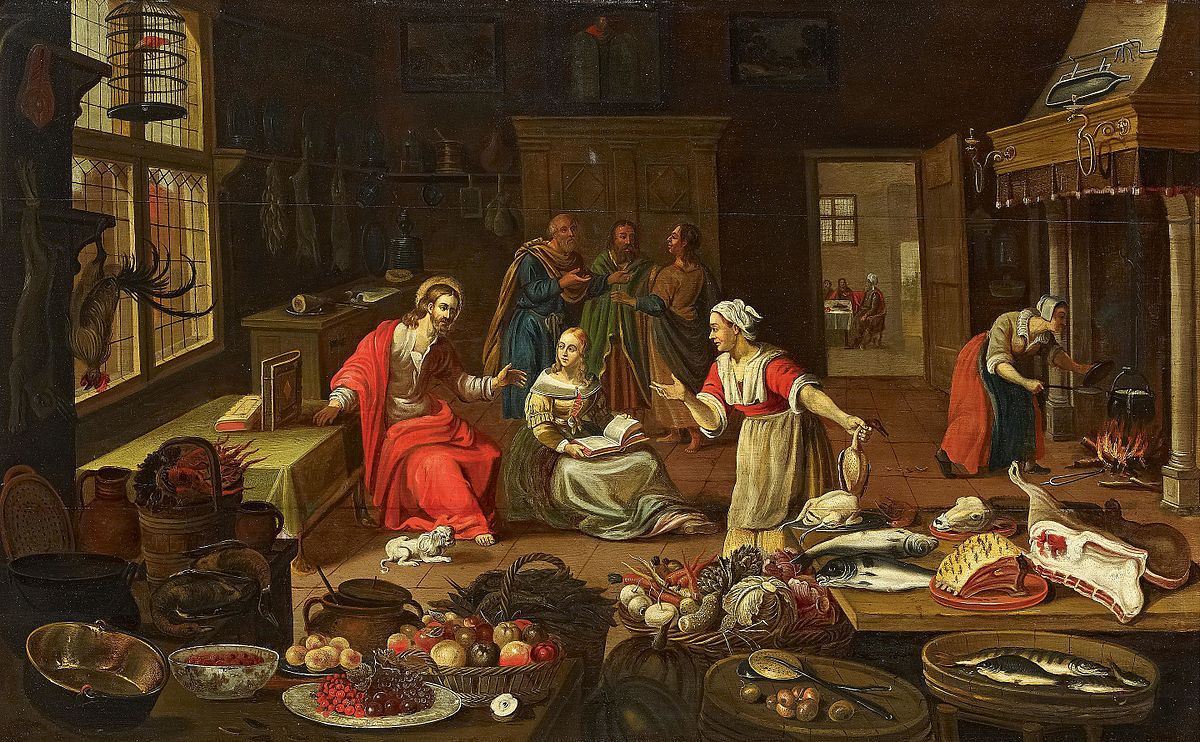
Luke tells us the story of Mary and Martha. This is when Jesus drops in for an impromptu visit and Martha says, “I sure could use some help in the kitchen” and Jesus says, “No you don’t. Be more like Mary.”

It’s not a favorite story of mine from the gospels. It can sometimes be framed as a competition between the two women: Mary, who does right, sits at Jesus’s feet for his teaching; and Martha, who does wrong, refills glasses, wipes up a spill, looks at the pile of dishes like her own Golgotha.

Now. Mary’s action — to sit at the feet of Jesus — is radical. “This is extraordinary,” my pastor explained when she preached on the topic several weeks ago. And it is! It is extraordinary! And wonderfully gnostic, because the Gnostics were VERY open to women engaging with teaching, and teaching as well. Again, though, this isn’t a competition. Martha shouldn’t lose because Mary won.

Some things we can guess, just by being intelligent readers of Luke 10:38-42:

1) Jesus arrives with his disciples. Not necessarily just the 12 we know of. There were numbers of followers who weren’t the 12 Disciples. But let’s just say that it was only the 12 at this repast. That’s still a LOT of people, unannounced, to show up for a visit.

2) The text doesn’t suggest this was a planned visit. I don’t know that Martha had, say, Tuesday, circled in red on her calendar, with “Jesus, etc., for lunch.” So a guy shows up with a bunch of people, and Martha welcomes them into her home.

3) And it’s MARTHA’S home. That’s something to note. The text says, “a woman named Martha welcomed them into her home.” Not her husband’s home. And it isn’t her husband granting permission. Martha has done that. In the middle of this story I don’t care much for is this wonderful detail about how Jesus’s mission is not just to men. Women were vital all the way through his ministry.

4) Some fuller context, re: Mary and Martha. They are the sisters of Lazarus, raised by the dead by Jesus. So it’s not like Mary and Martha welcomed a total stranger into the home. They welcomed a man who has performed the most astonishing miracle ever. Their brother, whom Jesus described as “only sleeping,” is back from the dead.

5) So you’re going to break out the good china, right? You’re going to — even though you know there is no literal way to — repay this man as much as you can because of the miracle he bestowed on your family. Your dead brother is impossibly, but also literally, alive.

6) The text tells us that Mary was “at the Lord’s feet,” listening “to what he was saying.” But we don’t know what he was saying. We don’t get to know the nature of the lesson he was giving.

7) But maybe there was something in Jesus’s message — something maybe about serving, which is something Jesus talks about with some regularity — that made Martha say, “Hey. Speaking of.”

Here’s the thing. I’ll lay out all my cards here. I’m a Martha. VERY much a Martha. And women for almost 100% of history have been relegated to the Martha role. SOMEONE needs to prepare the olives and make sure there’s enough goat and refill the hummus bowls. It’s all very well to say, as Jesus says to Martha, “You are worried and distracted by many things.” YEAH. Roughly 12+ other things who are now in my house expecting food and hospitality and I’m ONE WOMAN even though there are MANY OF US IN HERE and no one is helping me.

And, I love Jesus — Lord knows I do — but this is also a man who cursed a fig tree for not doing its job so you can forgive Martha and me for assuming that he’d also be pretty angry if we started running low on pita bread.

We need Marthas. There’s a woman named Judy who sets up the after-church spread every Sunday. If Judy didn’t do it, someone else would have to. There is ALWAYS a need for a Martha. Things don’t get done without Marthas. “LET’S PUT ON A SHOW!” You’re gonna need a Martha. And I just think it’s sort of crummy that Jesus says to her, “Martha, be more like Mary. Choose ‘the better part.'” And all Martha wanted was someone to help wash a dish or fill some wine glasses. “Yeah, I’d like to sit and listen but none of you are tidying up after yourself.”

(We men can live in a privileged bubble of [waves hand at pile of logistical work] “things will work out” because they rely on, without acknowledging, the Marthas of the world. I work with a guy who depends on the fact that there are Marthas here to fill in blanks for him, and mind calendars, and cross t’s/dot i’s.)

And in closing, what makes this so infuriating, to me, a Martha, is this: JESUS LITERALLY FED THOUSANDS OF PEOPLE and I feel he could have said to Martha, “Oh, sorry — I’ve got this.” And then Martha would have felt like she had the space to sit and listen with Mary.

You sometimes have to take ministry TO the people who need it.